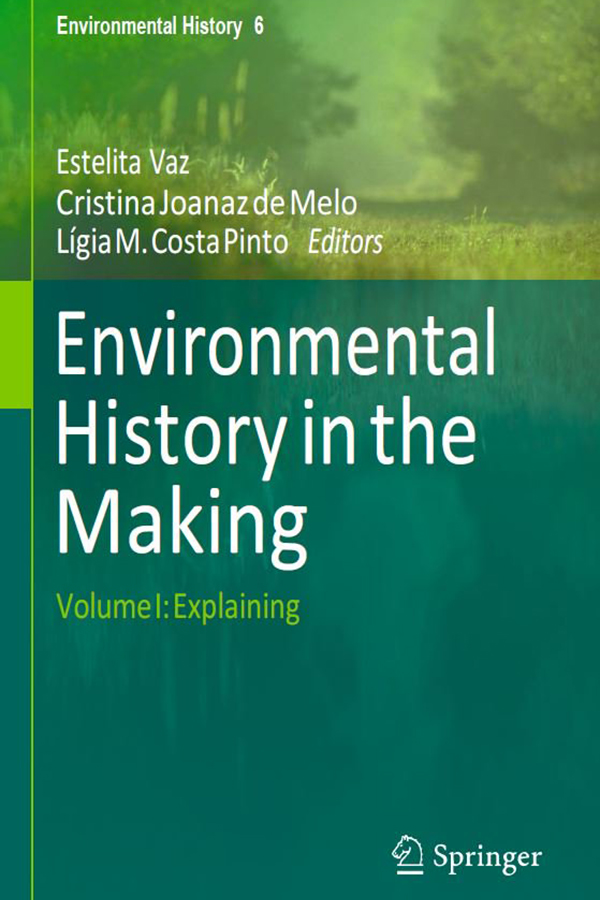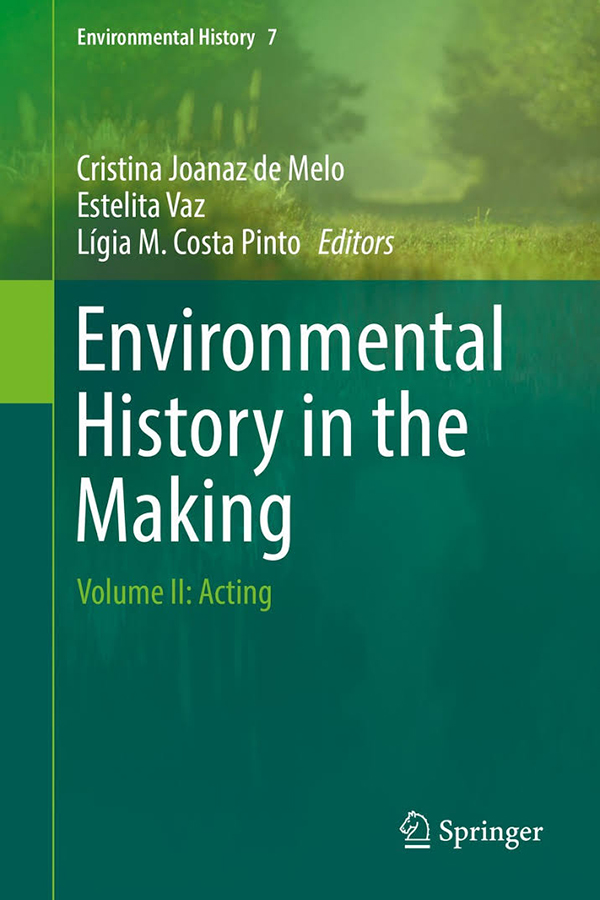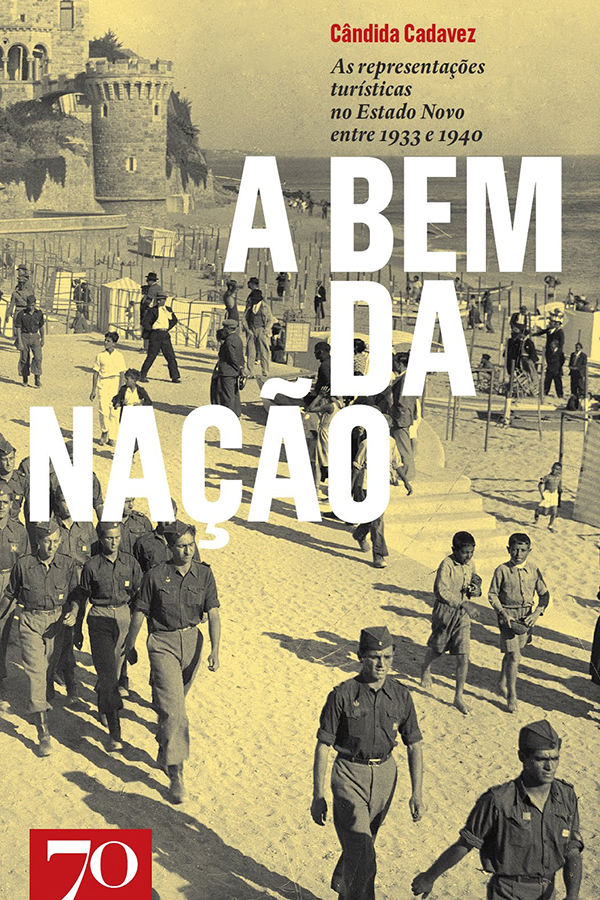
Florestas de encanto
Jan 29, 2021 | Capítulos, Publicações

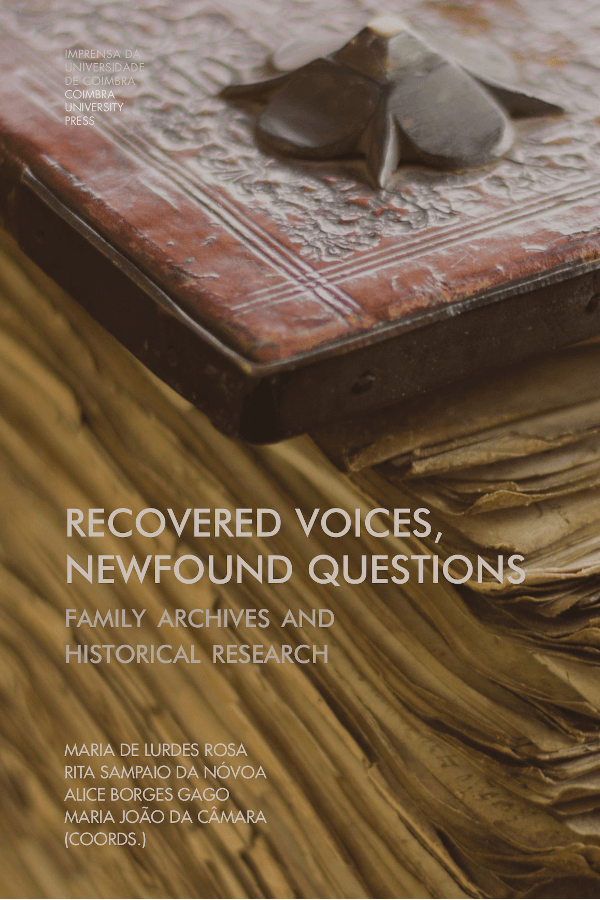
Florestas de encanto
- Cristina Joanaz de Melo, Catarina Madureira Villamariz, Tânia Manuel Casimiro & Pedro Urbano
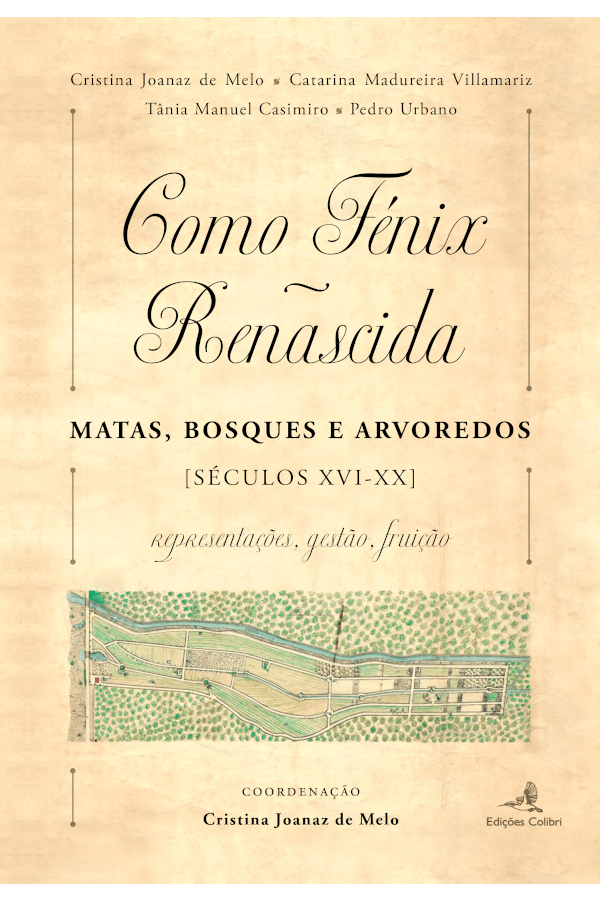
- Como a Fénix renascida. Matas, bosques e arvoredos (séculos XVI-XX): representações, gestão, fruição
- Cristina Joanaz de Melo (Coord.)
- 2020
- Lisboa: Edições Colibri
- Idioma: Português
- ISBN: 978-989-689-946-2
- Depósito legal n.º 465 468/19
- 7-17 p.
Excerto:
Cenário de bailados, óperas e inspiradora de poesias, a floresta é profundamente sensorial. No jogo do visual entre a luz e as trevas, do aromático atordoante ou balsâmico ou ainda do auditivo ao musical encantador, a floresta provoca um leque variado de sensações físicas e psíquicas: medo, beleza, pureza, purificação, liberdade, esconderijo, proteção, expiação, fonte de alimento, de frescura, de calor, exaustão, recuperação de forças espirituais. Palco de inúmeras perceções, é então um lugar passível de ser representado, explorado ad limite mas também recuperado e fruído.
Sobre o livro:
No decurso da história, a floresta gerou conceções e representações espirituais e artísticas, permitiu utilizações económicas e sociais e adquiriu funções utilitárias e lúdicas. Atravessando diferentes períodos e contextos, o presente livro pretende refletir sobre temas inovadores que vão da representação à gestão e fruição da floresta. A narrativa, intencionalmente poliédrica, explora as representações de florestas, matas e arvoredos no vitral de produção nacional da época medieval e moderna, bem como na faiança dos séculos XVI a XVIII. Paralelamente, analisa-se a exploração e regeneração de recursos florestais, considerando a gestão territorial, respetivo ordenamento e fruição de elemento naturais do final da Idade Média ao século XIX. E, por fim, aborda-se a relação que se estabelece entre caçadas e tapadas régias nos finais da monarquia constitucional.
Intencionalmente, procurou-se trabalhar períodos cronológicos anteriores aos grandes flagelos ecológicos despoletados por guerras mundiais e pelo boom demográfico mundial do século XX, a partir do qual a relação com a floresta mudou exponencialmente. Atualmente, num paradigma de reflexão ecológico-ambiental, considera-se que o património florestal mundial se encontra em risco e, em consequência dessa realidade insofismável, em risco também a vida do planeta, tal como a conhecemos. Com esta obra, para além de trazer para a luz questões até aqui deixadas na sombra, apostando numa abordagem inovadora em torno da temática da floresta, procurou-se também valorizar a mesma e relembrar o lugar de destaque que ocupou ao longo dos séculos e que se espera que o século XXI lhe venha a devolver.
Mais informações sobre o livro
Outras Publicações
Pesquisa
Agenda
março, 2026
Tipologia do Evento:
Todos
Todos
Apresentação
Ciclo
Colóquio
Conferência
Congresso
Curso
Debate
Encontro
Exposição
Inauguração
Jornadas
Lançamento
Mesa-redonda
Mostra
Open calls
Outros
Palestra
Roteiro
Seminário
Sessão de cinema
Simpósio
Workshop
- Event Name
seg
ter
qua
qui
sex
sab
dom
-
-
-
-
-
-
1
2
3
4
5
6
7
8
9
10
11
12
13
14
15
16
17
18
19
20
21
22
23
24
25
26
27
28
29
30
31

Detalhes do Evento
Seminário de investigação que procura alargar o campo dos estudos sobre o petróleo para além das narrativas, geografias e fronteiras disciplinares estabelecidas, dando maior destaque às perspetivas do Sul Global e
Ver mais
Detalhes do Evento
Seminário de investigação que procura alargar o campo dos estudos sobre o petróleo para além das narrativas, geografias e fronteiras disciplinares estabelecidas, dando maior destaque às perspetivas do Sul Global e de outros locais de extracção e resistência.
Mind the Gap III:
Unearthing Petromodernity: Oil Studies in the Anthropocene
Online Research Seminar
The rise of fossil fuels has been central to the political, economic, cultural, and material transformations of the past two centuries, yet the forms of power, knowledge, and life enabled by carbon energy often remain analytically invisible. As we confront the converging crises of the Anthropocene, the need to rethink the centrality of fossil fuels to modern life has never been more urgent.
At a moment when toxic landscapes, resource frontiers, and environmental inequality reveal the uneven geographies of fossil modernity, the humanities and social sciences are reorienting analytical attention toward the energetic foundations of modern life. From pipelines and refineries to plastics and everyday petrochemical products, the material properties of oil have fundamentally shaped modern infrastructures and forms of life. What forms of political and social power are created through fossil fuel industries? How have fossil fuels shaped modern societies, their economic models, governmental regimes, everyday lives? How have they contributed to uneven global geographies rooted in colonialism and capitalism? What kinds of transitions to post-carbon futures are possible?
Bringing together approaches from history, anthropology, political ecology, and geography, we seek to expand the field of oil studies beyond established narratives, geographies, and disciplinary boundaries, amplifying perspectives from the Global South and other sites of extraction and resistance.
📎 Download full programme (PDF)
Programme:
Every fortnight we will meet online to discuss an article or book chapter circulated in advance. The sessions will start with a 20–30 minute presentation, followed by discussion. The sessions will take place on Mondays at 2PM.
We will explore key concepts such as petro-culture, carbon democracy, extractivism, fossil capital, energy regimes, and transition imaginaries, examining how energy dependence shapes modern subjectivities, infrastructures, economies, and ecological futures. The texts will be shared with participants in advance.
Everyone is welcome.
To register, please fill out the online form. After registering you will receive the readings and access information ahead of each session.
For more information, please write to unearthingpetromodernity@proton.me.
30 March | Timothy Mitchell, Carbon Democracy: Political Power in the Age of Oil. Selected chapter TBA (Verso, 2011)
Davide Scarso (CIUHCT — FCT NOVA)
Focus: How fossil fuels structured democratic politics, labour power and modern governance
13 April | Adam Hanieh, “Petrochemical Empire: The Geo-Politics of Fossil-Fuelled Production“ New Left Review (139)
Ricardo Noronha (IHC — NOVA FCSH / IN2PAST)
Focus: Global production networks, the Gulf region and the restructuring of capitalism through petrochemicals
27 April | Carola Hein (ed.), Oil Spaces: Exploring the Global Petroleumscape. Chapter 8: Peyerl, D. “Building Brazil’s Petroleumscape on Land and Sea: Infrastructure, Expertise, and Technology” (Routledge, 2022)
Henrique Oliveira (IHC — NOVA FCSH / IN2PAST)
Focus: Infrastructure, territorial development and the spatial materiality of oil
11 May | Stephanie LeMenager, Living Oil: Petroleum Culture in the American Century. Selected chapter TBA (Oxford University Pres, 2014)
Raquel Ribeiro (CHAM — NOVA FCSH)
Focus: Oil, media, culture, and everyday life in twentieth-century society
25 May | Appel, Mason & Watts (Eds.), Subterranean Estates: Life Worlds of Oil and Gas. Introduction: “Oil Talk” (Cornell University Press, 2015)
Amedeo Policante (IHC — NOVA FCSH / IN2PAST)
Focus: Anthropological and political-economic perspectives on oil extraction and everyday life
8 June | Alice Mah, Petrochemical Planet: Multiscalar Battles of Industrial Transformation. Chapter 2: “Enduring Toxic Injustice and Fenceline Mobilizations” (Duke University Press, 2023)
João Pedro Santos (IHC — NOVA FCSH / IN2PAST)
Focus: Environmental justice, pollution, and grassroots activism around petrochemical industries
22 June | Chelsea Schields, Offshore Attachments: Oil and Intimacy in the Caribbean. Introduction and Chapter 1. “Crude Bargains” (University of California Press, 2023)
Anita Buhin (IHC — NOVA FCSH / IN2PAST)
Focus: Oil economies, intimacy, and social relations in offshore extraction zones
6 July | Tim Di Muzio & Matt Dow, “Global capitalism and oil“ in Handbook on Oil and International Relations (Edward Elgar Publishing , 2022)
Davide Scarso (CIUHCT — FCT NOVA), Amedeo Policante & Ricardo Noronha (IHC — NOVA FCSH / IN2PAST)
Focus: Oil in international relations, financialization and the structure of global capitalism
Organisation:
Davide Scarso (CIUHCT — FCT NOVA)
Amedeo Policante (IHC — NOVA FCSH / IN2PAST)
Ricardo Noronha (IHC — NOVA FCSH / IN2PAST)
Tempo
(Segunda-feira) 2:00 pm - 4:00 pm
Localização
Link a divulgar a quem se inscrever
Plataforma Zoom
Organizador
Instituto de História Contemporânea — Faculdade de Ciências Sociais e Humanas da Universidade NOVA de Lisboa e Centro Interuniversitário de História das Ciências e da Tecnologia
Notícias
Exposição ‘Duplo Vazio’ chega a Lisboa
Mar 23, 2026
Inaugurou na galeria Space Zero
Yvette Santos inicia missão arquivística em Paris
Mar 18, 2026
Laboratoire des Études Romanes da Universidade Paris 8 acolhe a investigadora do IHC
VINCULUM — Um fim e um novo começo
Fev 24, 2026
A FCSH acolheu a a sessão de encerramento do projecto VINCULUM