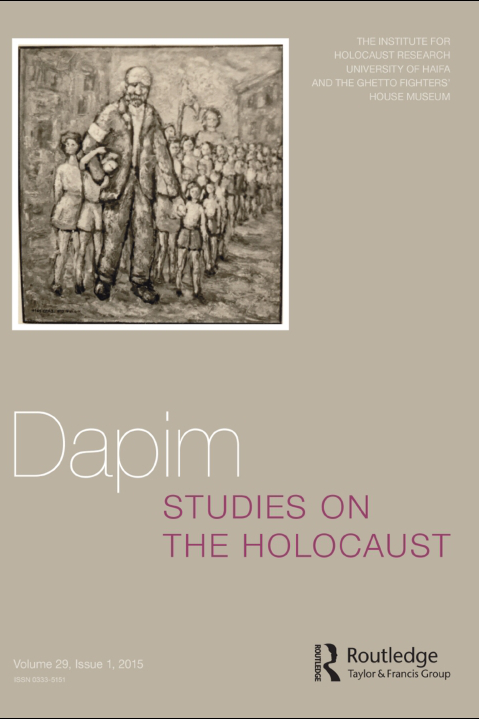
Portugal, Jewish Refugees, and the Holocaust
Mai 29, 2015 | Artigos, Publicações

Portugal, Jewish Refugees, and the Holocaust
- Irene Flunser Pimentel & Cláudia Ninhos
- 2015
- Dapim: Studies on the Holocaust
- Volume 29, Número 2
- 101-113
- Idioma: Inglês
- DOI: 10.1080/23256249.2015.1032118
- ISSN: 2325-6249 / 2325-6257 (Online)
This article constitutes a case study of, on the one hand, the evolution of Portuguese border policy regarding refugees and, on the other, the circumstances surrounding the awareness of the Holocaust by the Portuguese state. The first section discusses the evolution of official Portuguese policy toward refugees, in particular Jews, from the early 1930s onward. We support the argument that Portugal’s increasingly restrictive border policies toward Jewish refugees are most effectively explained not by antisemitic ideology, but by social and political motivations. The following section of this paper will focus on the period that followed the invasion of the Soviet Union, when the Holocaust began. Our main objective is to understand the point at which the Portuguese government and Portuguese society became aware of the mass slaughter that was taking place in Eastern Europe. We will then analyze the impact of this knowledge on the Portuguese government’s position on the refugees, especially as it became aware of the extent of the crimes being committed. The article will conclude with the presentation and discussion, for the first time, of German primary sources that inform on the role of the Portuguese state in the Holocaust. This last section assesses an important and heretofore unanswered question regarding Nazi Germany’s inclusion of neutral countries, including Portugal, in the carrying out of the ‘Final Solution to the Jewish Question’.
Palavras-chave:
Portugal, Salazar, Holocaust, refugees policy
Outras Publicações
Pesquisa
Agenda
setembro, 2026
Tipologia do Evento:
Todos
Todos
Apresentação
Ciclo
Colóquio
Conferência
Congresso
Curso
Debate
Encontro
Exposição
Inauguração
Jornadas
Lançamento
Mesa-redonda
Mostra
Open calls
Outros
Palestra
Roteiro
Seminário
Sessão de cinema
Simpósio
Workshop
- Event Name
seg
ter
qua
qui
sex
sab
dom
-
1
2
3
4
5
6
7
8
9
10
11
12
13
14
15
16
17
18
19
20
21
22
23
24
25
26
27
28
29
30

Detalhes do Evento
O segundo volume do livro de José Pedro Castanheira vai ser lançado no Liceu Camões, em Lisboa, com apresentação de Maria Inácia
Ver mais
Detalhes do Evento
O segundo volume do livro de José Pedro Castanheira vai ser lançado no Liceu Camões, em Lisboa, com apresentação de Maria Inácia Rezola e Fernando Mendes.
Histórias da PIDE
Quando era a DGS de Caetano. Volume 2
A «evolução na continuidade» prometida em 1968 por Marcello Caetano nada alterou na temida e execrada polícia política da ditadura. Apenas mudou o nome: a salazarista PIDE passou a chamar‑se Direção‑Geral de Segurança (DGS). A «primavera marcelista», que desabrochara com o fim da deportação de Mário Soares em São Tomé, começou a murchar 18 meses depois, quando o socialista foi compelido ao exílio em Paris. Outra vítima foi Daniel Cabrita, militante clandestino do PCP, fundador e primeiro líder da Intersindical (atual CGTP), torturado, julgado e condenado, cuja mulher se suicidou quando ele estava preso na cadeia de Peniche. À atenção e vigilância da PIDE/DGS continuava a não escapar ninguém: nem os sucessivos patriarcas de Lisboa, nem os sete oficiais que viriam a fazer parte da Junta de Salvação Nacional do 25 de Abril de 1974. A violência da DGS atingiu o paroxismo nas colónias, testemunhada pela Cruz Vermelha Internacional: nas vésperas da revolução, em Moçambique a tortura prosseguia, em massa e até à morte.
Estas são algumas das Histórias da PIDE que José Pedro Castanheira investigou ao longo dos anos para o Expresso, e que ocorreram durante a governação de Marcello Caetano.
Mais informações sobre o livro
Tempo
(Quarta-feira) 6:30 pm - 8:00 pm
Organizador
Edições Tinta da China e Escola Secundária de Camões
Notícias
IHC renova os seus Órgãos Sociais e Coordenações
Set 15, 2026
Rui Lopes é o novo Presidente da Direcção do IHC
PHONLAB dá origem a exposição permanente na Universidade de Coimbra
Set 10, 2026
‘Ala Armando de Lacerda’ é inaugurada a 17 de Setembro
Lisboa acolhe a 8ª Conferência Internacional de História Pública
Ago 31, 2026
Sob o tema “A História Pública de Passados Difíceis”