
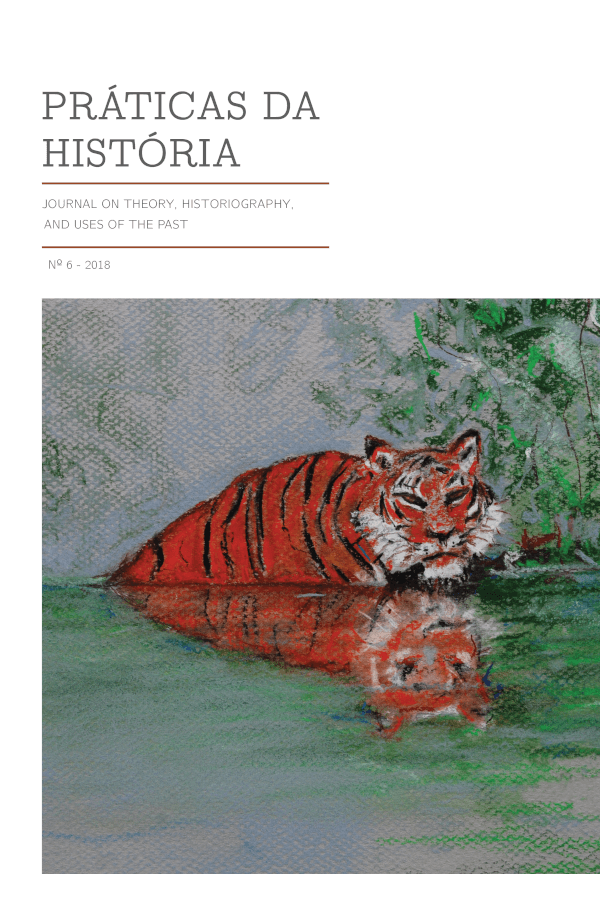
Práticas da História Nº 6
Práticas da História – Journal on Theory, Historiography and Uses of the Past
- 2018
- Número 6
- ISSN: 2183-590X
- Tema: The History of Hayden White
Excerto do editorial:
The homage the present issue embodies is far from an original gesture, or even one that would have to wait for Hayden White’s death. Since the 1990s, White and his academic trajectory have been the object of a number of tributes.10 On this occasion, we challenged a group of co-leagues from different countries to engage with one of the many essays penned by White throughout his career. We asked them to comment that specific essay as they saw fit, namely by exploring the way White questions their own field or line of research (as Paul-Arthur Tortosa does, within the frame of the History of Medicine) or exploring the relations between White and other authors – in some cases, classical authors (such as Vico, by Maria-Benedita Basto, and Freud, by Nancy Partner), in others, contemporary with White (such as Paul Ricoeur, brought to this issue by João Luís Lisboa, and Frederic Jameson, by Luís Trindade, or Dominick LaCapra, by Rui Bebiano).
To make White’s essays the topic or motto for the issue’s contributions was not an innocent choice. As previously mentioned, he was the author of one of the most influential History books ever published, Metahistory: The Historical Imagination in Nineteenth-century Europe, whose 40th anniversary was recently acknowledged in different parts of the world (see, for instance, the book Metahistoria: 40 años después. Ensayos en homenaje a Hayden White, edited by Aitor Bolanõs de Miguel, who also happens to participate in this same issue). But White’s interventions in the field of theory of History were not limited to monographs. In fact, most of his work was first published in journals or as chapters in collective works.12 As a counterpoint to this dispersion, from time to time he published works such as Tropics of Discourse. Essays in Cultural Criticism (1978), The Content of the Form: Narrative Discourse and Historical Representation (1987), Figural Realism. Studies in the Mimesis Effect (1999) and The Practical Past (2015). The Fiction of Narrative – Essays on History, Literature, and Theory (2010), mentioned earlier, is a collection of White’s essays selected by Robert Doran with a biographically-structured anthological purpose.14 The same anthological principle presides over White’s essay collections published in languages other than his native English. Such is the case with Forme di storia: dalla realtà alla narrazione, published in Italian in 2006, Proza historyczna, published in Polish in 2009, or, more recently, L’Histoire s’écrit, published in French. The texts that the organisers of those works sign in the issue of our journal – respectively, Eduardo Tortarolo, Ewa Domanska and Philippe Carrard – bring to light some of these editorial processes and their relation with the historiographical cultures of the countries where these anthologies were published.
There is a well-established genealogy of the essay as a genre – or, we could also say, as an anti-genre – that can be traced back from Lukács to Montaigne, for example.16 The point here is not to re-trace or extend this particular topic. And the place of the essay as a form in White’s work also has been acknowledged, among others, by LaCapra, Richard Vann and Robert Doran. I would just like to add that the choice of White’s essays as the starting point for the various contributions we gather in this budding academic journal also springs from our will to insist on the need to problematize what is implied in the modes of production historians nowadays are subjected, or subject themselves, to. Some of the conceptions of the discipline of History and of historical time itself that we have attributed to White in the previous paragraphs seem to fit uneasily with the conventions of writing and academic publishing that currently prevail within social sciences and humanities. Those conceptions rather bring to our mind a text of T. W. Adorno originally published in German in 1958, in which he exalts the untimely nature of the essay. It is with Adorno’s words in «The essay as form» that we conclude: «The usual reproach against the essay, that it is fragmentary and random, itself assumes the giveness of totality and thereby the identity of subject and object, and it suggests that man is in control of totality. But the desire of the essay is not to seek and filter the eternal out of the transitory; it wants, rather, to make the transitory eternal. Its weakness testifies to the non-identity that it has to express, as well as to that excess of intention over its object, and thereby it points to that utopia which is blocked out by the classification of the world into the eternal and the transitory. In the emphatic essay, thought gets rid of the traditional idea of truth.»
José Neves (IHC — NOVA FCSH)
Outras Publicações


















Pesquisa
Agenda
junho, 2026
seg
ter
qua
qui
sex
sab
dom
1
2
3
4
5
6
7
8
9
10
11
12
13
14
15
16
17
18
19
20
21
22
23
24
25
26
27
28
29
30

Notícias
Marta Pinto Machado em dose dupla em Lisboa: MNAC e CCCV
A exposição “Ceci n’est Pas Francisco” está patente no MNAC e vai-se estender ao CCCV
Ainda há VINCULUM na Madeira
O “Tombo I da Igreja de Machico” vai ser o mote para uma série de eventos culturais
Nuno Silas expõe no MUHNAC
É um dos curadores da exposição “Olhares Críticos no Arquivo Colonial – Sombras e Memórias”