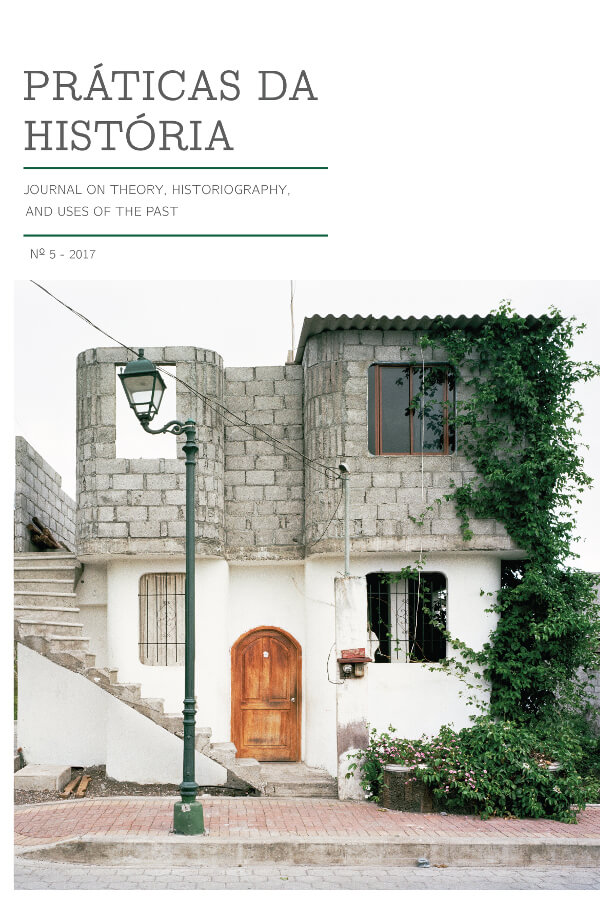
Práticas da História Nº 3
Práticas da História – Journal on Theory, Historiography and Uses of the Past
- 2016
- Número 3
- ISSN: 2183-590X
- Tema: “The archive and the subaltern” – Coordenado por Carolien Stolte e António da Silva Rego
Editorial:
This special issue takes inspiration from a series of events surrounding Dipesh Chakrabarty’s visit to Leiden University in October 2015. Especially thought-provoking was the Faculty Roundtable entitled ‘Minor Archives, Meta Histories: Rethinking Peripheries in the Age of Global Assemblages’. Together with Nira Wickramasinghe, Ksenia Robbe, Wayne Modest, and Ethan Mark, Chakrabarty discussed the potential of the ‘minor mode’: scholarship that seeks to give voice to the marginalized, foregrounds history’s ‘unlikely subjects’ and critiques the larger historiographical frames that rendered them invisible in the first place. Questions that drove the roundtable were how we might use micro-voices, -histories, and –archives to articulate different conceptions of the global and of global history; how they might help to imagine a post-national historiography in the Global South; but also where we might look for the appropriate sources for such histories. In other words: what is the archive of the minor?
A full transcript of the roundtable is included with this issue, in which the speakers touch on issues ranging from the interpretation of Australian Aboriginal songs, to discursive power imbalances within the Global South, to the ways in which scaling up – even to the planetary level – can still be considered part of the ‘minor mode’. Making this roundtable available to the wider public was an initiative of António da Silva Rêgo. From that starting point we developed the idea of a dedicated special issue, for which we recruited reflections on the nature of the archive and the possible sources for writing subaltern history.
In the first research article, ‘Travellers in Archives, or the Possibilities of a Post-Post-Archival Historiography’, Benjamin Zachariah shows what the historical profession stands to gain from a more active conception of the archive. It is time, he argues, to recover from the ‘post-archival’ condition, first contracted by historians in the wake of the postmodernist interventions of the 1970s and, more pertinent to this special issue, Ranajit Guha’s influential intervention in Subaltern Studies II [Ranajit Guha, “The Prose of Counter-Insurgency,” in Selected Subaltern Studies, ed. Ranajit Guha and Gayatri Spivak, (New Dehli: Oxford University Press, 1988 [1983]), 45-85]. The archive was generalized into a state-created collection of documents, meant to reinforce the state’s own legitimacy. With the colonial archive, in this view, the statist perspective was further exacerbated. As Zachariah notes, the colonial archive was seen as a ‘repository of prejudice’, reflecting colonial viewpoints rather than historical reality. Any effort to be attentive to the way the colonial archive was constructed, to read sources critically or to compensate for the biases inherent in the archive, was doomed to failure: Guha concluded his essay by stating that even historians seeking to write from the subaltern’s point of view are distanced from colonial discourse ‘only by a declaration of sentiment’ [Ranajit Guha, “The Prose of Counter-Insurgency,” in Selected Subaltern Studies, ed. Ranajit Guha and Gayatri Spivak, (New Dehli: Oxford University Press, 1988 [1983]), 84].
Zachariah calls upon historians to join a recent historiographical trend that, while maintaining a critical perspective on the archive, can overcome some of the limiting aspects of Guha’s view of it: by seeing the archive not as a place, but as a rhetorical move – a set of sources collected and combined by the historian, driven by his or her research questions. For archivally-minded historians his conclusions will be cause for optimism: ‘the singular control over history and memory attributed to ‘the’ archive has never existed. We invent an archive every time we have a question to answer; and then someone reinvents the archive in the service of a new question.’
Next, Dale Luis Menezes questions Indian nationalist discourses in Portuguese India, and the sources we need to consider these discourses critically. ‘Christians and Spices: a Critical Reflection on Indian Nationalist Discourses in Portuguese India’ illuminates the unique colonial trajectory that set Portuguese India apart from British India, and the way this has shaped a postcolonial trajectory for the region that likewise sets it apart from the Indian nationalist mainstream. Examining debates in the Konkani language press, in pamphlets and in other political writings, he problematizes the widespread understanding of the Portuguese period as one of spiritual and cultural destruction, as well as its mirror image: the problematic ways in which the region was discursively ‘made’ into an integral part of the Indian nation.
With Ruy Llera Blanes’ article, our discussion stays within the realm of archives and their representation of subaltern interests and perspectives. His contribution, too, is ultimately optimistic when it comes to archival potential, but like our other contributors, he locates this potential outside the archives of the state. In ‘A Febre do Arquivo. O “efeito Benjamin” e as revoluções angolanas’ (Archival Fever. The “Benjamin effect” and the Angolan Revolutions’), Blanes discusses the crucial importance of the archive in understanding recent political upheavals in Angola. Taking his cue from Derrida’s concept of archive fever [Jacques Derrida, Archive Fever. A Freudian Impression [first published as Mal d’Archive: Une Impression Freudienne] (Chicago: University of Chicago Press, 1995)], he argues that Angola’s contemporary political dialectic produces a distance between hegemonic and subaltern interests in confrontation. Blanes analyzes the archive of the so-called Revu movement as a subaltern archive, and elucidates the processes through which it poses an epistemological alternative to the official narrative of the Angolan regime. This includes rendering ‘invisible chronologies’ of protest and repression visible, and the ‘recovery’ of lost memory: it offers a rereading of the history of Angola as an independent country.
Orazio Irrera concludes the research section with an article entitled ‘De l’archéologie du savoir aux archives coloniales. L’archive comme dispositif colonial de violence épistémique’ (On the Archaeology of Knowledge in Colonial Archives. The Archive as a Colonial Device of Epistemic Violence). Irrera problematizes the archive as a place of production of truth at the intersection of its epistemological
and juridico-political matrices, in order to show to what extent the archive reflects European modernity and its colonial expansion. With Benjamin Zachariah above, he notes that recent projects, both documentary and artistic, have made the archive into an object of derision, the device of an alternative history or counter-memory. Irrera argues, however, that the force of subversion revealed by these projects cannot be understood without grasping the specific type of violence that once accompanied the establishment of the archives. Referring to strategies of objectification, surveillance, and control, he shows how the archive is linked to the proces of extracting and registering knowledge. Analyzing the archive’s direct relationship to such forms of epistemic violence, he focuses on two different aspects: ‘gestures of silence’, which create discernable absences in the colonial archive, and the ways in which the colonial archive testifies to an anguish linked to discrepancies between colonial intent, and practice on the ground.
Ranging from India to Angola and from the Goan vernacular press to records of the colonial state, each contribution to this issue takes forward questions around the archive and the minor mode. Fittingly, the issue is completed by an in-depth interview with Sanjay Seth, known for his thoughtful interventions on the theory and practice of writing history, conducted by José Neves.
Carolien Stolte (Leiden University)