Alien Plant Species
Jan 29, 2019 | Capítulos, Publicações

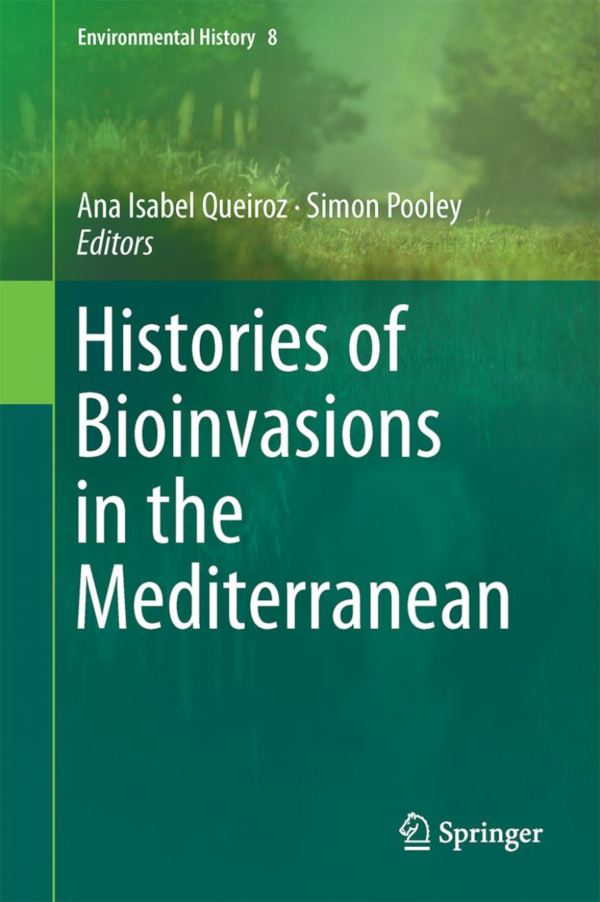
Alien Plant Species: Environmental Risks in Agricultural and Agro-Forest Landscapes Under Climate Change
- Joana R. Vicente, Ana Sofia Vaz, Ana Isabel Queiroz, Ana R. Buchadas, Antoine Guisan, Christoph Kueffer, Elizabete Marchante, Hélia Marchante, João A. Cabral, Maike Nesper, Olivier Broennimann, Oscar Godoy, Paulo Alves, Pilar Castro-Díez, Renato Henriques & João P. Honrado
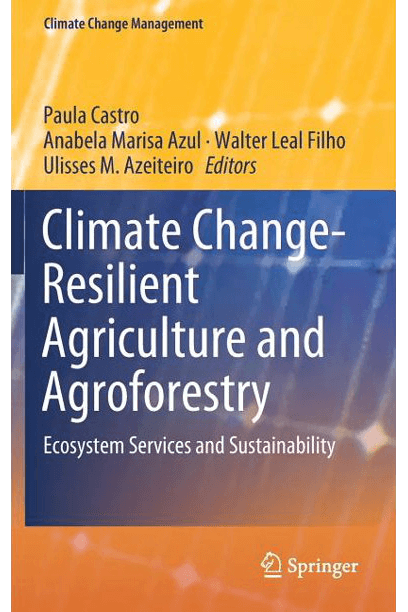
- Climate Change-Resilient Agriculture and Agroforestry
- Paula Castro, Anabela Marisa Azul, Walter Leal Filho & Ulisses M. Azeiteiro (Eds.)
- 2019
- Basel: Springer
- Idioma: Inglês
- ISBN: 978-3-319-75003-3 / 978-3-319-75004-0 (online)
- DOI: https://doi.org/10.1007/978-3-319-75004-0_13
- 215-234 p.
Alien plant species have been essential for farming and agro-forestry systems and for their supply of food, fiber, tannins, resins or wood from antiquity to the present. They also contributed to supporting functions and regulating services (water, soil, biodiversity) and to the design of landscapes with high cultural and scenic value. Some of those species were intentionally introduced, others arrived accidentally, and a small proportion escaped, naturalized and became invasive in natural ecosystems—these are known as invasive alien species (IAS). Here, invasive means that these species have some significant negative impact, either by spreading from human-controlled environments (e.g. fields, gardens) to natural ecosystems, where they can cause problems to native species, or to other production systems or urban areas, impacting on agricultural, forestry activities or human health. Socio-environmental impacts associated with plant invasions have been increasingly recognized worldwide and are expected to increase considerably under changing climate or land use. Early detection tools are key to anticipate IAS and to prevent and control their impacts. In this chapter, we focus on crop and non-crop alien plant species for which there is evidence or prediction of invasive behaviour and impacts. We provide insights on their history, patterns, risks, early detection, forecasting and management under climate change. Specifically, we start by providing a general overview on the history of alien plant species in agricultural and agroforestry systems worldwide (Sect. 1). Then, we assess patterns, risks and impacts resulting from alien plants originally cultivated and that became invasive outside cultivation areas (Sect. 2). Afterwards, we provide several considerations for managing the spread of invasive plant species in the landscape (Sect. 3). Finally, we discuss challenges of alien plant invasions for agricultural and agroforest systems, in the light of climate change (Sect. 4).
Sobre o livro:
This book collects wide-ranging contributions such as case studies, reviews, reports on technological developments, outputs of research/studies, and examples of successful projects, presenting current knowledge and raising awareness to help the agriculture and forestry sectors find solutions for mitigating climate variability and adapting to change. It brings the topic of ecosystem services closer to education and learning, as targeted by the Framework Convention on Climate Change and the Paris Agreement, the 2030 Agenda for Sustainable Development and the EU Biodiversity Strategy to 2020. Climate change and its impacts on agriculture and agroforestry have been observed across the world during the last 50 years. Increasing temperatures, droughts, biotic stresses and the impacts of extreme events have continuously decreased agroforestry systems’ resilience to the effects of climate change. As such, there is a need to adapt farming and agroforestry systems so as to make them better able to handle ever-changing climate conditions, and to preserve habitats and ecosystems services.
Outras Publicações
Pesquisa
Agenda
maio, 2026
Tipologia do Evento:
Todos
Todos
Apresentação
Ciclo
Colóquio
Conferência
Congresso
Curso
Debate
Encontro
Exposição
Inauguração
Jornadas
Lançamento
Mesa-redonda
Mostra
Open calls
Outros
Palestra
Roteiro
Seminário
Sessão de cinema
Simpósio
Workshop
- Event Name
seg
ter
qua
qui
sex
sab
dom
-
-
-
-
1
2
3
4
5
6
7
8
9
10
11
12
13
14
15
16
17
18
19
20
21
22
23
24
25
26
27
28
29
30
31

Detalhes do Evento
Seminário de investigação que procura alargar o campo dos estudos sobre o petróleo para além das narrativas, geografias e fronteiras disciplinares estabelecidas, dando maior destaque às perspetivas do Sul Global e
Ver mais
Detalhes do Evento
Seminário de investigação que procura alargar o campo dos estudos sobre o petróleo para além das narrativas, geografias e fronteiras disciplinares estabelecidas, dando maior destaque às perspetivas do Sul Global e de outros locais de extracção e resistência.
Mind the Gap III:
Unearthing Petromodernity: Oil Studies in the Anthropocene
Online Research Seminar
The rise of fossil fuels has been central to the political, economic, cultural, and material transformations of the past two centuries, yet the forms of power, knowledge, and life enabled by carbon energy often remain analytically invisible. As we confront the converging crises of the Anthropocene, the need to rethink the centrality of fossil fuels to modern life has never been more urgent.
At a moment when toxic landscapes, resource frontiers, and environmental inequality reveal the uneven geographies of fossil modernity, the humanities and social sciences are reorienting analytical attention toward the energetic foundations of modern life. From pipelines and refineries to plastics and everyday petrochemical products, the material properties of oil have fundamentally shaped modern infrastructures and forms of life. What forms of political and social power are created through fossil fuel industries? How have fossil fuels shaped modern societies, their economic models, governmental regimes, everyday lives? How have they contributed to uneven global geographies rooted in colonialism and capitalism? What kinds of transitions to post-carbon futures are possible?
Bringing together approaches from history, anthropology, political ecology, and geography, we seek to expand the field of oil studies beyond established narratives, geographies, and disciplinary boundaries, amplifying perspectives from the Global South and other sites of extraction and resistance.
📎 Download full programme (PDF)
Programme:
Every fortnight we will meet online to discuss an article or book chapter circulated in advance. The sessions will start with a 20–30 minute presentation, followed by discussion. The sessions will take place on Mondays at 2PM.
We will explore key concepts such as petro-culture, carbon democracy, extractivism, fossil capital, energy regimes, and transition imaginaries, examining how energy dependence shapes modern subjectivities, infrastructures, economies, and ecological futures. The texts will be shared with participants in advance.
Everyone is welcome.
To register, please fill out the online form. After registering you will receive the readings and access information ahead of each session.
For more information, please write to unearthingpetromodernity@proton.me.
30 March | Timothy Mitchell, Carbon Democracy: Political Power in the Age of Oil. Selected chapter TBA (Verso, 2011)
Davide Scarso (CIUHCT — FCT NOVA)
Focus: How fossil fuels structured democratic politics, labour power and modern governance
13 April | Adam Hanieh, “Petrochemical Empire: The Geo-Politics of Fossil-Fuelled Production“ New Left Review (139)
Ricardo Noronha (IHC — NOVA FCSH / IN2PAST)
Focus: Global production networks, the Gulf region and the restructuring of capitalism through petrochemicals
27 April | Carola Hein (ed.), Oil Spaces: Exploring the Global Petroleumscape. Chapter 8: Peyerl, D. “Building Brazil’s Petroleumscape on Land and Sea: Infrastructure, Expertise, and Technology” (Routledge, 2022)
Henrique Oliveira (IHC — NOVA FCSH / IN2PAST)
Focus: Infrastructure, territorial development and the spatial materiality of oil
11 May | Stephanie LeMenager, Living Oil: Petroleum Culture in the American Century. Selected chapter TBA (Oxford University Pres, 2014)
Raquel Ribeiro (CHAM — NOVA FCSH)
Focus: Oil, media, culture, and everyday life in twentieth-century society
25 May | Appel, Mason & Watts (Eds.), Subterranean Estates: Life Worlds of Oil and Gas. Introduction: “Oil Talk” (Cornell University Press, 2015)
Amedeo Policante (IHC — NOVA FCSH / IN2PAST)
Focus: Anthropological and political-economic perspectives on oil extraction and everyday life
8 June | Alice Mah, Petrochemical Planet: Multiscalar Battles of Industrial Transformation. Chapter 2: “Enduring Toxic Injustice and Fenceline Mobilizations” (Duke University Press, 2023)
João Pedro Santos (IHC — NOVA FCSH / IN2PAST)
Focus: Environmental justice, pollution, and grassroots activism around petrochemical industries
22 June | Chelsea Schields, Offshore Attachments: Oil and Intimacy in the Caribbean. Introduction and Chapter 1. “Crude Bargains” (University of California Press, 2023)
Anita Buhin (IHC — NOVA FCSH / IN2PAST)
Focus: Oil economies, intimacy, and social relations in offshore extraction zones
6 July | Tim Di Muzio & Matt Dow, “Global capitalism and oil“ in Handbook on Oil and International Relations (Edward Elgar Publishing , 2022)
Davide Scarso (CIUHCT — FCT NOVA), Amedeo Policante & Ricardo Noronha (IHC — NOVA FCSH / IN2PAST)
Focus: Oil in international relations, financialization and the structure of global capitalism
Organisation:
Davide Scarso (CIUHCT — FCT NOVA)
Amedeo Policante (IHC — NOVA FCSH / IN2PAST)
Ricardo Noronha (IHC — NOVA FCSH / IN2PAST)
Tempo
(Segunda-feira) 2:00 pm - 4:00 pm
Localização
Link a divulgar a quem se inscrever
Plataforma Zoom
Organizador
Instituto de História Contemporânea — Faculdade de Ciências Sociais e Humanas da Universidade NOVA de Lisboa e Centro Interuniversitário de História das Ciências e da Tecnologia
Notícias
Nuno Silas expõe no MUHNAC
Abr 29, 2026
É um dos curadores da exposição “Olhares Críticos no Arquivo Colonial – Sombras e Memórias”
Pedro Cerdeira, Prémio Amílcar Cabral, em Lisboa
Abr 28, 2026
Participará no encontro “Desconstruir o Colonialismo: Entre Tradição e Revolução”
Fernando Rosas: o actor da história que estudou
Abr 23, 2026
“É muito importante tornar a história da democracia em Portugal muito presente”