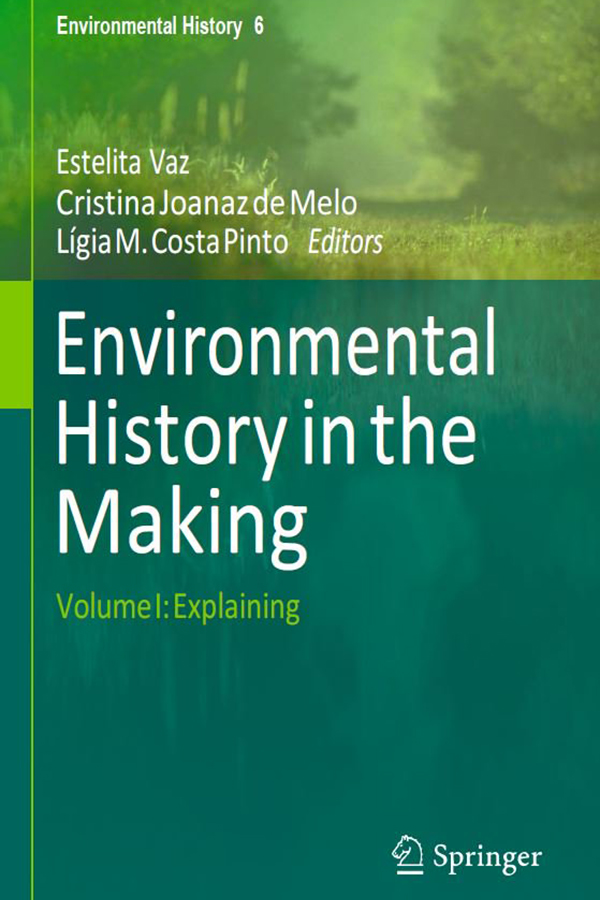
Environmental History in the Making
Mai 2, 2017 | Livros, Publicações

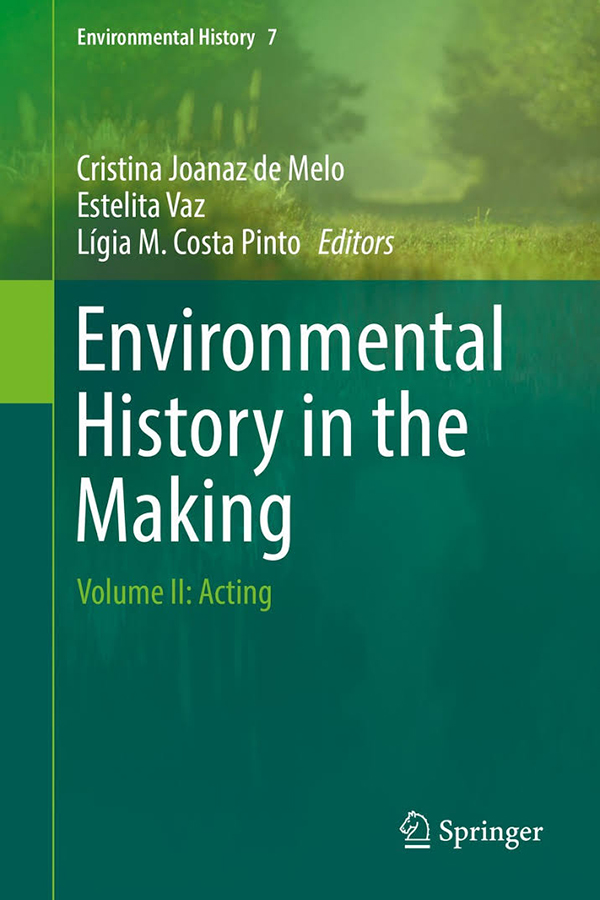
Environmental History in the Making. Volume II: Acting
- Cristina Joanaz de Melo, Estelita Vaz & Lígia M. Costa Pinto (Eds.)
- 2017
- Basel: Springer International Publishing
- ISBN: 978-3-319-41137-8
- DOI: 10.1007/978-3-319-41139-2
- Idioma: Inglês
- 376 pp.
This book is the product of the 2nd World Conference on Environmental History, held in Guimarães, Portugal, in 2014. It gathers works by authors from the five continents, addressing concerns raised by past events so as to provide information to help manage the present and the future. It reveals how our cultural background and examples of past territorial intervention can help to combat political and cultural limitations through the common language of environmental benefits without disguising harmful past human interventions.
Considering that political ideologies such as socialism and capitalism, as well as religion, fail to offer global paradigms for common ground, an environmentally positive discourse instead of an ecological determinism might serve as an umbrella common language to overcome blocking factors, real or invented, and avoid repeating ecological loss.
Therefore, agency, environmental speech and historical research are urgently needed in order to sustain environmental paradigms and overcome political, cultural an economic interests in the public arena.
This book intertwines reflections on our bonds with landscapes, processes of natural and scientific transfer across the globe, the changing of ecosystems, the way in which scientific knowledge has historically both accelerated destruction and allowed a better distribution of vital resources or as it, in today’s world, can offer alternatives that avoid harming those same vital natural resources: water, soil and air. In addition, it shows the relevance of cultural factors both in the taming of nature in favor of human comfort and in the role of the environment matters in the forging of cultural identities, which cannot be detached from technical intervention in the world.
In short, the book firstly studies the past, approaching it as a data set of how the environment has shaped culture, secondly seeks to understand the present, and thirdly assesses future perspectives: what to keep, what to change, and what to dream anew, considering that conventional solutions have not sufficed to protect life on our planet.
Outras Publicações
Pesquisa
Agenda
setembro, 2026
Tipologia do Evento:
Todos
Todos
Apresentação
Ciclo
Colóquio
Conferência
Congresso
Curso
Debate
Encontro
Exposição
Inauguração
Jornadas
Lançamento
Mesa-redonda
Mostra
Open calls
Outros
Palestra
Roteiro
Seminário
Sessão de cinema
Simpósio
Workshop
- Event Name
seg
ter
qua
qui
sex
sab
dom
-
1
2
3
4
5
6
7
8
9
10
11
12
13
14
15
16
17
18
19
20
21
22
23
24
25
26
27
28
29
30

Detalhes do Evento
Conferência que procura desafiar o revisionismo histórico, amplificar vozes marginalizadas e promover diálogos transnacionais sobre reconciliação, responsabilização e justiça restaurativa. The Public History of Difficult Pasts 8th
Ver mais
Detalhes do Evento
Conferência que procura desafiar o revisionismo histórico, amplificar vozes marginalizadas e promover diálogos transnacionais sobre reconciliação, responsabilização e justiça restaurativa.
The Public History of Difficult Pasts
8th International Conference on Public History
IFPH 2026
The 8th International Conference on Public History, organised by the International Federation for Public History, IFPH, will take place in Lisbon from September 7 to 11, 2026. It will be hosted by IN2PAST – the Associate Laboratory for Research and Innovation in Heritage, Arts, Sustainability and Territory, a transdisciplinary consortium of seven research centres, at the Almada Negreiros College on the Campolide Campus of NOVA University Lisbon.
In a time of escalating attacks by right-wing movements on memory, diversity, human rights, democracy, and history itself, the IFPH reaffirms its commitment to fostering critical engagement with the ways societies confront, interpret, and relate to their difficult pasts and challenging presents. The IFPH strongly condemns book banning, the censorship of historical narratives, the surveillance of students and educators, the targeting of sites of remembrance, and the imposition of ideological agendas — particularly right-wing distortions — that not only threaten academic freedom but undermine the very principles upon which public history is built. Against this backdrop, the conference seeks to challenge historical revisionism and silencing, to amplify marginalised voices and memories, and to promote transnational dialogues on reconciliation, accountability, and restorative justice.
Public History has long addressed global historical processes such as colonialism, the transatlantic slave trade, and the genocide of Indigenous peoples, as well as phenomena that emerge in multiple contexts, including armed conflicts and dictatorships. It embodies both a political and ethical commitment to examining how difficult pasts have been lived and remembered by different communities and individuals, ensuring that their perspectives are acknowledged and respected. At the same time, engaging with these histories through Public History raises significant challenges. Sharing authority with specific communities and amplifying marginalised narratives may unintentionally silence other voices, while also presenting complex ethical dilemmas. Furthermore, Public History operates within the public sphere, engaging diverse audiences and navigating competing representations of the past in an era increasingly marked by the political instrumentalisation of history and the spread of revisionist and denialist discourses.
🔗 Free registration HERE.
Call for contributions
This conference seeks to challenge historical revisionism, amplify marginalised voices, and foster transnational dialogues on reconciliation, accountability, and restorative justice. We invite contributions that explore:
Historical Contexts and Global Processes
-
- Colonialism and its enduring legacies
- The transatlantic slave trade and its commemorations
- Indigenous genocide and cultural destruction
- Armed conflicts, civil wars, and their aftermath
- Dictatorships, authoritarianism, and state violence
- Mass atrocities and crimes against humanity
Contemporary Challenges and Methodological Innovations
-
- Countering historical denial and revisionism
- Navigating contested memories and competing narratives
- Sharing authority with affected communities
- Ethical dilemmas in representing traumatic pasts
- Digital humanities, media, and social networks
- Museum practices and memorial sites
- Archives, and archival activism
- Educational approaches to sensitive histories
Voices and Perspectives
-
- Survivor testimonies and intergenerational trauma
- Community-based historical projects
- Oral history and marginalised narratives
- Gender, sexuality, and intersectional approaches
- Youth engagement with difficult pasts
- Transnational and comparative perspectives
Justice and Reconciliation
-
- Truth commissions and transitional justice
- Reparations and historical redress
- Memorialisation and commemoration practices
- Restorative justice approaches
- Healing and collective memory
- Building inclusive historical narratives
Calendar
Opening of the Call for Presentations: 30 September 2025
Deadline for Application: 30 November 7 December 2025 [new deadline]
Deadline for reviewers to do their reviews: 31 January 2026
Call for posters: January 2026
Results of the Call for Presentations will be announced by March 2026
Programme of the conference shall be available around June 2026
Deadline for registration for on-site attendance: August 2026
Conference: 7-11 September 2026
Submission of proposals
🔗 Submit your panel proposal HERE.
🔗 Submit your paper proposal HERE.
🔗 Submit your Working Group proposal HERE.
>> Download the call for papers (PDF) <<
Tempo
7 (Segunda-feira) 11:00 am - 11 (Sexta-feira) 6:00 pm
Organizador
Várias instituições

Notícias
Lisboa acolhe a 8ª Conferência Internacional de História Pública
Ago 31, 2026
Sob o tema “A História Pública de Passados Difíceis”
Quinta edição do Prémio Amílcar Cabral
Jul 27, 2026
Candidaturas abertas até 30 de Setembro
Marta Pinto Machado em dose dupla em Lisboa: MNAC e CCCV
Mai 14, 2026
A exposição “Ceci n’est Pas Francisco” está patente no MNAC e vai-se estender ao CCCV