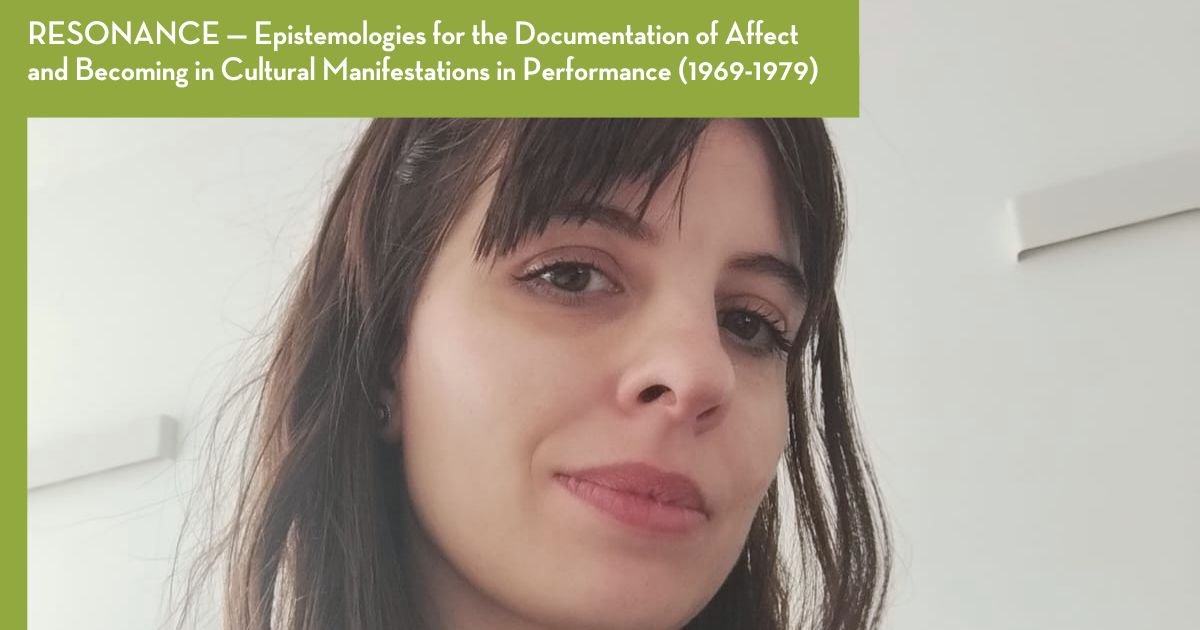
How can we study and preserve ephemeral cultural manifestations, such as an experimental theatre piece, a performance or the new Portuguese dance? This is the challenge that the project RESONANCE — Epistemologies for the Documentation of Affect and Becoming in Cultural Manifestations in Performance (1969-1979), coordinated by Hélia Marçal, will embrace.
The aim of RESONANCE is to analyse this type of cultural manifestations, those based on performance, in the period around the Portuguese 1974 Carnation Revolution (1969-1979), in order to interrogate the politics of memory across temporal and affective landscapes, as well as to challenge the apparent epistemological dichotomy between performance-based art and the performing arts. The challenge is great since, more often than not, these actions remained undocumented, as some artists directly opposed forms of inscriptional memory, while others documented their works sparingly. However, the historical relevance of these works is great, as they were created during a period of socio-political change and global experimentation in the fields of visual and performing arts and are characterised by a deep engagement with politics within circles of artistic practice. The temporal specificity of these forms of artistic practice is fundamental to understanding performance-based art and the urgent history of these works is yet to be done, partly due to issues with epistemologies and methodologies.
In addition to Hélia Marçal, the project will include Ana Bigotte Vieira (also from the IHC), Afonso Dias Ramos (IHA), Filipa Magalhães (CESEM), Ana Pais (ICNOVA), Vasco Baptista Marques (IFILNOVA), and Joana Lia Ferreira (CIUHCT – NOVA FCT). The National Museum of Theatre and Dance and the Calouste Gulbenkian Foundation will be partners in the project.
This was one of only six projects in the arts to receive funding from FCT under the Call for SR&TD Projects in All Scientific Domains launched at the end of 2023, and one of only three with ERDF funding in this disciplinary area. Benefits are expected for the creative industries, artists, academic and non-academic audiences.
Other news
-
 The History in the Public Sphere Programme is relaunching the project this academic year
 -
 Six Junior Researchers and seven Assistant Researchers
 -
 The exhibition will open on 29 September at FCSH