Um pacto de la Moncloa em Portugal?
Oct 28, 2020 | Chapters, Publications

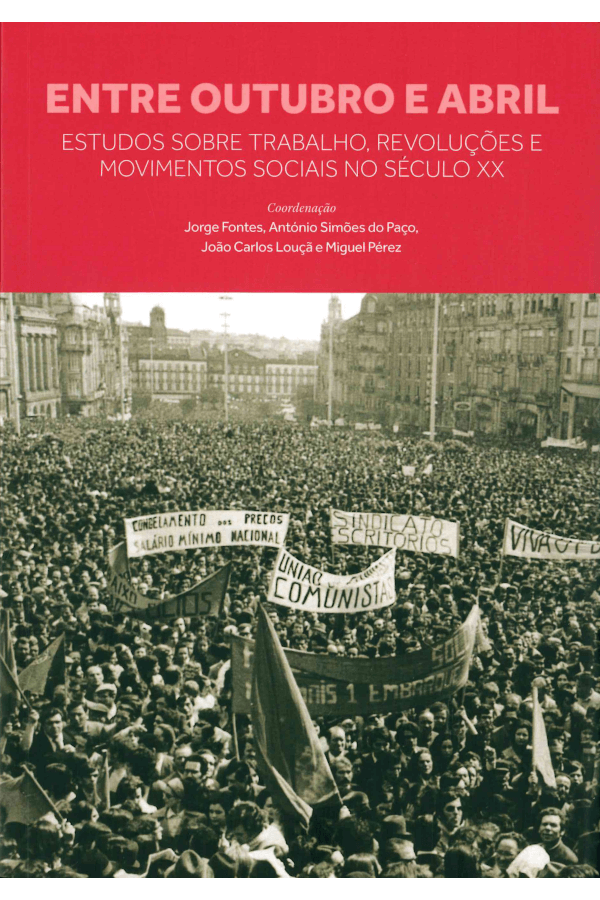
Um pacto de la Moncloa em Portugal? [A Moncloa pact in Portugal?]
- Jorge Filipe Figueiredo Fontes
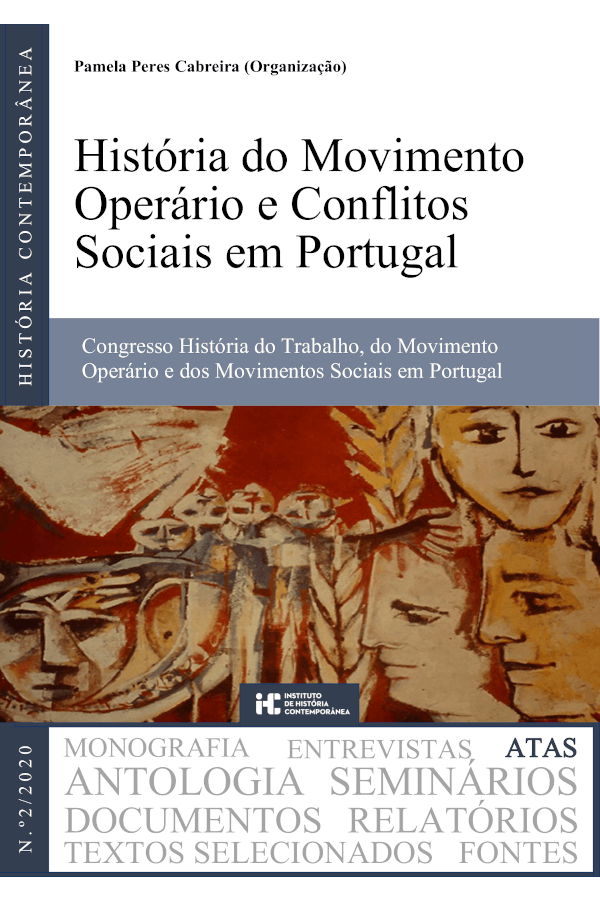
- História do Movimento Operário e Conflitos Sociais em Portugal. Atas do IV Congresso História do Trabalho, do Movimento Operário e dos Conflitos Sociais em Portugal e III Conferência do Observatório para as Condições de Trabalho e Vida [History of the Labour Movement and Social Conflicts in Portugal]
- Pamela Peres Cabreira (Org.) & Raquel Varela (Coord.)
- 2020
- Lisbon: Instituto de História Contemporânea | Colecção E-IHC
- Language: Portuguese
- ISBN: 978-989-8956-20-0
- 225-231 p.
Excerpt:
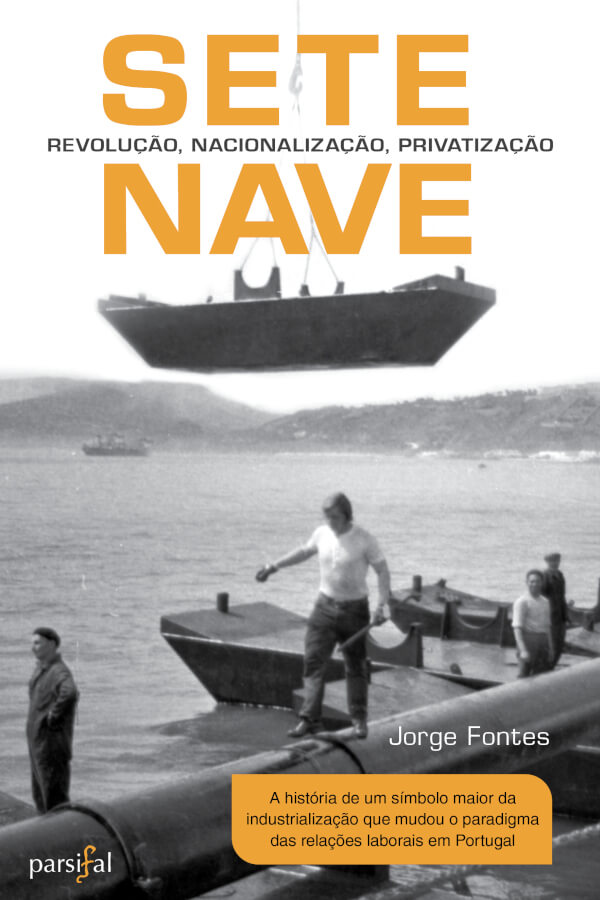
Neste capítulo, iremos abordar uma pequena parte da história da luta e concertação de classes na II República Portuguesa, nomeadamente a primeira grande tentativa de estabelecimento de um acordo de concertação social após o epílogo do processo revolucionário, avançando com algumas hipóteses para a sua não consubstanciação a exemplo do caso espanhol.
About the book:
Nos últimos decénios tem feito curso nas ciências sociais e humanas a ideia de que as sociedades teriam deixado de se organizar em torno do trabalho. Paralelamente, tem-se afirmado igualmente o fim das ideologias, do sindicalismo ou da militância. No entanto, o que a realidade nos mostra é que, ao invés da supressão do trabalho, se tem vindo a assistir antes ao crescimento do número de pessoas nele envolvidas. Nesta nova etapa de desenvolvimento do capitalismo, o trabalho não se extinguiu e o que se verifica, verdadeiramente, é que sofreu profundas transformações ao ter-se tornado, para largos setores, mais instável, multifacetado, intensificado e desvalorizado. Por conseguinte, há que redescobrir o trabalho, tornar visível o que alguns pretendem ocultar e apreender toda a sua complexidade a partir dos olhares diversos que são protagonizados pelas várias ciências, numa perspectiva inter e multidisciplinar. Por outro lado, há que evidenciar igualmente as consequências da intensificação e da desvalorização do trabalho para a saúde dos trabalhadores e as suas condições de vida, bem como as modalidades de resistência que estes lhes opõem – no presente e no passado. Esta é a abordagem deste livro, que corresponde à organização dos textos e temas apresentados no IV Congresso de História do Trabalho, do Movimento Operário e dos Movimentos Sociais em Portugal & III Conferência do Observatório para as Condições de Trabalho e Vida, realizado na cidade de Lisboa em Novembro de 2019.
Other Publications
Search
Events
abril, 2026
Tipologia do Evento:
Todos
Todos
Colloquium
Conference
Conference
Congress
Course
Cycle
Debate
Exhibition
Launch
Lecture
Meeting
Movie session
Open calls
Opening
Other
Presentation
Round table
Seminar
Showcase
Symposium
Tour
Workshop
- Event Name
seg
ter
qua
qui
sex
sab
dom
-
-
1
2
3
4
5
6
7
8
9
10
11
12
13
14
15
16
17
18
19
20
21
22
23
24
25
26
27
28
29
30

Detalhes do Evento
Conference that intends to discuss how the new far-right of the 21st century positions itself in relation to the legacy of classical fascism. From Fascism to Neo-Fascism? (Dis)Continuities
Ver mais
Detalhes do Evento
Conference that intends to discuss how the new far-right of the 21st century positions itself in relation to the legacy of classical fascism.
From Fascism to Neo-Fascism?
(Dis)Continuities Between Classical Fascism and 21st Century’s Far-Right
>> Detailed conference programme (PDF) <<
The debate on the political, ideological and social nature of contemporary far-right, especially the one active in the 21st century, has been ongoing for a long time. Academic debate, in this case more than in others, closely follows the public debate on political developments that are perceived to have dramatic consequences for the future. A large number of positions have been proposed and a wide range of concepts offered, applicable to specific cases, whether national or regional in scope, or to the global phenomenon itself — because, let us start here, it is a global phenomenon we are dealing with. Just as fascism was a hundred years ago. However, research is almost always forced to take a position on the question of continuities (Finchelstein, 2019; Palheta, 2022) and discontinuities (Forti, 2024) between, on the one hand, classical fascism (1922-1945) and what were in those days other ultra-reactionary phenomena that in the interwar years became by-products of fascism through the process of fascistization, and, on the other hand, the new forms adopted by the far-right since 1945 and, above all, since the turn of the 20th century to the 21st century. In the name of the urgency of a scientific approach to what appears to be the most serious crisis of liberal systems since the 1930s, at this conference we intend to discuss how the new extreme right of the 21st century positions itself in relation to the legacy of classical fascism, because “we need to explain the continuity between historical fascism and contemporary right-wing populism as a radicalization of post-liberal politics based on the erosion of democratic participation and the emergence of a new politics of fear” (Woodley, 2010).
In line with this position, this conference will also welcome studies on the anti-fascist political cultures, starting with those that emerged in reaction to the fascist wave of the 1930s and its political success (Kallis, 2015). The aim here is to make room for studies on the variety of forms of resistance to fascism. Anti-fascism is also a transnational movement (Traverso, 2004), and it did not lose its political effectiveness in 1945 or become a community of memory of a past encapsulated in time. It has re-emerged over the last 80 years whenever the extreme right has reappeared in force. As is the case today.
We welcome different possible areas for papers and panels on:
(i) (Fascism(s), neo-fascism, far-right, reaction and modernity. Concepts and theory.
(ii) The nation, the West, white supremacy: one hundred years of far-right worldvisions.
(iii) Hypermasculinity, anti-feminism and misogyny: social reproduction and fascism.
(iv) One hundred years of far-right political culture: continuities, discontinuities, adaptation, networks.
(v) Fascism, neo-fascism and the other(s): specificities of fascist and global far-right political articulation of xenophobia and racism.
(vi) Party, State, movements, militias, welfare, associations. The organisational dimension of the far-right. (vii) Violence, war, and genocide: far-right and political action.
(viiii) Fascism and crisis: context and causality of far-right boosts in history.
(ix) Anti-fascism as a transnational political culture: resisting fascism, preserving democracy, rebuilding democracy, from the 1920s to the 2020s. Intersections with anti-colonialism, anti-racism and feminism.
(x) Neo-fascism, far-right and anti-fascism in collective memory: uses of the past, memory, “culture wars” and political action.
Submission and presentations:
Researchers interested in attending or contributing to the conference should send an email with a title, an abstract (350 words max.), short bio, and contact information to congresso.neo.fascismo.2026@gmail.com no later than 4 January 2026.
We welcome individual papers as well as panel proposals in English. We will also welcome proposals for creative/artistic interventions that are built on an interdisciplinary intersection with the social sciences, which will be subject to peer review in the same way as proposals for papers and panels. In this case, proposals must include a description of the performance (specifying the means and time) and an abstract of objectives. Acceptance will depend on the actual and practical possibilities for integration into the programme.
Presentations should be done in-person in Portuguese, English or Spanish. There will be no online presentations.
Notification of acceptance by 8 February 2026.
No registration fees will be charged.
Keynote speakers: Ugo Palheta, Virgínia Fontes, and Fernando Rosas
>> Download the call for proposals (New! PDF) <<
Organising committee:
Manuel Loff (FLUP / IHC — NOVA FCSH / IN2PAST) Luís Trindade (IHC — NOVA FCSH / IN2PAST)
Arturo Zoffmann (IHC — NOVA FCSH / IN2PAST)
Ana Sofia Ferreira (FLUP / IS — Universidade do Porto)
Sílvia Correia (FLUP / IS — Universidade do Porto)
Adriano Amaral (IS — Universidade do Porto)
Gabriela Azevedo (IS — Universidade do Porto)
Bruno Madeira (Universidade do Minho / Lab2PT / IN2PAST) Sérgio Neto (FLUP / CITCEM)
Afonso Silva (UAB / IHC — NOVA FCSH / IN2PAST)
Carlos Martins (IS — Universidade do Porto)
Scientific Committee:
Caroline Silveira Bauer (Universidade Federal do Rio Grande do Sul, Brazil)
Francesca Billiani (University of Manchester, UK)
Kasper Braskén (University of Helsinki, Finland)
Gilberto Calil (Unioeste, Brazil)
Leonardo Carnut (Universidade de São Paulo, Brazil)
Rejane Carol (Universidade Federal do Rio de Janeiro, Brazil)
André Dantas (Fiocruz, Brazil)
Cristina Diac (The National Institute for the Study of Totalitarianism, Romania)
Fátima Moura Ferreira (University of Minho / Lab2PT / IN2PAST, Portugal)
Steven Forti (Universitat Autònoma de Barcelona, Spain)
Hugo García (Universidad Autónoma de Madrid, Spain)
Cátia Guimarães (Fiocruz, Brazil)
Xosé Manoel Núñez Seixas (Universidade de Santiago de Compostela, Spain)
Virgílio Borges Pereira (Universidade do Porto / IS, Portugal)
Fernando Rosas (IHC — NOVA FCSH / IN2PAST, Portugal)
Carlos Zacarias de Sena Júnior (Universidade Federal da Bahia, Brazil)
Carla Luciana Silva (Unioeste, Brazil)
Luís Reis Torgal (University of Coimbra / CEIS20, Portugal)
Vicente Valentim (IE University, Spain)
Tempo
abril 27 (Segunda-feira) - 28 (Terça-feira)
Localização
Faculty of Arts and Humanities of the University of Porto
Via Panorâmica Edgar Cardoso — 4150-564 Porto
Organizador
Several Institutions

Detalhes do Evento
Research seminar that seeks to expand the field of oil studies beyond established narratives, geographies, and disciplinary boundaries, amplifying perspectives from the Global South and other sites of extraction and
Ver mais
Detalhes do Evento
Research seminar that seeks to expand the field of oil studies beyond established narratives, geographies, and disciplinary boundaries, amplifying perspectives from the Global South and other sites of extraction and resistance.
Mind the Gap III:
Unearthing Petromodernity: Oil Studies in the Anthropocene
Online Research Seminar
The rise of fossil fuels has been central to the political, economic, cultural, and material transformations of the past two centuries, yet the forms of power, knowledge, and life enabled by carbon energy often remain analytically invisible. As we confront the converging crises of the Anthropocene, the need to rethink the centrality of fossil fuels to modern life has never been more urgent.
At a moment when toxic landscapes, resource frontiers, and environmental inequality reveal the uneven geographies of fossil modernity, the humanities and social sciences are reorienting analytical attention toward the energetic foundations of modern life. From pipelines and refineries to plastics and everyday petrochemical products, the material properties of oil have fundamentally shaped modern infrastructures and forms of life. What forms of political and social power are created through fossil fuel industries? How have fossil fuels shaped modern societies, their economic models, governmental regimes, everyday lives? How have they contributed to uneven global geographies rooted in colonialism and capitalism? What kinds of transitions to post-carbon futures are possible?
Bringing together approaches from history, anthropology, political ecology, and geography, we seek to expand the field of oil studies beyond established narratives, geographies, and disciplinary boundaries, amplifying perspectives from the Global South and other sites of extraction and resistance.
📎 Download full programme (PDF)
Programme:
Every fortnight we will meet online to discuss an article or book chapter circulated in advance. The sessions will start with a 20–30 minute presentation, followed by discussion. The sessions will take place on Mondays at 2PM.
We will explore key concepts such as petro-culture, carbon democracy, extractivism, fossil capital, energy regimes, and transition imaginaries, examining how energy dependence shapes modern subjectivities, infrastructures, economies, and ecological futures. The texts will be shared with participants in advance.
Everyone is welcome.
To register, please fill out the online form. After registering you will receive the readings and access information ahead of each session.
For more information, please write to unearthingpetromodernity@proton.me.
30 March | Timothy Mitchell, Carbon Democracy: Political Power in the Age of Oil. Selected chapter TBA (Verso, 2011)
Davide Scarso (CIUHCT — FCT NOVA)
Focus: How fossil fuels structured democratic politics, labour power and modern governance
13 April | Adam Hanieh, “Petrochemical Empire: The Geo-Politics of Fossil-Fuelled Production“ New Left Review (139)
Ricardo Noronha (IHC — NOVA FCSH / IN2PAST)
Focus: Global production networks, the Gulf region and the restructuring of capitalism through petrochemicals
27 April | Carola Hein (ed.), Oil Spaces: Exploring the Global Petroleumscape. Chapter 8: Peyerl, D. “Building Brazil’s Petroleumscape on Land and Sea: Infrastructure, Expertise, and Technology” (Routledge, 2022)
Henrique Oliveira (IHC — NOVA FCSH / IN2PAST)
Focus: Infrastructure, territorial development and the spatial materiality of oil
11 May | Stephanie LeMenager, Living Oil: Petroleum Culture in the American Century. Selected chapter TBA (Oxford University Pres, 2014)
Raquel Ribeiro (CHAM — NOVA FCSH)
Focus: Oil, media, culture, and everyday life in twentieth-century society
25 May | Appel, Mason & Watts (Eds.), Subterranean Estates: Life Worlds of Oil and Gas. Introduction: “Oil Talk” (Cornell University Press, 2015)
Amedeo Policante (IHC — NOVA FCSH / IN2PAST)
Focus: Anthropological and political-economic perspectives on oil extraction and everyday life
8 June | Alice Mah, Petrochemical Planet: Multiscalar Battles of Industrial Transformation. Chapter 2: “Enduring Toxic Injustice and Fenceline Mobilizations” (Duke University Press, 2023)
João Pedro Santos (IHC — NOVA FCSH / IN2PAST)
Focus: Environmental justice, pollution, and grassroots activism around petrochemical industries
22 June | Chelsea Schields, Offshore Attachments: Oil and Intimacy in the Caribbean. Introduction and Chapter 1. “Crude Bargains” (University of California Press, 2023)
Anita Buhin (IHC — NOVA FCSH / IN2PAST)
Focus: Oil economies, intimacy, and social relations in offshore extraction zones
6 July | Tim Di Muzio & Matt Dow, “Global capitalism and oil“ in Handbook on Oil and International Relations (Edward Elgar Publishing , 2022)
Davide Scarso (CIUHCT — FCT NOVA), Amedeo Policante & Ricardo Noronha (IHC — NOVA FCSH / IN2PAST)
Focus: Oil in international relations, financialization and the structure of global capitalism
Organisation:
Davide Scarso (CIUHCT — FCT NOVA)
Amedeo Policante (IHC — NOVA FCSH / IN2PAST)
Ricardo Noronha (IHC — NOVA FCSH / IN2PAST)
Tempo
(Segunda-feira) 2:00 pm - 4:00 pm
Localização
Link to be provided to registered participants
Zoom
Organizador
Institute of Contemporary History — NOVA School of Social Sciences and Humanities and Interuniversity Center for the History of Science and Technology
Detalhes do Evento
Miguel Filipe Silva's thesis, "À Urna pelo Socialismo! Anatomia e Ação Político-Institucional do Partido Socialista Português (1907-1933)", on the history of the Portuguese Socialist Party in
Detalhes do Evento
Miguel Filipe Silva‘s thesis, “À Urna pelo Socialismo! Anatomia e Ação Político-Institucional do Partido Socialista Português (1907-1933)”, on the history of the Portuguese Socialist Party in the early 20th century, will be defended in a public examination at the NOVA School of Social Sciences and Humanities.
Tempo
(Segunda-feira) 2:30 pm - 4:30 pm
Organizador
NOVA School of Social Sciences and Humanitiesgeral@fcsh.unl.pt Avenida de Berna, 26 C — 1069-061 Lisbon
News
Fernando Rosas: an actor in the history he studied
Apr 23, 2026
‘It is very important to keep the history of democracy in Portugal very much in the public consciousness’
Diogo Ramada Curto — In Memoriam
Apr 13, 2026
Statement of condolence from the IHC Board
Paula Albuquerque in exhibition in Amsterdam
Apr 10, 2026
The exhibition Eye(s) Open opened at the Eye Filmuseum
CONTACTS
WORKING HOURS