Conhecimento e liberdade
Aug 25, 2020 | Chapters, Publications

Conhecimento e liberdade. Friedrich Hayek enquanto filósofo da ciência [Knowledge and freedom. Friedrich Hayek as a philosopher of science]
- Ricardo Noronha
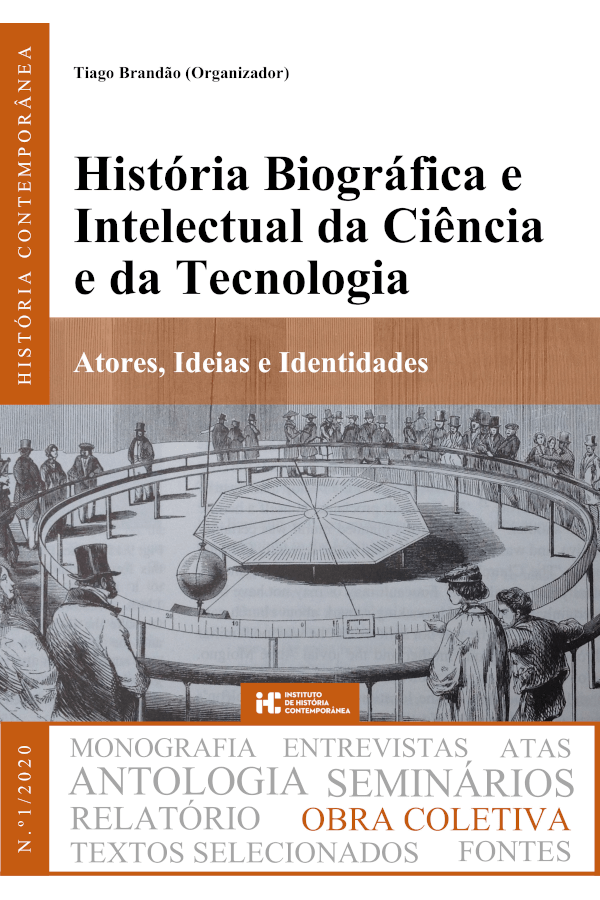
- História Biográfica e Intelectual da Ciência e da Tecnologia: Atores, Ideias e Identidades [Biografical and Intelectual History of Science and Tecnology: Actors, Ideas, and Identities]
- Tiago Brandão (Org.)
- 2020
- Lisbon: Instituto de História Contemporânea | Colecção E-IHC
- Language: Portuguese
- ISBN: 978-989-8956-19-4
- 313-330 p.
Excerpt:
Friedrich August Von Hayek nasceu em Viena, em 1899, no seio de uma família aristocrática repleta de intelectuais: o pai, August, era médico e botânico, enquanto o seu avô materno, Franz Von Juraschek, era economista, e o avô paterno, Gustav von Hayek, biólogo (Ebenstein 2001). Após ter servido como voluntário no exército austro-húngaro durante a I Guerra Mundial, Hayek decidiu prosseguir os seus estudos avançados na Universidade de Viena, onde se doutorou em Direito (1921) e em Ciência Política (1923). Foi nesse período que se sentiu atraído pelo Liberalismo, em grande parte devido à influência intelectual de Ludwig von Mises, com quem fundaria, em 1927, o Österreichisches Institut für Wirtschaftsforschung (Instituto Austríaco para a Pesquisa dos Ciclos Económicos). O seu trabalho enquanto economista atraiu a atenção de Lionel Robbins (Reitor da London School of Economics [LSE]), que o convidou a lecionar naquela escola em 1931. Hayek viria a trocar a LSE pela Universidade de Chicago em 1950 (integrando o Committee on Social Thought, diretamente financiado pelo Volker Fund), para se estabelecer mais tarde na Universidade de Freiburg entre 1962 e 1968, e na Universidade de Salzburgo entre 1969 e 1977, antes de regressar a Freiburg, onde trabalhou até ao fim da sua vida (Jones 2012, 57-84).
About the book:
Este livro de contributos vários percorre século e meio de ideias e autores, por via de uma aproximação biográfica, metodologia comum a todos os colaboradores, em que é possível termos assim uma medida interessante dos temas e desafios que condicionaram a implantação da modernidade científica (e técnica) em Portugal.
Other Publications
Search
Events
setembro, 2020
Tipologia do Evento:
Todos
Todos
Colloquium
Conference
Conference
Congress
Course
Cycle
Debate
Exhibition
Launch
Lecture
Meeting
Movie session
Open calls
Opening
Other
Presentation
Round table
Seminar
Showcase
Symposium
Tour
Workshop
- Event Name
seg
ter
qua
qui
sex
sab
dom
-
1
2
3
4
5
6
7
8
9
10
11
12
13
14
15
16
17
18
19
20
21
22
23
24
25
26
27
28
29
30

Detalhes do Evento
[POSTPONED to 2021] A conference concerned with exploring what geospatial technologies such as Geographical Information Systems have to contribute to humanities research. Deadline: 28 February 9 March 2020 Spatial
Ver mais
Detalhes do Evento
[POSTPONED to 2021] A conference concerned with exploring what geospatial technologies such as Geographical Information Systems have to contribute to humanities research. Deadline: 28 February 9 March 2020
Spatial Humanities 2020
We are delighted to announce that the third in the series of Spatial Humanities conferences will be held in Lisbon, 24-25th September 2020. Spatial Humanities 2020 is concerned with exploring what geospatial technologies such as Geographical Information Systems (GIS) have to contribute to humanities research. The main aim is to explore and demonstrate the contributions to knowledge enabled by these technologies, approaches and methods within and beyond the digital humanities. We welcome submissions on all aspects of using geospatial technologies in humanities research, including database development, methodological innovation and applied research that develops our understanding of the geographies of the past.
We welcome contributions from all humanities disciplines including (but not limited to) history (including fields from social science history such as historical demography and environmental history), archaeology, literary studies, classics, linguistics, art history, anthropology and religious studies, as well as from technical fields including GISc, digital humanities, computational linguistics and computer science. Contributions from PhD students are encouraged and bursaries are available (see below). Non-speaking participants are also welcome.
Keynote speakers:
Katrina Navickas, Department of History, University of Hertfordshire
Barbara Piatti, Basel, Switzerland
We also have a scientific committee made up of Spatial Humanities experts from across the world.
Student fee waivers: We are delighted to offer up to four student fee waivers to PhD students who are sole or lead authors of a paper. Applications will be considered by the Scientific Committee on the basis of the quality of the abstract. To apply simply check the appropriate box on the conference abstract submission form.
How to participate: Submissions can be complete sessions or individual papers. A session will usually have three or four papers and a chair. Other formats are also welcome. Individual papers will be assigned to sessions by the scientific committee. To submit, please use the abstract submission form, including an abstract of up to 250 words for each paper.
Deadline for abstracts: 28 February 2020. 9 March 2020
Notification of acceptance: 31 March 2020.
Venue: NOVA FCSH venue in Campolide is easily accessible from Lisbon International Airport, and from there using the Metro red line. In 20 minutes, you can reach São Sebastião station and from there a 15 minutes’ walk will take you to NOVA FCSH campus and Almada Negreiros College (CAN). For more information click here.
Costs: Full registration including teas & coffees and lunch on both days, plus the conference dinner on the 24th, costs €195, reduced to €95 for students. Day rates are €110 (full) and €55 (student) respectively. Accommodation is available in the city and should be booked separately once papers have been accepted.
| 📎 Download a conference flyer | 🔗 Submit an abstract |
Contact details for informal enquiries: spatialhum@lancaster.ac.uk
Conference Organisers:
Daniel Alves, Institute of Contemporary History — NOVA School of Social Sciences and Humanities
Ian Gregory, Digital Humanities Hub, Lancaster University
Scientific Committee:
David Bodenhamer, Indiana University – Purdue University Indianapolis
Isabelle Devos, Universiteit Gent
Tiffany Earley-Spadoni, University of Central Florida
Ruth Mostern, University of Pittsburgh
Patricia Murrieta-Flores, Lancaster University
Enrique Santos Unamuno, Universidad de Extremadura
Luís Espinha da Silveira, Universidade NOVA de Lisboa
Tempo
setembro 24 (Quinta-feira) - 25 (Sexta-feira)
Organizador
Digital Humanities Lab — Institute of Contemporary History — NOVA FCSH and Digital Humanities Hub — Lancaster University

Detalhes do Evento
Back from a Summer break, a new session of the book club organised by the IHC in partnership with the FCSH History students Group. Session dedicated to a book that
Ver mais
Detalhes do Evento
Back from a Summer break, a new session of the book club organised by the IHC in partnership with the FCSH History students Group. Session dedicated to a book that crosses literature, society, and politics, using Angola and Pepetela as a case study.
Através dos Livros #11:
Angola Imaginada. Nação, Guerra e Utopia na Ficção de Pepetela (1971-1996)
Após uma pausa estival, regressam as nossas sessões mensais, por ora virtuais e acessíveis a qualquer parte do mundo, uma vez que marcamos encontro no Canal YouTube do IHC.
A convidada da décima-primeira sessão é Alexandra Santos, que apresentará o seu livro, Angola Imaginada. Nação, Guerra e Utopia na Ficção de Pepetela (1971-1996) (Imprensa de Ciências Sociais, 2019). Os comentários estarão a cargo de Phillip Rothwell (Universidade de Oxford) e Ana Martinho (CHAM — NOVA FCSH) e a moderação será de Pedro Aires Oliveira.
Como é habitual, os participantes poderão colocar questões através do chat no nosso canal YouTube.
Sobre o ciclo:
Num momento em que os sistemas de avaliação universitários tendem cada vez mais a premiar o artigo em revistas especializadas, queremos com esta iniciativa sublinhar a importância do livro (e da monografia em particular) como veículo por excelência para a difusão do saber histórico e, também, para o debate de ideias.
Neste espaço de discussão, daremos prioridade a obras recentes que correspondam a investigações originais e/ou sínteses que se proponham a desafiar ou rever paradigmas vigentes.
Tempo
(Quinta-feira) 3:30 pm - 5:00 pm
Organizador
Institute of Contemporary History and the NOVA FCSH History Students
News
The Year of the Death of Ricardo Reis debuts with ‘help’ from the IHC
Sep 15, 2020
The film O Ano da Morte de Ricardo Reis had Pedro Aires Oliveira and Quintino Lopes as historical consultants.
IHC strengthens research into forced workers in Nazi Germany
Jul 17, 2020
Two new projects, one European and one national, will be a significant stimulus to research into forced labour in Nazi camps.
Helena da Silva is collecting memories of the pandemic in Portugal
Jul 10, 2020
Today we launched the project Memória COVID, which aims to document the ongoing pandemic through personal testimonies.
CONTACTS
WORKING HOURS