“Qual é o valor da tua ferramenta?”
Feb 19, 2021 | Chapters, Publications

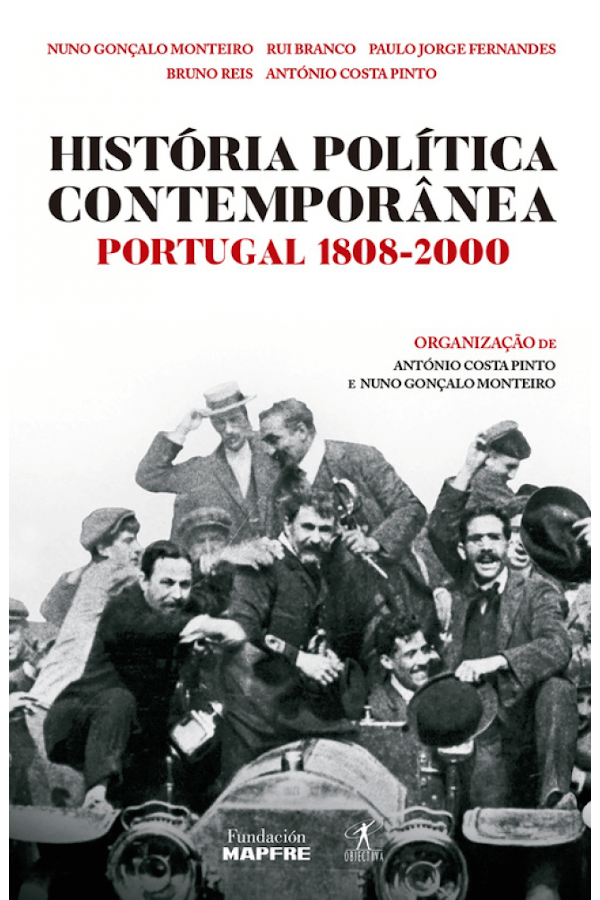
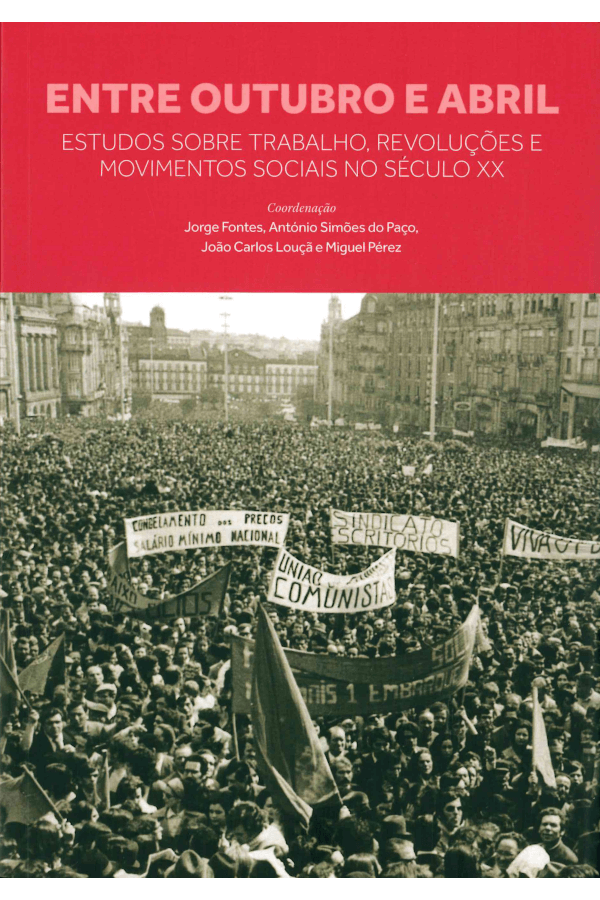
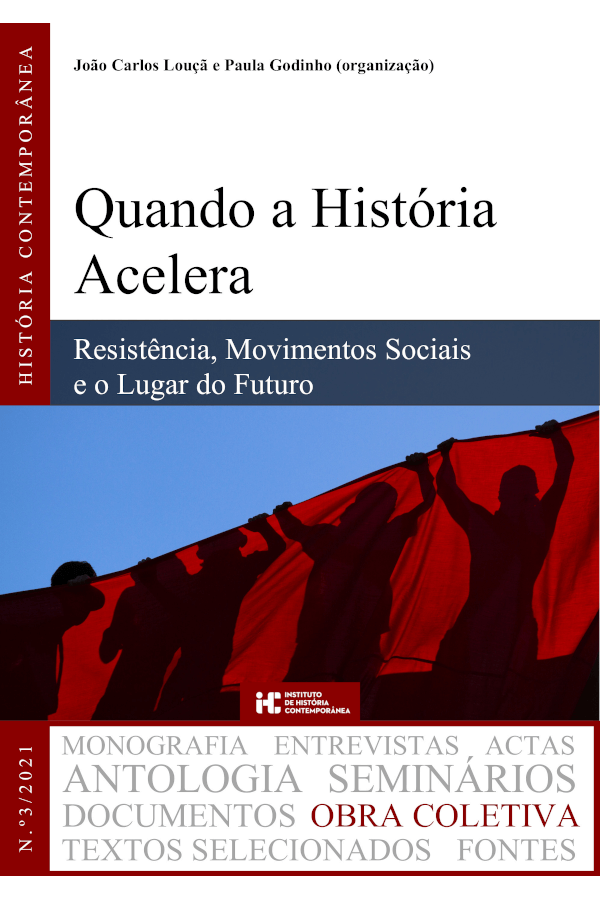
“Qual é o valor da tua ferramenta?” Economia política e conflitos sociais durante o PREC (1974-75) [“What is the value of your tool?” Political economy and social conflicts during PREC (1974-75)]
- Ricardo Noronha
- Quando a História Acelera. Resistência, movimentos sociais e o lugar do futuro [When History Accelerates. Resistance, social movements, and the place of the future]
- João Carlos Louçã e Paula Godinho (Orgs.)
- 2021
- Lisbon: Instituto de História Contemporânea | Colecção E-IHC
- Language: Portuguese
- ISBN: 978-989-8956-231
- 38-55 p.
Excerpt:
É bem conhecida a máxima de Frederic Jameson (1994), segundo a qual se tornou mais fácil imaginar o fim do mundo do que o fim do capitalismo. Este diagnóstico encontrou um sólido ponto de ancoragem nos acontecimentos que puseram fim ao “Socialismo Real” na Europa do Leste. Para lá dos seus efeitos geopolíticos, a queda do Muro de Berlim e o colapso da União Soviética contribuíram para reforçar a ideia de que a propriedade privada e a competição correspondem à ordem natural das coisas. Data de então a tese de Francis Fukuyama (1989), segundo a qual o Liberalismo se teria convertido no derradeiro estágio da evolução política, para lá do qual se tornaria impensável imaginar senão um retrocesso para formas menos dinâmicas e mais coercivas de organizar a vida social. E, ainda que não faltem declarações em sentido contrário, o facto é que a ideia de “fim da história” parece ter ganho raízes profundas, tanto à direita como à esquerda, no seio da qual se discute intensamente a melhor forma de gerir o capitalismo, mas raramente se descortina a veleidade de o substituir por outra coisa qualquer..
About the book:
Nesta obra, vários autores foram convidados a olhar para momentos do tempo em que, como escreveu Galeano, chove de baixo para cima. A partir de várias formações disciplinares, os investigadores que responderam ao repto olham para o tempo comum, para o dia anterior, para as rotinas que corroem, mas que também permitem sobreviver, para os fluxos de gente que se movimenta à procura de uma vida melhor, para a conquista da cidade e do espaço de reconhecimento, para as margens da vida, com as pequenas histórias das personagens secundárias, dos sobreviventes, dos subversivos, dos indígenas, daqueles que em narrativa estranha são entendidos como falhados, incompletos, fadados ao fracasso, irrelevantes. Conjugar o tempo longo, através da memória, do arquivo, da fotografia e da literatura, é um exercício a partir de um dado presente, num tempo de pandemia em que a duração parece ter coagulado. Contudo, convém retirar o tempo forte do baú, e escapar das debilidades presentistas do fim da história, do presente contínuo em que tudo parece confundir-se. A tanto nos propusemos, com esta obra destinada a interrogar os momentos de aceleração da história, os que os precedem e o lastro num tempo longo.
Other Publications
Search
Events
abril, 2026
Tipologia do Evento:
Todos
Todos
Colloquium
Conference
Conference
Congress
Course
Cycle
Debate
Exhibition
Launch
Lecture
Meeting
Movie session
Open calls
Opening
Other
Presentation
Round table
Seminar
Showcase
Symposium
Tour
Workshop
- Event Name
seg
ter
qua
qui
sex
sab
dom
-
-
1
2
3
4
5
6
7
8
9
10
11
12
13
14
15
16
17
18
19
20
21
22
23
24
25
26
27
28
29
30

Detalhes do Evento
Research seminar that seeks to expand the field of oil studies beyond established narratives, geographies, and disciplinary boundaries, amplifying perspectives from the Global South and other sites of extraction and
Ver mais
Detalhes do Evento
Research seminar that seeks to expand the field of oil studies beyond established narratives, geographies, and disciplinary boundaries, amplifying perspectives from the Global South and other sites of extraction and resistance.
Mind the Gap III:
Unearthing Petromodernity: Oil Studies in the Anthropocene
Online Research Seminar
The rise of fossil fuels has been central to the political, economic, cultural, and material transformations of the past two centuries, yet the forms of power, knowledge, and life enabled by carbon energy often remain analytically invisible. As we confront the converging crises of the Anthropocene, the need to rethink the centrality of fossil fuels to modern life has never been more urgent.
At a moment when toxic landscapes, resource frontiers, and environmental inequality reveal the uneven geographies of fossil modernity, the humanities and social sciences are reorienting analytical attention toward the energetic foundations of modern life. From pipelines and refineries to plastics and everyday petrochemical products, the material properties of oil have fundamentally shaped modern infrastructures and forms of life. What forms of political and social power are created through fossil fuel industries? How have fossil fuels shaped modern societies, their economic models, governmental regimes, everyday lives? How have they contributed to uneven global geographies rooted in colonialism and capitalism? What kinds of transitions to post-carbon futures are possible?
Bringing together approaches from history, anthropology, political ecology, and geography, we seek to expand the field of oil studies beyond established narratives, geographies, and disciplinary boundaries, amplifying perspectives from the Global South and other sites of extraction and resistance.
📎 Download full programme (PDF)
Programme:
Every fortnight we will meet online to discuss an article or book chapter circulated in advance. The sessions will start with a 20–30 minute presentation, followed by discussion. The sessions will take place on Mondays at 2PM.
We will explore key concepts such as petro-culture, carbon democracy, extractivism, fossil capital, energy regimes, and transition imaginaries, examining how energy dependence shapes modern subjectivities, infrastructures, economies, and ecological futures. The texts will be shared with participants in advance.
Everyone is welcome.
To register, please fill out the online form. After registering you will receive the readings and access information ahead of each session.
For more information, please write to unearthingpetromodernity@proton.me.
30 March | Timothy Mitchell, Carbon Democracy: Political Power in the Age of Oil. Selected chapter TBA (Verso, 2011)
Davide Scarso (CIUHCT — FCT NOVA)
Focus: How fossil fuels structured democratic politics, labour power and modern governance
13 April | Adam Hanieh, “Petrochemical Empire: The Geo-Politics of Fossil-Fuelled Production“ New Left Review (139)
Ricardo Noronha (IHC — NOVA FCSH / IN2PAST)
Focus: Global production networks, the Gulf region and the restructuring of capitalism through petrochemicals
27 April | Carola Hein (ed.), Oil Spaces: Exploring the Global Petroleumscape. Chapter 8: Peyerl, D. “Building Brazil’s Petroleumscape on Land and Sea: Infrastructure, Expertise, and Technology” (Routledge, 2022)
Henrique Oliveira (IHC — NOVA FCSH / IN2PAST)
Focus: Infrastructure, territorial development and the spatial materiality of oil
11 May | Stephanie LeMenager, Living Oil: Petroleum Culture in the American Century. Selected chapter TBA (Oxford University Pres, 2014)
Raquel Ribeiro (CHAM — NOVA FCSH)
Focus: Oil, media, culture, and everyday life in twentieth-century society
25 May | Appel, Mason & Watts (Eds.), Subterranean Estates: Life Worlds of Oil and Gas. Introduction: “Oil Talk” (Cornell University Press, 2015)
Amedeo Policante (IHC — NOVA FCSH / IN2PAST)
Focus: Anthropological and political-economic perspectives on oil extraction and everyday life
8 June | Alice Mah, Petrochemical Planet: Multiscalar Battles of Industrial Transformation. Chapter 2: “Enduring Toxic Injustice and Fenceline Mobilizations” (Duke University Press, 2023)
João Pedro Santos (IHC — NOVA FCSH / IN2PAST)
Focus: Environmental justice, pollution, and grassroots activism around petrochemical industries
22 June | Chelsea Schields, Offshore Attachments: Oil and Intimacy in the Caribbean. Introduction and Chapter 1. “Crude Bargains” (University of California Press, 2023)
Anita Buhin (IHC — NOVA FCSH / IN2PAST)
Focus: Oil economies, intimacy, and social relations in offshore extraction zones
6 July | Tim Di Muzio & Matt Dow, “Global capitalism and oil“ in Handbook on Oil and International Relations (Edward Elgar Publishing , 2022)
Davide Scarso (CIUHCT — FCT NOVA), Amedeo Policante & Ricardo Noronha (IHC — NOVA FCSH / IN2PAST)
Focus: Oil in international relations, financialization and the structure of global capitalism
Organisation:
Davide Scarso (CIUHCT — FCT NOVA)
Amedeo Policante (IHC — NOVA FCSH / IN2PAST)
Ricardo Noronha (IHC — NOVA FCSH / IN2PAST)
Tempo
(Segunda-feira) 2:00 pm - 4:00 pm
Localização
Link to be provided to registered participants
Zoom
Organizador
Institute of Contemporary History — NOVA School of Social Sciences and Humanities and Interuniversity Center for the History of Science and Technology
News
Diogo Ramada Curto — In Memoriam
Apr 13, 2026
Statement of condolence from the IHC Board
Paula Albuquerque in exhibition in Amsterdam
Apr 10, 2026
The exhibition Eye(s) Open opened at the Eye Filmuseum
FILMASPORA team holds a workshop in Cape Verde
Apr 1, 2026
Members of the FILMASPORA project team were in Praia for the Project’s First Workshop on Radical Creative Writing
CONTACTS
WORKING HOURS