Augusto P. Celestino da Costa
Aug 25, 2020 | Chapters, Publications

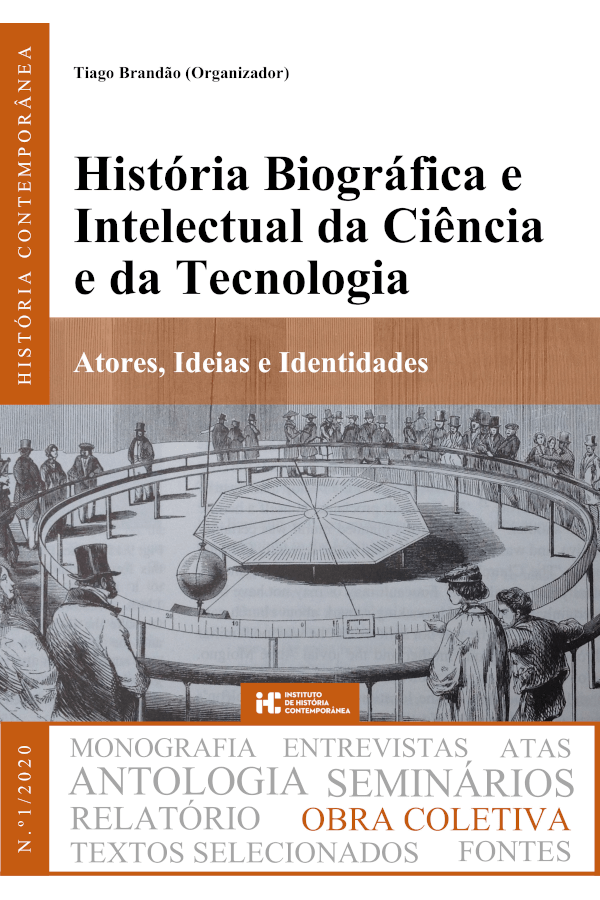
Augusto P. Celestino da Costa (1884-1956): Visões de política na organização da ciência em Portugal [Augusto P. Celestino da Costa (1884-1956): Policy visions in the organisation of science in Portugal]
- Tiago Brandão
- História Biográfica e Intelectual da Ciência e da Tecnologia: Atores, Ideias e Identidades [Biografical and Intelectual History of Science and Tecnology: Actors, Ideas, and Identities]
- Tiago Brandão (Org.)
- 2020
- Lisbon: Instituto de História Contemporânea | Colecção E-IHC
- Language: Portuguese
- ISBN: 978-989-8956-19-4
- 225-252 p.
Excerpt:
A ideia de “visões de política” remete para uma dimensão pouco explorada pelo género biográfico, sobretudo quando aplicado à história da ciência ou à expansão das suas fronteiras “internatlistas.” Largamente explorado no âmbito da história intelectual e das ideias, é uma das áreas da história com preceitos disciplinares bem definidos e consagrados na obra de autores reconhecidos (Skinner 2002). A noção de visões políticas, associadas à Ciência e à Tecnologia, é uma característica da empresa tecnocientífica, senão desde os seus primórdios, mas indiscutivelmente visível ao longo do século XX (Cholakov 2000). A ideia de visões políticas, enquanto um olhar que permite valorizar uma dimensão da atividade humana, é algo que nos parece rico, prenhe de potencialidades para olharmos algumas individualidades da nossa história da ciência. É isso que se fez aqui, relativamente ao cientista Augusto P. Celestino da Costa, valorizando uma dimensão da sua obra que normalmente não surge suficientemente analisada..
About the book:
Este livro de contributos vários percorre século e meio de ideias e autores, por via de uma aproximação biográfica, metodologia comum a todos os colaboradores, em que é possível termos assim uma medida interessante dos temas e desafios que condicionaram a implantação da modernidade científica (e técnica) em Portugal.
Other Publications
Search
Events
abril, 2026
Tipologia do Evento:
Todos
Todos
Colloquium
Conference
Conference
Congress
Course
Cycle
Debate
Exhibition
Launch
Lecture
Meeting
Movie session
Open calls
Opening
Other
Presentation
Round table
Seminar
Showcase
Symposium
Tour
Workshop
- Event Name
seg
ter
qua
qui
sex
sab
dom
-
-
1
2
3
4
5
6
7
8
9
10
11
12
13
14
15
16
17
18
19
20
21
22
23
24
25
26
27
28
29
30

Detalhes do Evento
The RESONANCE Reading Group is a monthly encounter of the wider academic community of the project RESONANCE invested in thinking-with one key text or book a month. RESONANCE Reading
Ver mais
Detalhes do Evento
The RESONANCE Reading Group is a monthly encounter of the wider academic community of the project RESONANCE invested in thinking-with one key text or book a month.
RESONANCE Reading Group
Session #4: Independent Music Theatre in Berlin, by Martina Stütz
The RESONANCE Reading Group is a monthly meeting that brings together members of the academic community, colleagues, friends, and enthusiasts of contemporary cultural history to reflect on and discuss a fundamental text or book. It is part of the project RESONANCE — Epistemologies for the Documentation of Affect and Becoming in Cultural Manifestations in Performance (1969-1979). This group meets in person at NOVA FCSH or online, during lunchtime on a weekday. Each participant brings their own lunch, and for in-person sessions, coffee and biscuits are kindly provided by the project.
The fourth session of the RESONANCE Reading Group focuses on the chapter “Independent Music Theatre in Berlin: Breaking Out of Traditional Discourses and Building New Structures,” by Martina Stütz. This chapter traces the development of independent musical-theatre in Berlin since the 1990s, drafting its ecologies of practice through forms of diversity and interdisciplinarity. It demonstrates some of the ways in which these nodes expand into the creation of production and collaboration networks, affirming musical theatre as a multimodal hybrid practice. In doing so, however, it expands this medium’s formal currency into paradox: how can such a capacious, vibrant, networked set of manifestations still be so scattered, fragmented, and invisible within institutional circuits? This reading group is going to be led by Filipa Magalhães (CESEM — NOVA FCSH / IN2PAST).
You can register by emailing Hélia Marçal at heliamarcal@fcsh.unl.pt, to receive an online meeting link and a PDF copy of the chapter.
More information about the RESONANCE project here.
This event is part of the RESONANCE’s Spring Seminar Series. Public events will also include the Seminar Performing the Archive, led by the curator and scholar Paula Parente Pinto, which will take place on the same day, April 29, at 6 PM, Auditorium B1 (Tower B), NOVA School of Social Sciences and Humanities.
Picture: Persimmon, axial view, MRI. Alexandr Khrapichev, University of Oxford. Source: Wellcome Collection, United Kingdom (CC BY)
The RESONANCE project is supported by the Programa Regional Lisboa 2030, Portugal 2030 and the European Union (LISBOA2030-FEDER-00914500). This work is also co-funded by national funds through FCT – Fundação para a Ciência e a Tecnologia, I.P., under the reference 2023.17624.ICDT (DOI: https://doi.org/10.54499/2023.17624.ICDT).
Tempo
(Quarta-feira) 12:30 pm - 2:00 pm
Organizador
Institute of Contemporary History, IHA, CESEM, ICNOVA e IFILNOVA — NOVA FCSH
News
Pedro Cerdeira, winner of the Amílcar Cabral Prize, in Lisbon
Apr 28, 2026
He will take part in the event ‘Desconstruir o Colonialismo: Entre Tradição e Revolução’
Fernando Rosas: an actor in the history he studied
Apr 23, 2026
‘It is very important to keep the history of democracy in Portugal very much in the public consciousness’
Diogo Ramada Curto — In Memoriam
Apr 13, 2026
Statement of condolence from the IHC Board
CONTACTS
WORKING HOURS