Iberians against locusts
Apr 5, 2019 | Papers, Publications

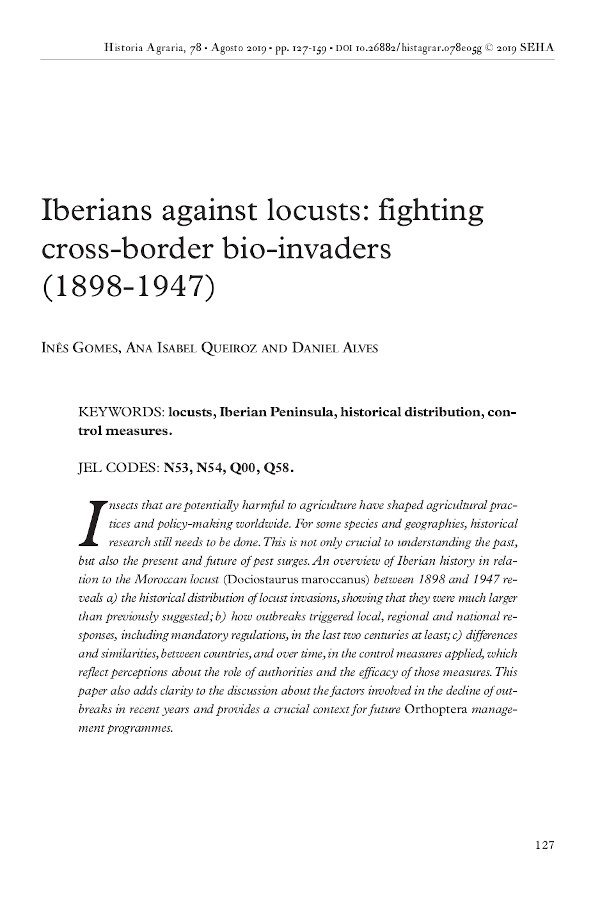
Iberians against locusts: fighting cross-border bio-invaders (1898-1947)
- Inês Gomes, Ana Isabel Queiroz & Daniel Alves
- 2019
- Historia Agraria
- Volume 78
- 127-159
- Language: English
- DOI: https://doi.org/10.26882/histagrar.078e05g
- ISSN: 1139-1472 / 2340-3659 (online)
Insects that are potentially harmful to agriculture have shaped agricultural practices and policy-making worldwide. For some species and geographies, historical research still needs to be done. This is not only crucial to understanding the past, but also the present and future of pest surges. An overview of Iberian history in relation to the Moroccan locust (Dociostaurus maroccanus) between 1898 and 1947 reveals a) the historical distribution of locust invasions, showing that they were much larger than previously suggested; b) how outbreaks triggered local, regional and national responses, including mandatory regulations, in the last two centuries at least; c) differences and similarities, between countries, and over time, in the control measures applied, which reflect perceptions about the role of authorities and the efficacy of those measures. This paper also adds clarity to the discussion about the factors involved in the decline of outbreaks in recent years and provides a crucial context for future Orthoptera management programmes.
Key-words:
locusts, Iberian Peninsula, historical distribution, control measures.
Other Publications
Search
Events
maio, 2026
Tipologia do Evento:
Todos
Todos
Colloquium
Conference
Conference
Congress
Course
Cycle
Debate
Exhibition
Launch
Lecture
Meeting
Movie session
Open calls
Opening
Other
Presentation
Round table
Seminar
Showcase
Symposium
Tour
Workshop
- Event Name
seg
ter
qua
qui
sex
sab
dom
-
-
-
-
1
2
3
4
5
6
7
8
9
10
11
12
13
14
15
16
17
18
19
20
21
22
23
24
25
26
27
28
29
30
31

Detalhes do Evento
Open lecture by Tommaso di Carpegna Falconieri, Visiting Researcher at the IHC, on medieval studies, the Middle Ages and their reception in later periods. Medievalism as Method: Reframing the
Ver mais
Detalhes do Evento
Open lecture by Tommaso di Carpegna Falconieri, Visiting Researcher at the IHC, on medieval studies, the Middle Ages and their reception in later periods.
Medievalism as Method: Reframing the Discipline of Medieval Studies
Tommaso di Carpegna Falconieri doutorou-se em História Medieval pela Universidade Católica de Milão. Desde 1998, é professor na Universidade de Urbino, onde ocupa, actualmente, o cargo de Professor Catedrático de História Medieval. Os seus principais temas de investigação são a história de Roma, da Igreja Romana e da Itália Central na Idade Média, com um foco específico nas fontes históricas e nas relações entre o facto histórico e a sua representação no imaginário. Actualmente, os seus interesses focam-se também nas representações da Idade Média após a Idade Média, os chamados medievalismos. Sobre este assunto publicou o livro intitulado Medioevo militante (Einaudi), também traduzido para espanhol (El presente medieval, Icaria), para francês (Médiéval et militante, Publications de la Sorbonne) e para inglês (The Militant Middle Ages, Brill). As suas publicações mais recentes incluem: Nel labirinto del passato. 10 modi di riscrivere la storia (Laterza, 2020); Cola di Rienzo (Salerno Editrice, 2024); La Storia al contrario (Salerno editrice, 2025).
Esta aula aberta é destinada a todas/os as/os estudantes e aqueles/as interessadas/os na Idade Média e a sua recepção em épocas posteriores.
A iniciativa é organizada pelo Instituto de Estudos Medievais e o Instituto de História Contemporânea da NOVA FCSH.
Tempo
(Quarta-feira) 6:00 pm - 8:00 pm
Organizador
Institute of Contemporary History and Institute for Medieval Studies — NOVA School of Social Sciences and Humanities

Detalhes do Evento
Victor Pereira’s new book, an updated overview of the Portuguese revolutionary process, is to be launched at the Institut Français du Portugal, in conversation with Rita
Ver mais
Detalhes do Evento
Victor Pereira’s new book, an updated overview of the Portuguese revolutionary process, is to be launched at the Institut Français du Portugal, in conversation with Rita Rato.
O povo é quem mais ordena. A revolução dos cravos 1974-1976
Mais do que o derrube de uma ditadura pelo exército, a Revolução dos Cravos desencadeou uma profunda transformação económica, social, cultural e democrática em Portugal. Em 25 de Abril de 1974, jovens oficiais, apoiados por uma grande parte da população, derrubaram o Estado Novo, regime autoritário instaurado por António de Oliveira Salazar em 1933. A queda desta ditadura com mais de quarenta anos precipitou também o fim de um dos principais impérios coloniais europeus. O Povo é Quem mais Ordena aborda não só a dinâmica revolucionária, as tensões entre os partidos políticos e os militares e os receios diplomáticos internacionais que a revolução provocou, mas também os diferentes movimentos sociais que tentaram transformar radicalmente a sociedade portuguesa. Trata-se de uma síntese actualizada sobre o processo revolucionário português, que pensa em conjunto elementos que raramente são analisados de forma integrada.
Mais informações sobre o livro
Tempo
(Quarta-feira) 7:00 pm - 8:00 pm
Organizador
Institut Français du Portugal and Fora de Jogo
News
Nuno Silas is exhibiting at MUHNAC
Apr 29, 2026
He is one of the curators of the exhibition “Olhares Críticos no Arquivo Colonial – Sombras e Memórias”
Pedro Cerdeira, winner of the Amílcar Cabral Prize, in Lisbon
Apr 28, 2026
He will take part in the event ‘Desconstruir o Colonialismo: Entre Tradição e Revolução’
Fernando Rosas: an actor in the history he studied
Apr 23, 2026
‘It is very important to keep the history of democracy in Portugal very much in the public consciousness’
CONTACTS
WORKING HOURS