
Alien Plant Species
Alien Plant Species: Environmental Risks in Agricultural and Agro-Forest Landscapes Under Climate Change
- Joana R. Vicente, Ana Sofia Vaz, Ana Isabel Queiroz, Ana R. Buchadas, Antoine Guisan, Christoph Kueffer, Elizabete Marchante, Hélia Marchante, João A. Cabral, Maike Nesper, Olivier Broennimann, Oscar Godoy, Paulo Alves, Pilar Castro-Díez, Renato Henriques & João P. Honrado
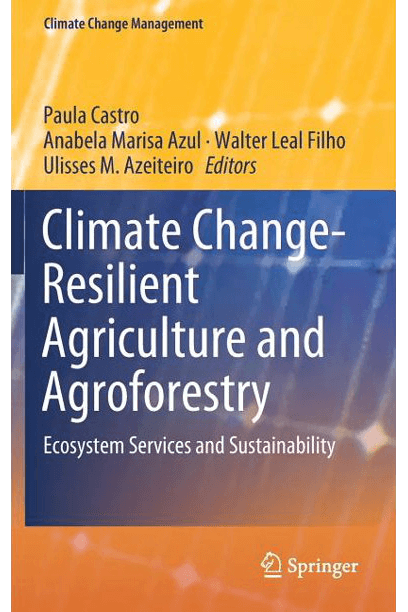
- Climate Change-Resilient Agriculture and Agroforestry
- Paula Castro, Anabela Marisa Azul, Walter Leal Filho & Ulisses M. Azeiteiro (Eds.)
- 2019
- Basel: Springer
- Language: English
- ISBN: 978-3-319-75003-3 / 978-3-319-75004-0 (online)
- DOI: https://doi.org/10.1007/978-3-319-75004-0_13
- 215-234 p.
Alien plant species have been essential for farming and agro-forestry systems and for their supply of food, fiber, tannins, resins or wood from antiquity to the present. They also contributed to supporting functions and regulating services (water, soil, biodiversity) and to the design of landscapes with high cultural and scenic value. Some of those species were intentionally introduced, others arrived accidentally, and a small proportion escaped, naturalized and became invasive in natural ecosystems—these are known as invasive alien species (IAS). Here, invasive means that these species have some significant negative impact, either by spreading from human-controlled environments (e.g. fields, gardens) to natural ecosystems, where they can cause problems to native species, or to other production systems or urban areas, impacting on agricultural, forestry activities or human health. Socio-environmental impacts associated with plant invasions have been increasingly recognized worldwide and are expected to increase considerably under changing climate or land use. Early detection tools are key to anticipate IAS and to prevent and control their impacts. In this chapter, we focus on crop and non-crop alien plant species for which there is evidence or prediction of invasive behaviour and impacts. We provide insights on their history, patterns, risks, early detection, forecasting and management under climate change. Specifically, we start by providing a general overview on the history of alien plant species in agricultural and agroforestry systems worldwide (Sect. 1). Then, we assess patterns, risks and impacts resulting from alien plants originally cultivated and that became invasive outside cultivation areas (Sect. 2). Afterwards, we provide several considerations for managing the spread of invasive plant species in the landscape (Sect. 3). Finally, we discuss challenges of alien plant invasions for agricultural and agroforest systems, in the light of climate change (Sect. 4).
About the book:
This book collects wide-ranging contributions such as case studies, reviews, reports on technological developments, outputs of research/studies, and examples of successful projects, presenting current knowledge and raising awareness to help the agriculture and forestry sectors find solutions for mitigating climate variability and adapting to change. It brings the topic of ecosystem services closer to education and learning, as targeted by the Framework Convention on Climate Change and the Paris Agreement, the 2030 Agenda for Sustainable Development and the EU Biodiversity Strategy to 2020. Climate change and its impacts on agriculture and agroforestry have been observed across the world during the last 50 years. Increasing temperatures, droughts, biotic stresses and the impacts of extreme events have continuously decreased agroforestry systems’ resilience to the effects of climate change. As such, there is a need to adapt farming and agroforestry systems so as to make them better able to handle ever-changing climate conditions, and to preserve habitats and ecosystems services.
Other publications


































































Search
Events
maio, 2026
seg
ter
qua
qui
sex
sab
dom
-
-
-
-
1
2
3
4
5
6
7
8
9
10
11
12
13
14
15
16
17
18
19
20
21
22
23
24
25
26
27
28
29
30
31


News
Nuno Silas is exhibiting at MUHNAC
He is one of the curators of the exhibition “Olhares Críticos no Arquivo Colonial – Sombras e Memórias”
Pedro Cerdeira, winner of the Amílcar Cabral Prize, in Lisbon
He will take part in the event ‘Desconstruir o Colonialismo: Entre Tradição e Revolução’
Fernando Rosas: an actor in the history he studied
‘It is very important to keep the history of democracy in Portugal very much in the public consciousness’