
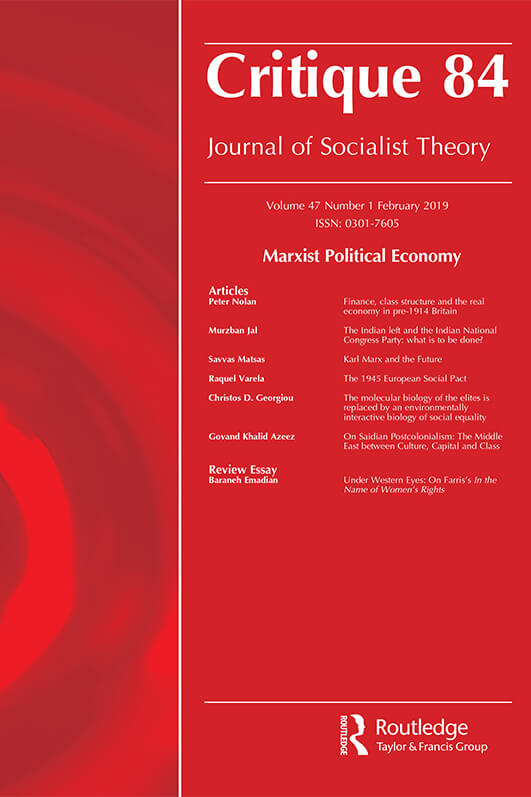
The 1945 European Social Pact
The 1945 European Social Pact
- Raquel Varela
- 2019
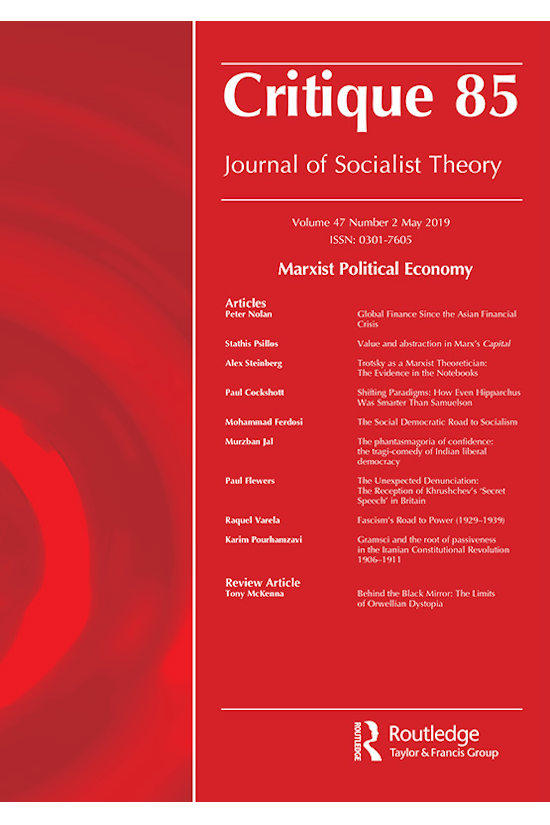
- Critique — Journal of Socialist Theory
- Volume 47, Issue 1
- 71-88 p.
- Language: English
- DOI: https://doi.org/10.1080/03017605.2018.1554759
- ISSN: 0301-7605 / 1748-8605 (online)
Among the dominant theses of the neoliberal period, exacerbated by the crisis of 2008, is that the European Union would be the builder of the European Social State. In fact, the consolidation of the European Union implied the destruction of the Welfare State. The European Social State was born robust in 1945–1947, ten years before the European Coal and Steel Community (later European Economic Community and the European Union). The EU was consolidated only in the 1980s, after several crises and periods of instability. At the time the EU was brought together, the Social State had begun to enter a crisis, albeit a gradual one. The EU will play a decisive role, through the European Social Fund and the Community Directives, in replacing the Social State (universal policies based on progressive taxation) by Social Assistance (policies focused on the unemployed and the poor based on the transfer of workers’ income of average sectors for poor workers).
Keywords:
European Union, Welfare State, Social Pact, Neoliberalism
Other publications










































































Search
Events
outubro, 2026
seg
ter
qua
qui
sex
sab
dom
-
-
-
1
2
3
4
5
6
7
8
9
10
11
12
13
14
15
16
17
18
19
20
21
22
23
24
25
26
27
28
29
30
31


News
History is at School! — IHC’s school programme for 2026/2027
The History in the Public Sphere Programme is relaunching the project this academic year
IHC to host 13 new CEEC contracts from the FCT
Six Junior Researchers and seven Assistant Researchers
IHC supports exhibition on the Spanish Civil War
The exhibition will open on 29 September at FCSH