Agenda
Calendar
september, 2026
Event Type :
All
All
Colloquium
Conference
Conference
Congress
Course
Cycle
Debate
Exhibition
Launch
Lecture
Meeting
Movie session
Open calls
Opening
Other
Presentation
Round table
Seminar
Showcase
Symposium
Tour
Workshop
- Event Name
mon
tue
wed
thu
fri
sat
sun
-
1
2
3
4
5
6
7
8
9
10
11
12
13
14
15
16
17
18
19
20
21
22
23
24
25
26
27
28
29
30

Event Details
8th edition of the IWHSCR. It will place a special emphasis on experimental phonetics as an emerging field at the intersection of the humanities, medical sciences, and engineering, which underwent
more
Event Details
8th edition of the IWHSCR. It will place a special emphasis on experimental phonetics as an emerging field at the intersection of the humanities, medical sciences, and engineering, which underwent rapid development throughout the twentieth century.
8th International Workshop on the History of Speech Communication Research
(IWHSCR)
Following its launch in Dresden in 2015, and subsequent editions in Helsinki (2017), Vienna (2019), Prague (2021), Porto (2022), Budapest (2024), and Paris (2025), the 8th edition of the IWHSCR will be organised by members of the PHONLAB project (2022.06811.PTDC), in collaboration with the Faculty of Arts and Humanities of the University of Coimbra.
This edition will place a special emphasis on experimental phonetics as an emerging field at the intersection of the humanities, medical sciences, and engineering, which underwent rapid development throughout the twentieth century. Particular attention will be given to the role of institutions, internationally engaged scientific actors, and the creation of innovative scientific spaces, technologies, and techniques.
Keynote speakers:
Ana Simões is full professor of History of Science at the Faculty of Sciences, University of Lisbon, Portugal, and member of the Centre for the History of Science and Technology (CIUHCT), which she (co-)coordinated from 2007 to 2019. She is the President-elect of the Division for the History of Science and Technology (2025–2029) – a division of the International Union for the History and Philosophy of Science and Technology (IUHPST) – and was previously the President of the European Society for the History of Science (2018–2020). She has written extensively on the history of quantum chemistry, and aspects of history of science in Portugal, 18th to 20th centuries, including popularisation of science and science and the city, framed by a historiographical reflection on the circulation of science including non-central places. She is a founding member of the international network Science and Technology in the European Periphery. She is member of several national and EU projects, editorial boards, scientific advisory boards and scientific societies.
Bernd Möbius studied phonetics, linguistics and sociology at the University of Bonn, where he also received his PhD degree in 1992. He was a member of technical staff (senior researcher) at Bell Labs in Murray Hill, NJ, from 1993 to 1998, and Assistant and Associate Professor at the University of Stuttgart from 1999 to 2011. After being Acting chair of Phonetics and Speech Communication at the University of Bonn (2007-2010), he was Full Professor of Phonetics and Phonology in the Department of Language Science and Technology at Saarland University from 2011 to 2025, where he is now a Senior Professor. A central theme of his research is to integrate phonetic knowledge in speech technology. He has worked extensively on text-to-speech synthesis and speech prosody, and recent work has focused on experimental methods and computational simulations to study aspects of speech production, perception and acquisition.
Call for papers
Contributions addressing this focus are welcome, as are submissions on any topics related to the historical aspects of speech communication research. Submissions must not exceed 10 pages (including references) and must follow the guidelines provided HERE. The proceedings will be published in the book series Studientexte zur Sprachkommunikation by TUDpress and will also be made available electronically in the ISCA archive.
Full paper submissions should be sent to the following email address: phonlab.project@gmail.com
Participation is free, but you must register in advance via this LINK.
Important dates:
Manuscript submission: 15 May 2026
Notification of acceptance: 1 June 2026
Registration: 30 June 2026
Revised manuscript submission: 1 July 2026
Organising Committee:
Albano Figueiredo, Faculty of Arts and Humanities, University of Coimbra
Ângela Salgueiro, University of Évora and IHC / IN2PAST
Jürgen Trouvain, Saarland University
Quintino Lopes, University of Évora and IHC / IN2PAST

Time
17 (Thursday) 12:00 am - 18 (Friday) 6:00 pm
Location
Faculty of Arts and Humanities — University of Coimbra
Largo da Porta Férrea — 3000-370 Coimbra
Organizer
Several Institutions

Event Details
Opening of an exhibition exploring the history of the Laboratory of Experimental Phonetics of Coimbra. An initiative of the PHONLAB project. Armando de Lacerda Wing: Laboratory of Experimental Phonetics
more
Event Details
Opening of an exhibition exploring the history of the Laboratory of Experimental Phonetics of Coimbra. An initiative of the PHONLAB project.
Armando de Lacerda Wing: Laboratory of Experimental Phonetics of Coimbra
During the 8th International Workshop on the History of Speech Communication Research (IWHSCR), participants will have the opportunity to take part in a guided visit to the exhibition Armando de Lacerda Wing: Laboratory of Experimental Phonetics of Coimbra, located on the Faculty of Arts and Humanities of the University of Coimbra.
The exhibition explores the history of phonetics in Portugal, with a particular focus on the Laboratory of Experimental Phonetics of Coimbra and its director, Armando de Lacerda. It brings together scientific instruments, archival materials, and oral testimonies to preserve and showcase the Laboratory’s legacy, offering a critical perspective on a largely overlooked chapter in twentieth-century phonetics research.

This exhibition is the result of the PHONLAB project, funded by the Foundation for Science and Technology (2022.06811.PTDC), in collaboration with the Rectorate of the University of Coimbra, its Science Museum, and Faculty of Arts and Humanities.
Time
(Thursday) 5:30 pm - 7:00 pm
Location
Faculty of Arts and Humanities — University of Coimbra
Largo da Porta Férrea — 3000-370 Coimbra
Organizer
Several Institutions
Next events
Event Details
8th edition of the IWHSCR. It will place a special emphasis on experimental phonetics as an emerging field at the intersection of the humanities, medical sciences, and engineering, which underwent
more
Event Details
8th edition of the IWHSCR. It will place a special emphasis on experimental phonetics as an emerging field at the intersection of the humanities, medical sciences, and engineering, which underwent rapid development throughout the twentieth century.
8th International Workshop on the History of Speech Communication Research
(IWHSCR)
Following its launch in Dresden in 2015, and subsequent editions in Helsinki (2017), Vienna (2019), Prague (2021), Porto (2022), Budapest (2024), and Paris (2025), the 8th edition of the IWHSCR will be organised by members of the PHONLAB project (2022.06811.PTDC), in collaboration with the Faculty of Arts and Humanities of the University of Coimbra.
This edition will place a special emphasis on experimental phonetics as an emerging field at the intersection of the humanities, medical sciences, and engineering, which underwent rapid development throughout the twentieth century. Particular attention will be given to the role of institutions, internationally engaged scientific actors, and the creation of innovative scientific spaces, technologies, and techniques.
Keynote speakers:
Ana Simões is full professor of History of Science at the Faculty of Sciences, University of Lisbon, Portugal, and member of the Centre for the History of Science and Technology (CIUHCT), which she (co-)coordinated from 2007 to 2019. She is the President-elect of the Division for the History of Science and Technology (2025–2029) – a division of the International Union for the History and Philosophy of Science and Technology (IUHPST) – and was previously the President of the European Society for the History of Science (2018–2020). She has written extensively on the history of quantum chemistry, and aspects of history of science in Portugal, 18th to 20th centuries, including popularisation of science and science and the city, framed by a historiographical reflection on the circulation of science including non-central places. She is a founding member of the international network Science and Technology in the European Periphery. She is member of several national and EU projects, editorial boards, scientific advisory boards and scientific societies.
Bernd Möbius studied phonetics, linguistics and sociology at the University of Bonn, where he also received his PhD degree in 1992. He was a member of technical staff (senior researcher) at Bell Labs in Murray Hill, NJ, from 1993 to 1998, and Assistant and Associate Professor at the University of Stuttgart from 1999 to 2011. After being Acting chair of Phonetics and Speech Communication at the University of Bonn (2007-2010), he was Full Professor of Phonetics and Phonology in the Department of Language Science and Technology at Saarland University from 2011 to 2025, where he is now a Senior Professor. A central theme of his research is to integrate phonetic knowledge in speech technology. He has worked extensively on text-to-speech synthesis and speech prosody, and recent work has focused on experimental methods and computational simulations to study aspects of speech production, perception and acquisition.
Call for papers
Contributions addressing this focus are welcome, as are submissions on any topics related to the historical aspects of speech communication research. Submissions must not exceed 10 pages (including references) and must follow the guidelines provided HERE. The proceedings will be published in the book series Studientexte zur Sprachkommunikation by TUDpress and will also be made available electronically in the ISCA archive.
Full paper submissions should be sent to the following email address: phonlab.project@gmail.com
Participation is free, but you must register in advance via this LINK.
Important dates:
Manuscript submission: 15 May 2026
Notification of acceptance: 1 June 2026
Registration: 30 June 2026
Revised manuscript submission: 1 July 2026
Organising Committee:
Albano Figueiredo, Faculty of Arts and Humanities, University of Coimbra
Ângela Salgueiro, University of Évora and IHC / IN2PAST
Jürgen Trouvain, Saarland University
Quintino Lopes, University of Évora and IHC / IN2PAST
Time
17 (Thursday) 12:00 am - 18 (Friday) 6:00 pm
Location
Faculty of Arts and Humanities — University of Coimbra
Largo da Porta Férrea — 3000-370 Coimbra
Organizer
Several Institutions
Event Details
Opening of an exhibition exploring the history of the Laboratory of Experimental Phonetics of Coimbra. An initiative of the PHONLAB project. Armando de Lacerda Wing: Laboratory of Experimental Phonetics
more
Event Details
Opening of an exhibition exploring the history of the Laboratory of Experimental Phonetics of Coimbra. An initiative of the PHONLAB project.
Armando de Lacerda Wing: Laboratory of Experimental Phonetics of Coimbra
During the 8th International Workshop on the History of Speech Communication Research (IWHSCR), participants will have the opportunity to take part in a guided visit to the exhibition Armando de Lacerda Wing: Laboratory of Experimental Phonetics of Coimbra, located on the Faculty of Arts and Humanities of the University of Coimbra.
The exhibition explores the history of phonetics in Portugal, with a particular focus on the Laboratory of Experimental Phonetics of Coimbra and its director, Armando de Lacerda. It brings together scientific instruments, archival materials, and oral testimonies to preserve and showcase the Laboratory’s legacy, offering a critical perspective on a largely overlooked chapter in twentieth-century phonetics research.
This exhibition is the result of the PHONLAB project, funded by the Foundation for Science and Technology (2022.06811.PTDC), in collaboration with the Rectorate of the University of Coimbra, its Science Museum, and Faculty of Arts and Humanities.
Time
(Thursday) 5:30 pm - 7:00 pm
Location
Faculty of Arts and Humanities — University of Coimbra
Largo da Porta Férrea — 3000-370 Coimbra
Organizer
Several Institutions
Event Details
António José Ramos's thesis, "Tuberculose. Inovações Médico-Científicas e Representações Sociais em Portugal: da década de 80 do Século XIX à década de 40 do Século XX", on the history of
more
Event Details
António José Ramos’s thesis, “Tuberculose. Inovações Médico-Científicas e Representações Sociais em Portugal: da década de 80 do Século XIX à década de 40 do Século XX”, on the history of the science advancements regarding tuberculosis in Portugal, will be defended in a public examination at the University of Évora.
Examiner panel:
Laurinda Abreu (Universidade de Évora) — President
Isabel Amaral (Universidade NOVA de Lisboa) — Member
Ângela Salgueiro (Universidade de Évora) — Member
Maria de Fátima Nunes (Universidade de Évora) — Supervisor
João Miguel Couto Duarte (Universidade Lusíada de Lisboa) — Member
João Rui Pita (Universidade de Coimbra) — Member
Time
(Tuesday) 2:30 pm - 4:30 pm
Organizer
University of Évorauevora@uevora.pt Largo dos Colegiais, 2 — 7000-803 Évora

Event Details
Second edition of the Annual Conference of the Institute of Contemporary History, which promotes the relationship between Research Groups and disseminates the IHC’s research to a wider audience. II
more
Event Details
Second edition of the Annual Conference of the Institute of Contemporary History, which promotes the relationship between Research Groups and disseminates the IHC’s research to a wider audience.
II Conferência Anual do Instituto de História Contemporânea
A Conferência Anual do IHC é um evento de dois dias, composta por vários painéis partilhados por membros dos diferentes Grupos de Investigação do Instituto. O objectivo é encontrar e desenvolver relações (a nível temático, conceptual e metodológico) entre investigadores/as e investigações de diferentes áreas, abrindo novos campos interdisciplinares e no interior da historiografia. Para além disso, a Conferência Anual procura ainda dar a conhecer o trabalho desenvolvido no IHC a um público mais vasto, desde projectos embrionários a investigações em curso, passando por exposições e outras iniciativas.
>> Descarregar o programa (PDF)
>> Descarregar o Livro de Resumos (PDF)

Time
24 (Thursday) 9:00 am - 25 (Friday) 6:00 pm
Location
Biblioteca Nacional de Portugal
Organizer
Institute of Contemporary History - NOVA FCSH and University of Évora

Event Details
A conference aiming to foster historiographical reflection and a multidisciplinary and transdisciplinary debate that situates the Saint Joseph Hospital (Lisbon) within the international dynamics of medical and scientific knowledge and
more
Event Details
A conference aiming to foster historiographical reflection and a multidisciplinary and transdisciplinary debate that situates the Saint Joseph Hospital (Lisbon) within the international dynamics of medical and scientific knowledge and the transformations of European medicine.
250 anos do Hospital de São José:
Ciência, Saúde, Ensino e Inovação
Inaugurado em Abril de 1775, o Hospital Real de São José resultou da transferência do Hospital Real de Todos-os-Santos para o antigo Colégio de Santo Antão-o-Novo. Ao longo de dois séculos e meio de actividade clínica ininterrupta, esta instituição conheceu diferentes enquadramentos administrativos e designações – inicialmente como Hospital Real de São José e Anexos, constituindo posteriormente os Hospitais Civis de Lisboa, mais tarde Centro Hospitalar Universitário Lisboa Central, reflectindo as sucessivas reformas da assistência pública e da organização hospitalar em Portugal. Actualmente, integra a Unidade Local de Saúde de São José, assegurando a continuidade de uma missão assistencial, científica e formativa iniciada no século XVIII.
No contexto das comemorações do seu 250.º aniversário, o Hospital de São José (HSJ), em parceria com o Instituto de História Contemporânea (IHC) e com o laboratório associado IN2PAST, organiza o congresso 250 anos do Hospital de São José: Ciência, Saúde, Ensino e Inovação, a realizar-se nos dias 5 e 6 de Novembro de 2026, no Salão Nobre do Hospital de São José, em Lisboa.
Com papel ímpar na História da Medicina Portuguesa, o Hospital afirmou-se como uma instituição central na assistência hospitalar portuguesa, em estreita articulação com os grandes centros médicos europeus. Inserido nas redes internacionais de circulação do conhecimento, foi receptor e difusor de inovações científicas – nas práticas clínicas, nas técnicas médicas e cirúrgicas, na organização hospitalar e nas políticas de saúde pública, acompanhando as transformações científicas, políticas e socio-culturais dos séculos XVIII, XIX e XX, tendo desempenhando um papel determinante na modernização da medicina em Portugal.
A sua dimensão formativa esteve intimamente ligada à criação da Real Escola de Cirurgia de Lisboa (1825), à fundação da Escola Médico-Cirúrgica (1836) e, em 1911, com a Primeira República, à criação da Faculdade de Medicina da Universidade de Lisboa, sua herdeira directa. Ao longo deste percurso, o Hospital destacou-se como espaço de formação e de experimentação, contribuindo para o desenvolvimento e consolidação de diversas especialidades médicas e biomédicas, bem como para a definição do perfil das profissões da área da saúde.
A história institucional do Hospital, nas suas várias configurações administrativas, reflecte amplos processos de internacionalização científica, de circulação do conhecimento e de institucionalização de modelos médicos e hospitalares. A instituição afirmou-se, assim, como um verdadeiro laboratório clínico e pedagógico, acompanhando as transformações do ensino médico e contribuindo para a integração de Portugal nas redes transnacionais da ciência e da medicina modernas.
Chamada para comunicações
Este congresso propõe uma reflexão historiográfica e um debate multidisciplinar e transdisciplinar que enquadre o Hospital nas dinâmicas internacionais do conhecimento médico e científico e nas transformações da medicina europeia. Incentiva-se, em particular, o estudo dos processos de transferência e adaptação de inovações científicas e técnicas; a recepção de influências externas; o posicionamento institucional e dos seus actores; as práticas médicas; as reformas e regulamentos sanitários; e os modelos hospitalares associados à instituição ao longo do tempo.
Convida-se todos os interessados/as a submeter propostas no âmbito dos seguintes eixos temáticos:
- Circulação e transmissão do conhecimento médico e científico
- Redes transnacionais e intercâmbios científicos e profissionais
- Espaços e actores científicos
- Inovação científica e técnica na prática hospitalar
- Formação, desenvolvimento e consolidação de áreas científicas e especialidades médicas
- O Hospital de São José no contexto internacional
- Articulação entre dinâmicas locais e correntes internacionais da medicina
- Formação e ensino numa perspetiva transnacional
- Museus e Património Histórico Hospitalar
A selecção das propostas será realizada pelos membros da Comissão Científica, sendo orientada pelo objectivo de garantir o máximo de qualidade, relevância e originalidade dos trabalhos.
As propostas de comunicação devem ter até 300 palavras e ser acompanhadas de uma breve nota biográfica do/a/s autor/a/s (máximo de 150 palavras), com indicação da afiliação institucional e contactos.
As propostas devem ser submetidas através do formulário disponível NESTE LINK.
Calendário:
Data limite de submissão: 27 Abril 2026 31 Maio 2026
Notificação de aceitação: 29 Maio 2026 30 Junho 2026
Comissão Organizadora:
Alexandra Marques, IHC – Universidade de Évora / IN2PAST
Ângela Salgueiro, Universidade de Évora / IHC / IN2PAST
Carlos Boavida, ULS São José
Fátima Palmeiro, ULS São José
Quintino Lopes, Universidade de Évora / IHC / IN2PAST

Time
november 5 (Thursday) - 6 (Friday)
Organizer
Institute of Contemporary History — University of Évora and Saint Joseph Hospital

Event Details
Aiming to raise a host of questions rather than provide the answers, the 4th Counter-Image unpacks the earth not as theme but rather as onto-episteme. Counter-Image International Conference
more
Event Details
Aiming to raise a host of questions rather than provide the answers, the 4th Counter-Image unpacks the earth not as theme but rather as onto-episteme.
Counter-Image International Conference 2026
How to speak with(in) the earth? Situated knowledges, unnaming methods, and visions of the threshold
The question “How to speak with(in) the earth?” is not a metaphor but a political, ontological, and epistemic imperative in the face of ecological collapse, the exhaustion of anthropocentric frameworks, and the representational models of the colonial-capitalist regime and its paradigm of territorial expansion and occupation—the plantation, whose logic of extraction, objectification, and extinction persists (Le Petitcorps et al. 2023; Bastos 2020; Thomas 2019; Haraway 2015; Tsing 2015; McKittrick 2013; Mirzoeff 2011; Stoler 2008, 2016; Hartman 2007). The Posts—postcolonialism, postmodernism, posthumanism—we insist on using to make sense of a world yet to be overcome are being replaced by the prefix Geo (Pratt 2025, 2022; Coelho & Ponce de Léon 2025; Krieger 2022; Ray 2019, 2026; Latour 2018; Povinelli 2016). The “advent of the Geo,” Mary Louise Pratt (2025) points out, marks a shift in scale (from the global to the planetary), imaginary (from the political to the ecological), and temporality (from historical time to deep time—the geological). This shift implies questioning what we take for granted and adopting alternative ways of thinking and producing knowledge that Gabriela Milone and Franca Maccioni, in “The Land of Language, the Language of the Earth” (2025), have described as “geo-logy” (the language of the earth) and “geo-graphy” (the writing of the earth). This also entails “speaking with the earth” rather than “about the earth” and in terms of “similarity” rather than “difference”—a “work of imagination” and “experimentation.” Emphasising subjectivation rather than objectification (Kopenawa 2010); prioritising fusion rather than occupation (Krenak 2022).
“How to speak with(in) the earth” is therefore inseparable from the question of how the earth has been constituted as object, resource, and image—a point addressed by Ursula K. Le Guin in She Unnames Them (1985). This short story explores the colonial impulse to name and identify, creating artificial boundaries, while at the same time urging us to find ways to speak with other creatures. Speaking “with” or “as” rather than “about” the earth signals an epistemological shift, requiring a rethinking of its naming, mediation, and representation. What if the earth were not the referent of discourse but its condition? What if the possibility of speaking with/as the earth opened a space between the individual and the multiple, between situated territory and planetary totality? This dialectic is methodological: a practice of “unnaming”—of eroding the semantics of objectification, extractivism, and extinction. If the earth has been mapped, renamed, and fenced in (and private property created), it is also resistance, cosmoperception, and ritual.
The 4th Counter-Image unpacks the earth not as theme but rather as onto-episteme. It focuses on situated knowledges rooted in territories, bodies, and relations that thrive within the cracks of colonialism and capital, rather than the universal, logocentric language that separates subject from object. It challenges the anthropocentric semantics of positivist science and its fictitious objectivity to instead promote unnaming methods that suspend colonial taxonomies, while enabling the soil, the fossil, the animal, the plant, the stone, the tree, the river, the mountain, the lichen, and the fungus to reveal their unique and interconnected existences. It rejects the pseudo scientific “view from nowhere,” favouring visions from the threshold—those shaped from our grandmothers’ porches or at dusk/dawn in dialectical, incandescent images of impossible syntheses.
Keynote speakers:
Gabriela Milone and Franca Maccioni (Universidade Nacional de Córdoba, Argentina)
Felipe Milanez (Universidade Federal da Bahia, Brazil)
Call for papers
Aiming to raise a host of questions rather than provide the answers, the 4th Counter-Image asks: what does it mean to think with/as the earth rather than about it? Is it possible to translate the language of the earth, animals, plants, and minerals? Is “unnaming” a philosophical-aesthetic method? How the visions from the threshold suspend extractive regimes of representation? What kind of artistic practices resist, reconfigure, or disrupt colonial regimes over the land? How to foster forms of belonging, care, and reparation towards a post-extractivist world? Anchored in Portugal’s Southern region of the Algarve, but broadening its connections to other territories, we invite researchers, artists, activists, and essayists to submit proposals engaging with the following thematic axes::
1. Situated Knowledges
How and what does the earth remember? This thread welcomes works grounded in relational compositions and geo-subjectivities that challenge the “view from nowhere,” as well as uncertainty, failure, and contradiction, encouraging the connection between research and lived experience.
- “Terricidio” (Millán 2024) and buen vivir
- Artisanal epistemologies (Farago et al. 2025) and epistemologies of the South
- Decolonial, anti-extractivist, ecofeminist, queer, and trans ecologies
- “Exilic ecologies” (Marder 2023)
- Indigenous and Afro-diasporic cosmopolitics
- The baldio and the quilombo/quilombismo (B. Nascimento 1977, A. Nascimento 1980)
- “Insurgent Archivings” (Biehl 2022) and counter-cartographies
- Environmental struggles, their mourning, and multispecies justice
- Critique of Linnaean taxonomies and biopolitics
- Environmental histories, landscape politics, and “pyropolitics” (Marder 2020)
2. Unnaming Methods
If the act of naming is colonizing, how can unnaming promote relationality? This thread welcomes works on geo-semantics and methodological and pedagogical experiments that challenge extractivist and speciesist perspectives.
- Unnaming as a philosophical-aesthetic method
- Poetics of silence and deep listening
- Walking as method and “seeing with the whole body” (Cusicanqui 2015)
- Animal, mineral, and “fossil ontologies” (Castro 2023)
- Geo-aesthetics (Coelho & Ponce de Léon 2025; Krieger 2022; Ray 2019), including volcanic and so-called weed aesthetics
- “Liquid alliances” and aesthetics (Mendes & Garcia-Antón 2026)
- Narratives of relationality and multispecies methods
- “Contracolonizar” (Nêgo Bispo 2015)
- Art as a laboratory of thought (rather than representation)
- Animist cinema and anti-extractivist and anti-speciesist visual assemblages
3. Visions from the Threshold
How to inhabit the threshold and move between worlds? This thread welcomes forms that transcend the dualistic principles of the Plantationocene/Capitalocene–the geo-choreographies that broaden affinities and alliances.
- Epistemologies of the threshold
- “Dark ecology” (Morton 2016), deep time, and submerged temporalities
- Grassroots ecology
- Non-human agency and the redistribution of the sensible
- “Ruins of the Plantationocene/Capitalocene” (Tsing 2015).
- “Interstitial zones” (Gomez-Barris 2017) and riverside and seaside knowledges
- Dialectical images (Benjamin 1940) and “image-skins” (Kopenawa 2010)
- “Ch’ixi” visions (Cusicanqui 2015)
- “Affective alliances” (Krenak 2022)
- “Florestania” (Krenak 2022) and “struggling with the forest” (Milanez 2024
Important dates:
25 May | Proposal submission
30 June | Notification of acceptance
18-20 November | Conference
Submission formats:
1. Papers (theoretical or empirical research): 300-word abstract
2. Artistic interventions (performances, poetry readings): 300-word description
3. Discussion circles, workshops, listening walks, affective cartographies: 300-word description
Abstracts (in English, Portuguese or Spanish) should be submitted along with a short bio (100 words) to: counterimageconference@fcsh.unl.pt
>> Download the call for papers (PDF) <<
Organising Committee
Inês Beleza Barreiros (ICNOVA — NOVA FCSH / CIAC — University of Algarve)
Liliana Coutinho (IHC — NOVA FCSH / IN2PAST)
Maria do Carmo Piçarra (ICNOVA — NOVA FCSH)
Salomé Lopes Coelho (ICON — Utrecht University / ICNOVA — NOVA FCSH)
Sílvia Leiria Viegas (CIAC — University of Algarve)
Teresa Castro (IRCAV — Sorbonne Nouvelle / ICNOVA — NOVA FCSH)
Teresa Mendes Flores (ICNOVA — NOVA FCSH)
Scientific Committee
Ana Lúcia Marsillac (Universidade Federal de Santa Catarina)
Bruno Mendes da Silva (CIAC, University of Algarve)
Cristiana Bastos (Instituto de Ciências Sociais)
Filippo Di Tomasi (ICNOVA — NOVA FCSH)
Iacã Macerata (Universidade Federal de Santa Catarina)
Isabel Stein (ICNOVA — NOVA FCSH)
Leila Lehnen (Brown University)
Luís Trindade (IHC — NOVA FCSH / IN2PAST)
Margarida Brito Alves (IHA — NOVA FCSH)
Margarida Mendes (ICNOVA — NOVA FCSH)
María Gloria Robalino (Washington University St. Louis)
Maria Teresa Cruz (ICNOVA — NOVA FCSH)
Marita Sturken (New York University)
Maura Castanheira Grimaldi (ICNOVA — NOVA FCSH)
Mirian Nogueira Tavares (CIAC — University of Algarve)
Patrícia Martins Marcos (University of Oklahoma)
Patrícia Martinho Ferreira (Brown University)
Paulo Nuno Vicente (ICNOVA — NOVA FCSH)
Rui Gomes Coelho (Durham University)
Susanne Knittel (ICON — Utrecht University)

Time
november 18 (Wednesday) - 20 (Friday)
Organizer
Several Institutions

Event Details
Meeting that seeks to open up reflection on a variety of subjects and themes related to the history of Portuguese migration during the interwar period. Deadline: 30 April 2026
more
Event Details
Meeting that seeks to open up reflection on a variety of subjects and themes related to the history of Portuguese migration during the interwar period. Deadline: 30 April 2026
Between wars and peace:
New Perspectives and Challenges of Portuguese Migration (1914-1945)
This event aims to bring together scholars working on the history of Portuguese migration during the interwar period. Its objective is to create a space for dialogue and scientific debate based on a multidirectional and multi-geographical perspective, in order to highlight the contributions and new research approaches toward which the scholarly community has more recently turned.
The nineteenth century and the period of the Trente Glorieuses have been privileged in studies of Portuguese migration. Whether focusing on migration to transatlantic or European countries, some works have addressed the interwar period; however, these remain fragmentary and, in some cases, outdated. It is therefore necessary to gain a better understanding of the characteristics of this migration, its stakes, and its impacts, within a national and international political context marked by profound change.
The interwar period constitutes a key moment in the history of Portuguese migration. It is characterised by a renewal and intensification of international migratory movements in the aftermath of the First World War; by the strong attraction exerted on migrant workers by transatlantic countries such as the United States or Brazil; but also by the opening of new destinations, such as France, which from the 1960s onward would become the main country of settlement for Portuguese migrants. This period also corresponds to a moment when measures aimed at strengthening control over migrants’ entry and presence were implemented, particularly in the context of the 1929 economic crisis and the Great Depression.
The event thus seeks to open up reflection on a variety of subjects and themes related to the history of Portuguese migration, mobilizing both multidisciplinary approaches and perspectives that make it possible to understand and critically examine this phenomenon. It is addressed to researchers working on Portuguese migration in both transatlantic and European contexts
Call for papers
The topics that may be addressed include:
- World Wars and Portuguese migration
- Exile, opposition, and resistance
- Reception and support networks
- Political and trade-union engagement
- Irregular emigration
- Migration, migrants, and police and administrative management
- Emigration and immigration policies
- Policies and practices of exclusion
- Migrant agency
- Community structures
- Health and Portuguese migration
- Migration, voluntary and forced returns
- Migration and the press
- Memory of Portuguese migration
- Any other topic deemed to be of scientific interest for understanding the history of Portuguese migration during the interwar period.
Submission of proposals
Paper proposals should include an abstract (up to 250 words), a title, the author’s name, institutional affiliation, and a short biographical note (up to 200 words). Proposals in French, English, and Portuguese are accepted.
Proposals should be sent to the email address histmigport@gmail.com by 30 April 2026.
>> Download the call for papers (PFD) <<
Organisation
Cristina Clímaco (Université Paris 8 / LER)
Yvette dos Santos (IHC — NOVA FCSH / IN2PAST)
Scientific Committee
Alberto Pena Rodriguez (Universidad de Vigo)
Armelle Enders (Université Paris 8 / IFG Lab)
Delphine Diaz (Université de Reims / CERHIC / IUF)
Érica Sarmiento (Universidade do Estado do Rio de Janeiro)
Heloisa Paulo (University of Coimbra)
Irene dos Santos (CNRS / URMIS)
Marcelo Borges (Dickinson College, Carlisle)
Marie-Christine Volovitch Tavares (CERMI)
Philippe Rygiel (ENS Lyon / INRIA)
Sónia Ferreira (CRIA — NOVA FCSH / IN2PAST)
Sylvie Aprile (ISP)
Victor Pereira (IHC — NOVA FCSH / IN2PAST)

Time
november 19 (Thursday) - 20 (Friday)
Organizer
Institute of Contemporary History — NOVA School of Social Sciences and Humanities and Laboratoire d'Etudes Romanes — Université Paris 8

Event Details
Tenth edition of the congress, which aims to provide a forum for debate, sharing and critical discussion on local history as a field of historical study. X Congresso
more
Event Details
Tenth edition of the congress, which aims to provide a forum for debate, sharing and critical discussion on local history as a field of historical study.
X Congresso de História Local
História local hoje: escalas, territórios, arquivos, comunidades e governação
O X Congresso de História Local constitui um marco relevante no percurso de uma iniciativa que, ao longo de mais de dez anos, se afirmou como espaço de referência para o debate historiográfico em torno da história local. Reunindo investigadores/as de diferentes gerações, filiações institucionais e áreas de especialidade, este encontro tem dado expressão à vitalidade de um campo em permanente renovação, como o demonstram as dezenas de comunicações apresentadas nas edições anteriores, a pluralidade de temas abordados e a diversidade de perspetivas metodológicas e epistemológicas mobilizadas. A sua continuidade, bem como o envolvimento de diferentes instituições organizadoras e de comissões científicas de reconhecida qualidade, confirmam a consolidação de uma comunidade de investigação atenta aos desafios conceptuais, documentais e públicos da história local.
A história local vive hoje um momento de renovação historiográfica particularmente estimulante. O estudo do local afirma-se como um observatório privilegiado para compreender processos históricos amplos, articular escalas de análise, testar interpretações consolidadas e aprofundar o conhecimento sobre fenómenos sociais, políticos, económicos, culturais e ambientais tal como se inscrevem em territórios, instituições e experiências situadas. Nesta perspectiva, a história local ganha especial relevância enquanto campo capaz de pôr em relação o micro, o regional, o nacional, o imperial e o global, contribuindo para uma historiografia mais densa, mais relacional e mais atenta à pluralidade dos contextos.
Neste quadro, a história local dialoga de forma cada vez mais intensa com a micro-história, a história regional, a história urbana e rural, a história ambiental, a história pública, a história oral, os estudos do património, as humanidades digitais e as abordagens comparativas e conectadas. O estudo de comunidades, paisagens, redes, poderes, arquivos, bibliotecas, memórias, conflitos, práticas de governação e usos públicos do passado permite compreender o local como lugar de densidade analítica, mediação social e produção crítica de conhecimento.
Este processo convida igualmente a repensar os suportes e as infraestruturas da investigação. Arquivos, bibliotecas, centros de documentação, colecções locais, repositórios digitais e redes locais de memória e conhecimento assumem um papel crescente na preservação, organização, mediação e democratização do saber histórico. A expansão da história oral, da participação comunitária, dos arquivos comunitários, da cartografia digital e das humanidades espaciais tem, por seu turno, vindo a alargar os métodos, os públicos e os modos de circulação da história local.
O X Congresso de História Local, a realizar no Porto, entre 24 e 26 de Novembro de 2026, na Biblioteca Municipal Almeida Garrett, pretende acompanhar e estimular esta renovação.
Chamada para comunicações
Dando continuidade às edições anteriores, o congresso propõe-se como espaço de debate, partilha e problematização em torno da história local enquanto campo historiográfico, prática de investigação e forma de mediação entre conhecimento académico, comunidades e território. Acolherá, por isso, contributos de natureza empírica, teórica e metodológica, bem como propostas que promovam o diálogo entre investigação histórica, ensino, história oral, arquivos, bibliotecas, património e participação pública.
A edição de 2026 reveste-se ainda de particular significado por coincidir com os 50 anos das primeiras eleições autárquicas democráticas. Esta efeméride convida a revisitar o poder local em democracia, a formação e consolidação das autarquias, o papel dos municípios e das freguesias, os processos de participação e representação, as transformações da administração local e as mudanças ocorridas nos territórios ao longo de meio século. Ao mesmo tempo, oferece uma oportunidade para analisar, à escala local, os modos concretos de construção da democracia, os seus ritmos, tensões, assimetrias e legados.
Convidam-se, assim, historiadores/as, investigadores/as, professores/as, estudantes, profissionais de arquivos, bibliotecas e património, bem como demais estudiosos/as, a submeter propostas de comunicação no amplo domínio da história local. Serão particularmente bem-vindas propostas que contribuam para aprofundar o lugar da história local na historiografia contemporânea, os seus instrumentos conceptuais, os seus desafios metodológicos e as suas articulações com outras escalas, campos e práticas de investigação.
- Teoria, historiografia, epistemologia e metodologias da história local
- História local entre o micro, o regional, o nacional, o imperial e o global
- Circulações, redes, conexões e abordagens comparativas, conectadas ou translocais
- Território, paisagem, ambiente, recursos e transformações socio-ecológicas
- História rural, urbana e regional em perspetiva renovada
- Municípios, freguesias, poder local, administração e governação territorial
- 50 anos das eleições autárquicas democráticas: participação, representação, cidadania e transformação local
- Comunidades, identidades, pertenças, memória e património
- História oral, testemunho, memória e conhecimento situado
- Arquivos, bibliotecas, centros de documentação, coleções locais e redes territoriais de conhecimento
- História pública, mediação cultural, participação comunitária e usos públicos do passado local
- Elites, sociabilidades, instituições, associativismo e trajetórias locais
- Trabalho, economia, mobilidades, infraestruturas, desigualdades e conflito social
- Violência política, resistência, repressão e democratização à escala local
- Perspetivas decoloniais, histórias situadas e crítica das narrativas hegemónicas
- Ferramentas digitais, cartografia histórica, SIG, bases de dados e humanidades espaciais
O congresso acolherá com particular interesse propostas que articulem investigação histórica rigorosa com reflexão conceptual, inovação metodológica e atenção às formas contemporâneas de preservação, circulação e uso do conhecimento histórico.
Serão igualmente valorizadas comunicações que explorem o potencial da história local para compreender problemas mais vastos, produzir conhecimento socialmente relevante e reforçar a ligação entre investigação, território e cidadania.
Painel para jovens investigadores: à semelhança das edições anteriores, o congresso pretende também incentivar a participação de estudantes em início de percurso académico, promovendo a sua integração em contextos de discussão científica exigentes e formativos.
Envio de propostas
Todas as propostas deverão ser submetidas através do formulário disponível 🔗neste link. até 31 de Julho de 2026.
Inscrições
A inscrição no congresso é individual e gratuita e deverá ser feita através do formulário disponível 🔗neste link até ao dia 23 de Novembro de 2026.
Calendarização
Submissão de propostas: até 31 de Julho de 2026
Notificação de aceitação de propostas: 20 de Setembro de 2026
Divulgação do Programa: 20 de Setembro de 2026
Prazo para inscrições: até 23 de Novembro de 2026
Congresso: 24 a 26 de Novembro de 2026
Contacto: congressohistorialocal@gmail.com
Comissão Organizadora
Catarina Pimentel Neto (CEF — NOVA FCSH)
Catarina Veiga dos Santos (CEF — NOVA FCSH)
Diogo Ferreira (CEF — NOVA FCSH)
Eunice Relvas (CEF — NOVA FCSH / GEO-CML)
Guilherme Sequeira (CEF — NOVA FCSH)
Inês José ( IHC — NOVA FCSH / IN2PAST / CEF — NOVA FCSH)
João Francisco Pereira (CEF — NOVA FCSH / CEHR-UCP)
João Pedro Santos (IHC – NOVA FCSH / IN2PAST)
Liliana Caldeira (CEF — NOVA FCSH)
Maria Fernanda Rollo (CEF — NOVA FCSH)
Maria Miguel Fresco (CEF — NOVA FCSH)
Mariana Reis de Castro (IHC – NOVA FCSH / IN2PAST / CEF — NOVA FCSH)
Pedro Serra (CEF — NOVA FCSH)

Time
november 24 (Tuesday) - 26 (Thursday)
Location
Almeida Garrett Municipal Library
Rua de D. Manuel II, Jardins do Palácio de Cristal — 4050-239 Porto
Organizer
Several Institutions

Event Details
International conference that marks the culmination of the KNOW.AFRICA Project and will critically examine how cross-cultural encounters and local actors contributed to the production of knowledge about Africa. Knowing
more
Event Details
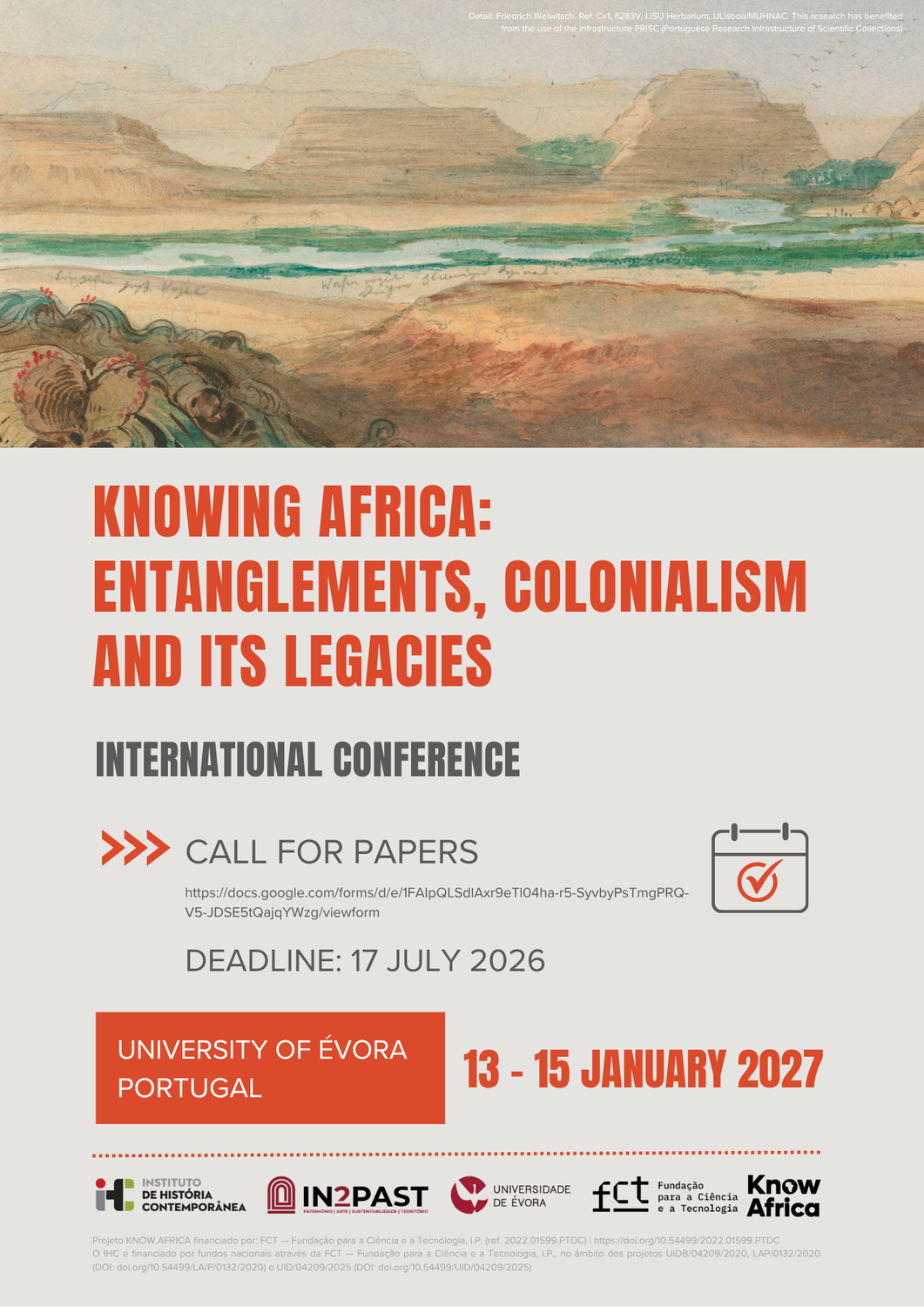
International conference that marks the culmination of the KNOW.AFRICA Project and will critically examine how cross-cultural encounters and local actors contributed to the production of knowledge about Africa.
Knowing Africa: Entanglements, colonialism and its legacies
The International Conference Knowing Africa: Entanglements, colonialism and its legacies will take place from 13 to 15 January 2027 at the University of Évora, organised by the following organisations: Instituto de História Contemporânea (IHC) da Universidade NOVA de Lisboa; IN2PAST ; Universidade de Évora; Projeto KNOW.AFRICA (https://doi.org/10.54499/2022.01599.PTDC)
This three-day international conference marks the culmination of the KNOW.AFRICA Project (https://doi.org/10.54499/2022.01599.PTDC) and will bring together scholars from the history of science, anthropology, museum studies, African studies, imperial and colonial history, biology, visual culture, and related fields to critically examine how cross-cultural encounters and local actors contributed to the production of knowledge about Africa.
Call for papers
We particularly welcome submissions that engage with, but are not limited to, the following themes:
- Methodological approaches to archival research in colonial and formerly colonized contexts;
- Ethical challenges in field-based research within the social sciences and humanities, including community engagement, protocols for the collection and use of materials, and practices of acknowledgement and attribution;
- Invisibilities, silences, and untold histories, including those of local actors, collections, archives, and knowledge systems;
- Cross-cultural encounters, exchanges, and processes of knowledge production;
- Science communication and public engagement in schools, local communities, and citizen science initiatives.
Submission period: 17 July 2026
Registration is free but mandatory, and proposals may be submitted via the following link.
>>Download the call for papers (PDF) <<
Time
january 13 (Wednesday) - 15 (Friday)
Organizer
Institute of Contemporary History - University of Évoracehfc@uevora.pt Largo dos Colegiais, 2 — 7000-812 Évora

Event Details
The aim of the fourth Karl Marx Congress is to analyse the crisis of neoliberal capitalism (1980s – first quarter of the 21st century). 4th Karl Marx Congress
more
Event Details
The aim of the fourth Karl Marx Congress is to analyse the crisis of neoliberal capitalism (1980s – first quarter of the 21st century).
4th Karl Marx Congress
The Crisis of Neoliberal Capitalism and Necropolitics
The 4th Karl Marx Congress will take place on 22 and 23 January 2027 at NOVA FCSH (Av. de Berna campus, Lisbon, Portugal), organised by the following institutions: Centre for Social Studies (CES), University of Coimbra; CULTRA — Association of Political Economy; Institute of Contemporary History (IHC), NOVA University Lisbon; Institute of Sociology, University of Porto; STEXEU project — The Constitutional Road to Dictatorship (ERC Grant 101163723).
The aim of the congress is to analyse the crisis of neoliberal capitalism (1980s – first quarter of the 21st century) from a dual perspective: that of historical analysis and that of theoretical debate of the crisis in its various dimensions, along with the study of related experiences of social, political, or cultural activism.
To this end, the congress will be organised around plenary sessions (keynote speeches) and the following seven thematic sections:
- Section I: The economic and financial crisis of neoliberal capitalism (nature and characteristics of the crisis of late capitalism; rates of profit and accumulation; centre and periphery; technological revolution and technocracies; financialisation; cryptocurrencies; the privatisation offensive; old and new forms of surplus value extraction and related issues)
- Section II: Politics, hyperpolitics and necropolitics (crisis of legitimacy/representativeness of liberal systems; the capitulation of liberalism; the decline of the two-party system between social democracy and liberal and conservative forces; the neo-fascist threat and its characteristics in the current era; the radicalisation of the traditional right; Trumpism and related phenomena; struggles and impasses of the emancipatory left)
- Section III: Social transformations and struggles (structural and behavioural changes within the working classes, segmentation, precarisation, unionisation; the new balance of power in the world of work: the 2025–26 labour reform in Portugal within the international context of the counter-reform of labour rights; migrant labour; migration, the international division of labour and racialised regimes of accumulation; fear and insecurity among the middle and marginalised classes; processes of pauperisation; changes within the ruling classes, technoligarchy; the new role of algorithmic manipulation and social media; heteronormativity and queer Marxism; experiences of struggle in the workplace, housing, healthcare, education, etc.).
- Section IV: Late capitalism, ecological and environmental disaster, and ecosocialism (the environmental policies of capitalism; the ecological and environmental crisis and its evolution; growth and degrowth, the Anthropocene and the Capitalocene, extractivism; experiences of environmental activism in its various forms and expressions)
- Section V: Feminisms, emancipation and social reproduction (patriarchy and the situation of women in society, politics and the culture of late capitalism; reproductive labour and struggles surrounding social reproduction; LGBTQIA+ rights and discrimination, overexploitation, violence, male power: coexistence, impunity, political conquests, the current situation; neo-fascism, male chauvinism, anti-feminism; feminist struggles; the emancipatory left and the feminist movement; the various currents and expressions of contemporary feminisms).
- Section VI: Culture and cultural counter-revolution (the role of cultural counter-revolution in the emergence of the new neo-fascist far right; the various dimensions of conservative and fascist cultural revisionism: in history, memory, politics, social discourse, ideology; the new role of democratic and mass culture in the transformative understanding of present realities).
- Section VII: Imperialism, war and genocide (new and old forms of imperialism; wars of aggression and imperial rivalry: Ukraine, Palestine, Lebanon, Iran; the collapse of multilateralism and international law; the unpunished return of gunboat diplomacy and the law of the jungle; Trumpism and Latin America: Cuba, Venezuela and similar cases; the arms race; the threat of World War III; the struggles against imperial necropolitics).
Call for papers
Proposals for papers for the congress will only be considered by the Scientific Committee under the following conditions:
a) Their content must fall within the thematic scope of the seven sections of the congress;
b) They must take the form of abstracts – in Portuguese or English – of no more than 2,000 characters, including a very brief identifying note and the authors’ short bio;
c) They must be submitted using this online form.
All proposals for papers must be received by 30 June 2026.
Proposals will be assessed by the congress’ Scientific Committee and proposers will be notified of the outcome by 30 September 2026. FCSH’s room capacity may limit the number of paper proposals that can be accepted.
The 4th Karl Marx Congress is open to the public and admission is free.
Organising Committee
Arturo Zoffmann Rodriguez, IHC — NOVA FCSH / IN2PAST
Fernando Rosas, IHC — NOVA FCSH / IN2PAST / CULTRA
Giulia Strippoli, IHC — NOVA FCSH / IN2PAST
Jonas Van Vossole, CES — University of Coimbra
José Soeiro, Instituto de Sociologia — FLUP
Luís Trindade, IHC — NOVA FCSH / IN2PAST
Manuel Loff, FLUP / IHC — NOVA FCSH / IN2PAST
Mariana Mortágua, DINÂMIA’CET — Iscte
Scientific Committee
Adriana Valobra, UNLP
Alexis Cukier, UPoitiers
Alexandre Abreu, ISEG
Ana Alves da Silva, APEP
Ana Sofia Ferreira, IS-UP
André Vianna Matos, Fiocruz
Ankica Čakardić, UZagreb
António Pedro Pita, CES/UC
Aurélie Andry, IHC — NOVA FCSH / IN2PAST
Bernardo Ferro, IEF/UC
Carme Molinero, UAB
Carla Luciana Silva, UNIOESTE
Carlos Zacarias de Sena Júnior, UFBA
Cátia Guimarães, Fiocruz
Cecília Honório, CULTRA
Emanuele Leonardo, UBologna
Fernando Bessa Ribeiro, CICS.NOVA
Fernando Oliveira Baptista, ISA/UL
Francisco Louçã, ISEG/UL
Geo Britto, ETP-RJ
George Souvlis, IHC — NOVA FCSH / IN2PAST
Gilberto Calil, UNIOESTE
Giovanna Vertova, UBergamo
Hernán Camarero, UBA-CEHTI
Inês Barbosa, IS-UP
Javier Tébar, UB
Joana Dias Pereira, IHC — NOVA FCSH / IN2PAST
João Leonardo Medeiros, UFF
João Mineiro, CRIA/ISCTE
João Rodrigues, FE/UC
João Teixeira Lopes, IS-UP
Lígia Ferro, IS-UP
Manuel Carlos Silva, CICS/UMinho
Marcela Uchoa, IEF/UC
Marcelo Badaró Mattos, UFF
Mariana Mortágua, ISCTE
Miguel Cardina, CES/UC
Olivier Neveux, ENS Lyon
Paula Godinho, IHC — NOVA FCSH / IN2PAST
Pere Ysàs, UAB
Riccardo Bellofiore, UBergamo
Ricardo Noronha, IHC — NOVA FCSH / IN2PAST
Sílvia Correia, IS-UP
Simone Tulumello, APEP
>> Download the call for papers (PDF) <<

Time
january 22 (Friday) - 23 (Saturday)
Organizer
Several Institutions

Event Details
International conference focused on exploring the historical implementation of states of exception across different geographical contexts, both within and beyond Europe, and in a longer timespan (circa 1890-1950). Deadline: 1
more
Event Details
International conference focused on exploring the historical implementation of states of exception across different geographical contexts, both within and beyond Europe, and in a longer timespan (circa 1890-1950). Deadline: 1 October 2026
The Constitutional Road to Authoritarianism:
States of Exception in Historical Perspective, 1890-1950
International Conference, Crete, University of Rethymno, May 2027
How exceptional are states of exception in liberal democracies? During the two world wars, European governments suspended constitutional norms and granted themselves extraordinary powers in the name of national survival and public order. Yet emergency rule was not merely a temporary wartime deviation. As scholars such as Carl Schmitt, Giorgio Agamben, Nomi Claire Lazar and Eugénie Mérieau have argued, states of exception are deeply embedded within modern liberal democracies. In some cases, emergency mechanisms facilitated the transition from liberal democracy to dictatorship.
A state of exception may be broadly defined as the temporary and geographically limited suspension of individual and public rights and freedoms and of the separation of powers in response to a perceived crisis. It enables governments to exercise extraordinary powers beyond normal legal constraints. Sometimes these powers are clearly codified through legal categories such as “state of siege” or “martial law.” In other cases, exceptional rules operate through more ambiguous legal frameworks. What has become increasingly clear, however, is that such measures are not historical aberrations but structural features of modern governance.
The study of states of exception has traditionally been dominated by jurists and philosophers, whereas historians have rarely engaged with this phenomenon. This conference addresses this gap. Rather than focusing solely on legal doctrines or constitutional texts, the conference examines how states of exception were historically enacted, negotiated, and contested in practice, highlighting the concrete actors and institutions—both state and non-state—that enabled the suspension of normal legal order. The conference examines concretely what happened on the ground when states of exception were activated. Emphasis is placed on historically specific episodes, tracing how emergency measures were mobilized, enforced, and legitimized, revealing the mechanisms through which extraordinary powers reshaped political and social orders.
This workshop is organised within the framework of the ERC project STEXEU – “The Constitutional Road to Dictatorship: States of Exception and Authoritarianism in Europe, 1900-1939”. While the project focuses primarily on Europe, we invite contributions exploring the historical implementation of states of exception across different geographical contexts, both within and beyond Europe, and in a longer timespan (circa 1890-1950).
Drawing directly on the STEXEU analytical framework, the conference situates states of exception within the broader constitutional and institutional pathways toward authoritarianism. Contributions are encouraged to examine not only formal decrees but also the concrete practices, negotiations, and conflicts through which emergency powers were operationalized. By connecting legal texts with social, political, and institutional processes, the workshop seeks to show how states of exception contributed to the erosion of the rule of law and facilitated the rise of fascist or authoritarian regimes, while also exploring variation across time, space, and political contexts. Comparative and transnational perspectives are particularly welcome, as are studies that consider interactions between state and non-state actors in shaping exceptional governance.
We aim to publish a selection of the conference papers as a special issue or as an edited volume with a leading academic publisher. Participants will therefore be asked to submit a draft chapter prior to the workshop and to read the papers of fellow presenters in advance. We plan to organize the workshop as a discussion-based event, with substantial time devoted to collective feedback and exchange around the pre-circulated drafts. For this reason, the conference will have an exclusively in-person format.
Format: In-person conference
Call for Papers
Key Themes (indicative, not exhaustive):
- Historical case studies of specific states of exception in Europe and beyond
- Institutions of exception: military, judiciary, police, administrative bodies
- Non-state actors and the enforcement of exception (paramilitaries, militias, economic actors)
- Political elites, bureaucrats, and intellectuals as implementers of exceptional measures
- Targets of states of exception in the liberal metropoles (organized workers, ethnic minorities, colonized peoples, women and queer minorities, etc.)
- Circulations of actors, ideas and practices of states of exception from the colonies to the colonial cores
- Emergency powers and the erosion of the rule of law
- States of exception and pathways to authoritarianism or fascism
- Everyday practices of exception: local, regional, and sectoral perspectives
- Comparative and transnational perspectives on exceptional governance
Submission Guidelines
Please submit:
- An abstract of 300 words
- A short biographical note (maximum 150 words)
Deadline for submissions: 1 October 2026
Notification of acceptance:15 October 2026
Submissions should be sent to this google form.
Any questions should be directed to: gsouvlis@fcsh.unl.pt
Funding
Limited funding may be available to support participants. Priority will be given to early-career scholars without access to institutional funding.
Organising committee
- Aurélie Andry
- Henrique Cintra Santos
- Aliaksandr Piahanau
- George Souvlis
- Carmine Stornaiuolo
- Arturo Zoffmann Rodriguez

Time
may 13 (Thursday) - 14 (Friday)
Organizer
Institute of Contemporary History — NOVA School of Social Sciences and Humanitiescomunicacao.ihc@fcsh.unl.pt Avenida de Berna, 26C - 1069-061 Lisbon
Meetings with open calls
Detalhes do Evento
International conference focused on exploring the historical implementation of states of exception across different geographical contexts, both within and beyond Europe, and in a longer timespan (circa 1890-1950). Deadline: 1
Ver mais
Detalhes do Evento
International conference focused on exploring the historical implementation of states of exception across different geographical contexts, both within and beyond Europe, and in a longer timespan (circa 1890-1950). Deadline: 1 October 2026
The Constitutional Road to Authoritarianism:
States of Exception in Historical Perspective, 1890-1950
International Conference, Crete, University of Rethymno, May 2027
How exceptional are states of exception in liberal democracies? During the two world wars, European governments suspended constitutional norms and granted themselves extraordinary powers in the name of national survival and public order. Yet emergency rule was not merely a temporary wartime deviation. As scholars such as Carl Schmitt, Giorgio Agamben, Nomi Claire Lazar and Eugénie Mérieau have argued, states of exception are deeply embedded within modern liberal democracies. In some cases, emergency mechanisms facilitated the transition from liberal democracy to dictatorship.
A state of exception may be broadly defined as the temporary and geographically limited suspension of individual and public rights and freedoms and of the separation of powers in response to a perceived crisis. It enables governments to exercise extraordinary powers beyond normal legal constraints. Sometimes these powers are clearly codified through legal categories such as “state of siege” or “martial law.” In other cases, exceptional rules operate through more ambiguous legal frameworks. What has become increasingly clear, however, is that such measures are not historical aberrations but structural features of modern governance.
The study of states of exception has traditionally been dominated by jurists and philosophers, whereas historians have rarely engaged with this phenomenon. This conference addresses this gap. Rather than focusing solely on legal doctrines or constitutional texts, the conference examines how states of exception were historically enacted, negotiated, and contested in practice, highlighting the concrete actors and institutions—both state and non-state—that enabled the suspension of normal legal order. The conference examines concretely what happened on the ground when states of exception were activated. Emphasis is placed on historically specific episodes, tracing how emergency measures were mobilized, enforced, and legitimized, revealing the mechanisms through which extraordinary powers reshaped political and social orders.
This workshop is organised within the framework of the ERC project STEXEU – “The Constitutional Road to Dictatorship: States of Exception and Authoritarianism in Europe, 1900-1939”. While the project focuses primarily on Europe, we invite contributions exploring the historical implementation of states of exception across different geographical contexts, both within and beyond Europe, and in a longer timespan (circa 1890-1950).
Drawing directly on the STEXEU analytical framework, the conference situates states of exception within the broader constitutional and institutional pathways toward authoritarianism. Contributions are encouraged to examine not only formal decrees but also the concrete practices, negotiations, and conflicts through which emergency powers were operationalized. By connecting legal texts with social, political, and institutional processes, the workshop seeks to show how states of exception contributed to the erosion of the rule of law and facilitated the rise of fascist or authoritarian regimes, while also exploring variation across time, space, and political contexts. Comparative and transnational perspectives are particularly welcome, as are studies that consider interactions between state and non-state actors in shaping exceptional governance.
We aim to publish a selection of the conference papers as a special issue or as an edited volume with a leading academic publisher. Participants will therefore be asked to submit a draft chapter prior to the workshop and to read the papers of fellow presenters in advance. We plan to organize the workshop as a discussion-based event, with substantial time devoted to collective feedback and exchange around the pre-circulated drafts. For this reason, the conference will have an exclusively in-person format.
Format: In-person conference
Call for Papers
Key Themes (indicative, not exhaustive):
- Historical case studies of specific states of exception in Europe and beyond
- Institutions of exception: military, judiciary, police, administrative bodies
- Non-state actors and the enforcement of exception (paramilitaries, militias, economic actors)
- Political elites, bureaucrats, and intellectuals as implementers of exceptional measures
- Targets of states of exception in the liberal metropoles (organized workers, ethnic minorities, colonized peoples, women and queer minorities, etc.)
- Circulations of actors, ideas and practices of states of exception from the colonies to the colonial cores
- Emergency powers and the erosion of the rule of law
- States of exception and pathways to authoritarianism or fascism
- Everyday practices of exception: local, regional, and sectoral perspectives
- Comparative and transnational perspectives on exceptional governance
Submission Guidelines
Please submit:
- An abstract of 300 words
- A short biographical note (maximum 150 words)
Deadline for submissions: 1 October 2026
Notification of acceptance:15 October 2026
Submissions should be sent to this google form.
Any questions should be directed to: gsouvlis@fcsh.unl.pt
Funding
Limited funding may be available to support participants. Priority will be given to early-career scholars without access to institutional funding.
Organising committee
- Aurélie Andry
- Henrique Cintra Santos
- Aliaksandr Piahanau
- George Souvlis
- Carmine Stornaiuolo
- Arturo Zoffmann Rodriguez
Tempo
maio 13 (Quinta-feira) - 14 (Sexta-feira)
Organizador
Institute of Contemporary History — NOVA School of Social Sciences and Humanitiescomunicacao.ihc@fcsh.unl.pt Avenida de Berna, 26C - 1069-061 Lisbon
setembro, 2026
Tipologia do Evento:
Todos
Todos
Colloquium
Conference
Conference
Congress
Course
Cycle
Debate
Exhibition
Launch
Lecture
Meeting
Movie session
Open calls
Opening
Other
Presentation
Round table
Seminar
Showcase
Symposium
Tour
Workshop

Detalhes do Evento
Conference that seeks to challenge historical revisionism, amplify marginalised voices, and foster transnational dialogues on reconciliation, accountability, and restorative justice. The Public History of Difficult Pasts 8th International
Ver mais
Detalhes do Evento
Conference that seeks to challenge historical revisionism, amplify marginalised voices, and foster transnational dialogues on reconciliation, accountability, and restorative justice.
The Public History of Difficult Pasts
8th International Conference on Public History
IFPH 2026
The 8th International Conference on Public History, organised by the International Federation for Public History, IFPH, will take place in Lisbon from September 7 to 11, 2026. It will be hosted by IN2PAST – the Associate Laboratory for Research and Innovation in Heritage, Arts, Sustainability and Territory, a transdisciplinary consortium of seven research centres, at the Almada Negreiros College on the Campolide Campus of NOVA University Lisbon.
In a time of escalating attacks by right-wing movements on memory, diversity, human rights, democracy, and history itself, the IFPH reaffirms its commitment to fostering critical engagement with the ways societies confront, interpret, and relate to their difficult pasts and challenging presents. The IFPH strongly condemns book banning, the censorship of historical narratives, the surveillance of students and educators, the targeting of sites of remembrance, and the imposition of ideological agendas — particularly right-wing distortions — that not only threaten academic freedom but undermine the very principles upon which public history is built. Against this backdrop, the conference seeks to challenge historical revisionism and silencing, to amplify marginalised voices and memories, and to promote transnational dialogues on reconciliation, accountability, and restorative justice.
Public History has long addressed global historical processes such as colonialism, the transatlantic slave trade, and the genocide of Indigenous peoples, as well as phenomena that emerge in multiple contexts, including armed conflicts and dictatorships. It embodies both a political and ethical commitment to examining how difficult pasts have been lived and remembered by different communities and individuals, ensuring that their perspectives are acknowledged and respected. At the same time, engaging with these histories through Public History raises significant challenges. Sharing authority with specific communities and amplifying marginalised narratives may unintentionally silence other voices, while also presenting complex ethical dilemmas. Furthermore, Public History operates within the public sphere, engaging diverse audiences and navigating competing representations of the past in an era increasingly marked by the political instrumentalisation of history and the spread of revisionist and denialist discourses.
🔗 Free registration HERE.
Call for contributions
This conference seeks to challenge historical revisionism, amplify marginalised voices, and foster transnational dialogues on reconciliation, accountability, and restorative justice. We invite contributions that explore:
Historical Contexts and Global Processes
-
- Colonialism and its enduring legacies
- The transatlantic slave trade and its commemorations
- Indigenous genocide and cultural destruction
- Armed conflicts, civil wars, and their aftermath
- Dictatorships, authoritarianism, and state violence
- Mass atrocities and crimes against humanity
Contemporary Challenges and Methodological Innovations
-
- Countering historical denial and revisionism
- Navigating contested memories and competing narratives
- Sharing authority with affected communities
- Ethical dilemmas in representing traumatic pasts
- Digital humanities, media, and social networks
- Museum practices and memorial sites
- Archives, and archival activism
- Educational approaches to sensitive histories
Voices and Perspectives
-
- Survivor testimonies and intergenerational trauma
- Community-based historical projects
- Oral history and marginalised narratives
- Gender, sexuality, and intersectional approaches
- Youth engagement with difficult pasts
- Transnational and comparative perspectives
Justice and Reconciliation
-
- Truth commissions and transitional justice
- Reparations and historical redress
- Memorialisation and commemoration practices
- Restorative justice approaches
- Healing and collective memory
- Building inclusive historical narratives
Calendar
Opening of the Call for Presentations: 30 September 2025
Deadline for Application: 30 November 7 December 2025 [new deadline]
Deadline for reviewers to do their reviews: 31 January 2026
Call for posters: January 2026
Results of the Call for Presentations will be announced by March 2026
Programme of the conference shall be available around June 2026
Deadline for registration for on-site attendance: August 2026
Conference: 7-11 September 2026
Submission of proposals
🔗 Submit your panel proposal HERE.
🔗 Submit your paper proposal HERE.
🔗 Submit your Working Group proposal HERE.
>> Download the call for papers (PDF) <<

Tempo
7 (Segunda-feira) 11:00 am - 11 (Sexta-feira) 6:00 pm
Organizador
Several Institutions

Detalhes do Evento
The RESONANCE Reading Group is a monthly encounter of the wider academic community of the project RESONANCE invested in thinking-with one key text or book a month. RESONANCE Reading
Ver mais
Detalhes do Evento
The RESONANCE Reading Group is a monthly encounter of the wider academic community of the project RESONANCE invested in thinking-with one key text or book a month.
RESONANCE Reading Group
Session #6: Images of Class: Operaismo, Autonomia and the Visual Arts (1962-1988), by Jacopo Galimberti
The RESONANCE Reading Group is a monthly meeting that brings together members of the academic community, colleagues, friends, and enthusiasts of contemporary cultural history to reflect on and discuss a fundamental text or book. It is part of the project RESONANCE — Epistemologies for the Documentation of Affect and Becoming in Cultural Manifestations in Performance (1969-1979). This group meets in person at NOVA FCSH or online, during lunchtime on a weekday. Each participant brings their own lunch, and for in-person sessions, coffee and biscuits are kindly provided by the project.
The sixth session of the RESONANCE Reading Group focuses on Chapter 7 of the book Images of Class: Operaismo, Autonomia and the Visual Arts (1962-1988). The chapter – Art against Housework: The Gruppo Immagine and the Wages for Housework Campaign – brings together discussions on social reproduction vis-à-vis informal networks of solidarity across feminist art practice ecologies in the 1970s. This is a key text to explore the infrastructural dynamics of these movements with a close reading of artistic production at the crux of the Operaismo and Autonomia movements. This reading group is going to be led by Hélia Marçal (IHA, NOVA FCSH / IN2PAST) and will count with the author’s participation.
You can hear Jacopo presenting the book here, and in an e-flux podcast episode with Andreas Petrossiants here. This event will be conducted in English but we will do our best to facilitate translation into English if needed.
This session integrates RESONANCE’s Autumn Seminar, which also includes the RESONANCE Autumn Lecture, which will be delivered by Jacopo Galimberti. Galimberti will present his latest research at the Salão Nobre of the NOVA School of Social Sciences and Humanities, on September 9 at 18.00. The session – titled Hopeful Monsters: Operaismo, Autonomia, and the Reconfiguration of Revolutionary Subjectivity – seeks to trace the representation of revolutionary subjectivity, focusing on the figure of the monster as depicted in Italy in the 1960s and 1970s.
You can register for the Reading Group by emailing the RESONANCE project team at resonance.fcsh.unl@gmail.com and to receive a PDF copy of the chapter.
More information about the RESONANCE project here.

The RESONANCE project is supported by the Programa Regional Lisboa 2030, Portugal 2030 and the European Union (LISBOA2030-FEDER-00914500). This work is also co-funded by national funds through FCT – Fundação para a Ciência e a Tecnologia, I.P., under the reference 2023.17624.ICDT (DOI: https://doi.org/10.54499/2023.17624.ICDT).
Tempo
(Quarta-feira) 12:00 pm - 1:30 pm
Organizador
Institute of Contemporary History, IHA, CESEM, ICNOVA e IFILNOVA — NOVA FCSH

Detalhes do Evento
RESONANCE Autumn Seminar, with Jacopo Galimberti, that seeks to trace the representation of revolutionary subjectivity, focusing on the figure of the monster as depicted in Italy in the 1960s and
Ver mais
Detalhes do Evento
RESONANCE Autumn Seminar, with Jacopo Galimberti, that seeks to trace the representation of revolutionary subjectivity, focusing on the figure of the monster as depicted in Italy in the 1960s and 1970s.
Hopeful Monsters:
Operaismo, Autonomia, and the Reconfiguration of Revolutionary Subjectivity
Jacopo Galimberti (Università Iuav di Venezia)
In the context of the RESONANCE project and the IHA’s Permanent Seminar, Jacopo Galimberti will deliver a seminar featuring his latest research at the Salão Nobre of the NOVA School of Social Sciences and Humanities, on September 9 at 18.00. The session – titled Hopeful Monsters: Operaismo, Autonomia, and the Reconfiguration of Revolutionary Subjectivity – seeks to trace the representation of revolutionary subjectivity, focusing on the figure of the monster as depicted in Italy in the 1960s and 1970s. Galimberti will explore these hopeful monsters as a visual reflection on the political taxonomies of the twentieth century, tracing, in the process, the characteristics of a revolutionary subjectivity. This author’s approach relates to the RESONANCE project’s research on revolutionary intersubjectivity and its materialisations across timescapes.
The talk will be delivered in English.
This session integrates RESONANCE’s Autumn Seminar, which also includes the RESONANCE Reading Group, which will take place on September 9 at noon, and will count with Galimberti’s participation. The RESONANCE Reading Group is a monthly meeting that brings together members of the academic community, colleagues, friends, and enthusiasts of contemporary cultural history to reflect on and discuss a fundamental text or book. The sixth session of the RESONANCE Reading Group focuses on Chapter 7 of the book Images of Class: Operaismo, Autonomia and the Visual Arts (1962-1988).
More information about the RESONANCE project here.

The RESONANCE project is supported by the Programa Regional Lisboa 2030, Portugal 2030 and the European Union (LISBOA2030-FEDER-00914500). This work is also co-funded by national funds through FCT – Fundação para a Ciência e a Tecnologia, I.P., under the reference 2023.17624.ICDT (DOI: https://doi.org/10.54499/2023.17624.ICDT).
Tempo
(Quarta-feira) 6:00 pm - 8:00 pm
Organizador
Institute of Contemporary History, IHA, CESEM, ICNOVA e IFILNOVA — NOVA FCSH

Detalhes do Evento
A discussion based on the book 'European Perspectives on Transition'. With Pablo Sánchez León and José Neves.
Ver mais
Detalhes do Evento
A discussion based on the book ‘European Perspectives on Transition‘. With Pablo Sánchez León and José Neves.
Conversa sobre conceitos, transição e revolução
O conceito de transição ocupa um lugar incómodo nos estudos sobre a história europeia contemporânea. Aparentemente incapaz de decifrar os complexos factores que moldam os processos de democratização, parece muitas vezes redundante como estrutura para a compreensão dos desenvolvimentos políticos recentes e em curso. Em European Perspectives on Transition: A Comparative and Transnational Approach to the History of a Political and Social Concept, Pablo Sánchez León e Agustín Cosovschi mostram o contrário, oferecendo uma história conceptual pioneira e muito necessária da transição numa perspectiva comparativa. Reunindo oito estudos de caso sobre o discurso transicional, que vão desde a chamada Terceira Vaga do Sul da Europa na década de 1970 até às mudanças de regime na Europa Central e Oriental, este volume apresenta um novo e importante caminho para o estudo da temporalidade e da transição na Europa.
Conversa entre Pablo Sánchez León e José Neves, com moderação de Rita Luís.

Tempo
(Sexta-feira) 6:00 pm - 8:00 pm
Organizador
Institute of Contemporary History — NOVA School of Social Sciences and Humanities and Tigre de Papel

Detalhes do Evento
José Pedro Castanheira's second work about the political police of the Estado Novo during Caetano’s rule, will be launched at the Camões Secondary School in Lisbon,
Ver mais
Detalhes do Evento
José Pedro Castanheira’s second work about the political police of the Estado Novo during Caetano’s rule, will be launched at the Camões Secondary School in Lisbon, with a presentation by Maria Inácia Rezola and Fernando Mendes.
Histórias da PIDE
Quando era a DGS de Caetano. Volume 2
A «evolução na continuidade» prometida em 1968 por Marcello Caetano nada alterou na temida e execrada polícia política da ditadura. Apenas mudou o nome: a salazarista PIDE passou a chamar‑se Direção‑Geral de Segurança (DGS). A «primavera marcelista», que desabrochara com o fim da deportação de Mário Soares em São Tomé, começou a murchar 18 meses depois, quando o socialista foi compelido ao exílio em Paris. Outra vítima foi Daniel Cabrita, militante clandestino do PCP, fundador e primeiro líder da Intersindical (atual CGTP), torturado, julgado e condenado, cuja mulher se suicidou quando ele estava preso na cadeia de Peniche. À atenção e vigilância da PIDE/DGS continuava a não escapar ninguém: nem os sucessivos patriarcas de Lisboa, nem os sete oficiais que viriam a fazer parte da Junta de Salvação Nacional do 25 de Abril de 1974. A violência da DGS atingiu o paroxismo nas colónias, testemunhada pela Cruz Vermelha Internacional: nas vésperas da revolução, em Moçambique a tortura prosseguia, em massa e até à morte.
Estas são algumas das Histórias da PIDE que José Pedro Castanheira investigou ao longo dos anos para o Expresso, e que ocorreram durante a governação de Marcello Caetano.
Mais informações sobre o livro
Tempo
(Quarta-feira) 6:30 pm - 8:00 pm
Organizador
Tinda da China and Camões Secondary School
Detalhes do Evento
8th edition of the IWHSCR. It will place a special emphasis on experimental phonetics as an emerging field at the intersection of the humanities, medical sciences, and engineering, which underwent
Ver mais
Detalhes do Evento
8th edition of the IWHSCR. It will place a special emphasis on experimental phonetics as an emerging field at the intersection of the humanities, medical sciences, and engineering, which underwent rapid development throughout the twentieth century.
8th International Workshop on the History of Speech Communication Research
(IWHSCR)
Following its launch in Dresden in 2015, and subsequent editions in Helsinki (2017), Vienna (2019), Prague (2021), Porto (2022), Budapest (2024), and Paris (2025), the 8th edition of the IWHSCR will be organised by members of the PHONLAB project (2022.06811.PTDC), in collaboration with the Faculty of Arts and Humanities of the University of Coimbra.
This edition will place a special emphasis on experimental phonetics as an emerging field at the intersection of the humanities, medical sciences, and engineering, which underwent rapid development throughout the twentieth century. Particular attention will be given to the role of institutions, internationally engaged scientific actors, and the creation of innovative scientific spaces, technologies, and techniques.
Keynote speakers:
Ana Simões is full professor of History of Science at the Faculty of Sciences, University of Lisbon, Portugal, and member of the Centre for the History of Science and Technology (CIUHCT), which she (co-)coordinated from 2007 to 2019. She is the President-elect of the Division for the History of Science and Technology (2025–2029) – a division of the International Union for the History and Philosophy of Science and Technology (IUHPST) – and was previously the President of the European Society for the History of Science (2018–2020). She has written extensively on the history of quantum chemistry, and aspects of history of science in Portugal, 18th to 20th centuries, including popularisation of science and science and the city, framed by a historiographical reflection on the circulation of science including non-central places. She is a founding member of the international network Science and Technology in the European Periphery. She is member of several national and EU projects, editorial boards, scientific advisory boards and scientific societies.
Bernd Möbius studied phonetics, linguistics and sociology at the University of Bonn, where he also received his PhD degree in 1992. He was a member of technical staff (senior researcher) at Bell Labs in Murray Hill, NJ, from 1993 to 1998, and Assistant and Associate Professor at the University of Stuttgart from 1999 to 2011. After being Acting chair of Phonetics and Speech Communication at the University of Bonn (2007-2010), he was Full Professor of Phonetics and Phonology in the Department of Language Science and Technology at Saarland University from 2011 to 2025, where he is now a Senior Professor. A central theme of his research is to integrate phonetic knowledge in speech technology. He has worked extensively on text-to-speech synthesis and speech prosody, and recent work has focused on experimental methods and computational simulations to study aspects of speech production, perception and acquisition.
Call for papers
Contributions addressing this focus are welcome, as are submissions on any topics related to the historical aspects of speech communication research. Submissions must not exceed 10 pages (including references) and must follow the guidelines provided HERE. The proceedings will be published in the book series Studientexte zur Sprachkommunikation by TUDpress and will also be made available electronically in the ISCA archive.
Full paper submissions should be sent to the following email address: phonlab.project@gmail.com
Participation is free, but you must register in advance via this LINK.
Important dates:
Manuscript submission: 15 May 2026
Notification of acceptance: 1 June 2026
Registration: 30 June 2026
Revised manuscript submission: 1 July 2026
Organising Committee:
Albano Figueiredo, Faculty of Arts and Humanities, University of Coimbra
Ângela Salgueiro, University of Évora and IHC / IN2PAST
Jürgen Trouvain, Saarland University
Quintino Lopes, University of Évora and IHC / IN2PAST
Tempo
17 (Quinta-feira) 12:00 am - 18 (Sexta-feira) 6:00 pm
Localização
Faculty of Arts and Humanities — University of Coimbra
Largo da Porta Férrea — 3000-370 Coimbra
Organizador
Several Institutions
Detalhes do Evento
Opening of an exhibition exploring the history of the Laboratory of Experimental Phonetics of Coimbra. An initiative of the PHONLAB project. Armando de Lacerda Wing: Laboratory of Experimental Phonetics
Ver mais
Detalhes do Evento
Opening of an exhibition exploring the history of the Laboratory of Experimental Phonetics of Coimbra. An initiative of the PHONLAB project.
Armando de Lacerda Wing: Laboratory of Experimental Phonetics of Coimbra
During the 8th International Workshop on the History of Speech Communication Research (IWHSCR), participants will have the opportunity to take part in a guided visit to the exhibition Armando de Lacerda Wing: Laboratory of Experimental Phonetics of Coimbra, located on the Faculty of Arts and Humanities of the University of Coimbra.
The exhibition explores the history of phonetics in Portugal, with a particular focus on the Laboratory of Experimental Phonetics of Coimbra and its director, Armando de Lacerda. It brings together scientific instruments, archival materials, and oral testimonies to preserve and showcase the Laboratory’s legacy, offering a critical perspective on a largely overlooked chapter in twentieth-century phonetics research.
This exhibition is the result of the PHONLAB project, funded by the Foundation for Science and Technology (2022.06811.PTDC), in collaboration with the Rectorate of the University of Coimbra, its Science Museum, and Faculty of Arts and Humanities.
Tempo
(Quinta-feira) 5:30 pm - 7:00 pm
Localização
Faculty of Arts and Humanities — University of Coimbra
Largo da Porta Férrea — 3000-370 Coimbra
Organizador
Several Institutions
Detalhes do Evento
António José Ramos's thesis, "Tuberculose. Inovações Médico-Científicas e Representações Sociais em Portugal: da década de 80 do Século XIX à década de 40 do Século XX", on the history of
Ver mais
Detalhes do Evento
António José Ramos’s thesis, “Tuberculose. Inovações Médico-Científicas e Representações Sociais em Portugal: da década de 80 do Século XIX à década de 40 do Século XX”, on the history of the science advancements regarding tuberculosis in Portugal, will be defended in a public examination at the University of Évora.
Examiner panel:
Laurinda Abreu (Universidade de Évora) — President
Isabel Amaral (Universidade NOVA de Lisboa) — Member
Ângela Salgueiro (Universidade de Évora) — Member
Maria de Fátima Nunes (Universidade de Évora) — Supervisor
João Miguel Couto Duarte (Universidade Lusíada de Lisboa) — Member
João Rui Pita (Universidade de Coimbra) — Member
Tempo
(Terça-feira) 2:30 pm - 4:30 pm
Organizador
University of Évorauevora@uevora.pt Largo dos Colegiais, 2 — 7000-803 Évora
Detalhes do Evento
Second edition of the Annual Conference of the Institute of Contemporary History, which promotes the relationship between Research Groups and disseminates the IHC’s research to a wider audience. II
Ver mais
Detalhes do Evento
Second edition of the Annual Conference of the Institute of Contemporary History, which promotes the relationship between Research Groups and disseminates the IHC’s research to a wider audience.
II Conferência Anual do Instituto de História Contemporânea
A Conferência Anual do IHC é um evento de dois dias, composta por vários painéis partilhados por membros dos diferentes Grupos de Investigação do Instituto. O objectivo é encontrar e desenvolver relações (a nível temático, conceptual e metodológico) entre investigadores/as e investigações de diferentes áreas, abrindo novos campos interdisciplinares e no interior da historiografia. Para além disso, a Conferência Anual procura ainda dar a conhecer o trabalho desenvolvido no IHC a um público mais vasto, desde projectos embrionários a investigações em curso, passando por exposições e outras iniciativas.
>> Descarregar o programa (PDF)
>> Descarregar o Livro de Resumos (PDF)
Tempo
24 (Quinta-feira) 9:00 am - 25 (Sexta-feira) 6:00 pm
Localização
Biblioteca Nacional de Portugal
Organizador
Institute of Contemporary History - NOVA FCSH and University of Évora
Search
News
IHC renews its governing bodies and coordination teams
Sep 15, 2026
Rui Lopes is the new President of the Board of Directors
PHONLAB gives rise to a permanent exhibition at the University of Coimbra
Sep 10, 2026
‘Armando de Lacerda Wing’ opens on 17 September
Lisbon is hosting the 8th International Conference on Public History
Aug 31, 2026
Under the theme ‘The Public History of Difficult Pasts’
CONTACTS
WORKING HOURS