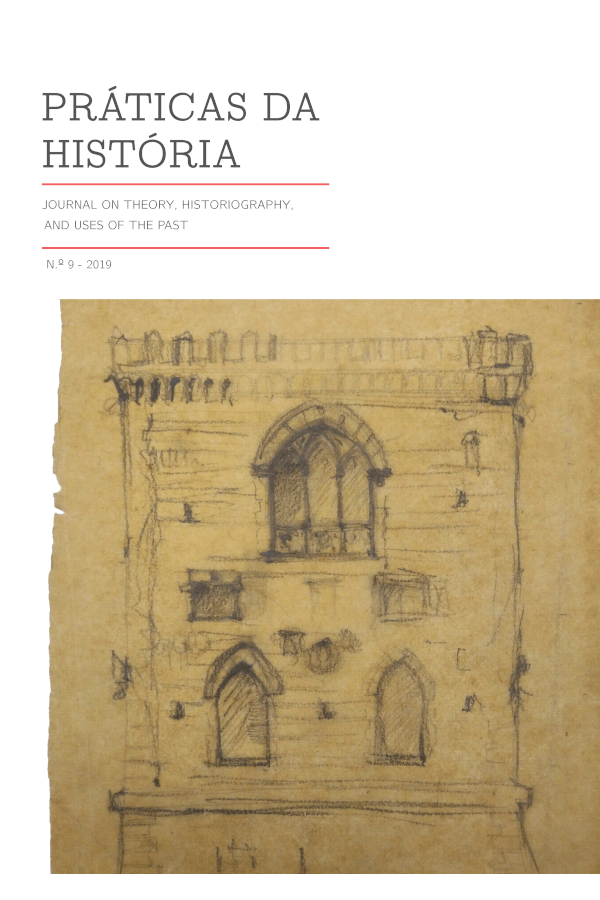
Práticas da História No. 9
Práticas da História – Journal on Theory, Historiography and Uses of the Past
- 2019
- Number 9
- ISSN: 2183-590X
- Theme: António Hespanha. Making and unmaking history
Editorial:
The void left by António Hespanha’s recent passing (1945-2019) has been filled with obituaries in international academic journals, alongside a range of articles in the Portuguese press at the time of his death. The collective that has directed the journal Practices of History would like to start by saying that his death leaves us saddened and poorer. Ever since this journal first started, António Hespanha has helped us more than generously. He was part of the journal’s scientific board and wrote article reviews. He was a regular speaker or member of the audience at events we organised. He brought to the pages of this journal a new version of one of his most relevant theoretical essays (his seminal text on categories) and, at our request, wrote a testimony about his experience at the head of the National Commission for the Commemoration of the Portuguese Discoveries. The highlight of our first issue’s launch event, which took place at the National Library in Lisbon, was a live inter-view with António Hespanha, in a room full of colleagues and students who were there to benefit from the experience of someone who turned his erudition into a way of arousing the curiosity of others, rather than a burden to weigh on the ignorance of others. The audio recording of this interview, conducted by the historian Luís Trindade in 2015, is now available on the journal’s website.
The idea of organising a dossier around the work of António Hespanha does not stem solely from the esteem in which he is held. Even if Theory of History and Historiography were not among his key areas of interest, Hespanha wrote a handful of seminal essays on issues that challenge the practice of the discipline and the historian’s craft in general. Moreover, many of his works, while dealing with specific subjects (from legal history to the history of the state, passing through the his-tory of the empire), are suffused with a self-reflexivity that testifies to a strong theoretical vocation, as if making History and undoing History were part of one and the same intellectual task, to gloss over the motto that presided over Penélope, an academic journal founded in 1988 and of which António Hespanha was the director. As to how this materialized and unfolded in Hespanha’s own trajectory, this is a question for a future research program in the field of the history of the discipline. In this editorial, it is certainly not possible to define the contours of such a programme, which may come to consider issues as diverse as Hespanha’s encounter with Foucauldian framework, his enthusiasm for the possibilities that information technology opened up for empirical research, the tension between his criticism of history as a discourse to appease the present and the assumption of leading positions in the Portuguese state’s official memory policy of in the 1990s; or even, in the last decade, the implications of the rise of so-called neoliberalism in his approach to the question of the state.
For our part, we merely want to suggest that the scientific concerns that led Hespanha to gauge the possibilities and limits of the knowledge produced by historians were often combined with a civic concern that led him to reflect on the political advantages and disadvantages of the discipline of history for our life in common. Among such combinations, one may serve as an exemplary instance: his intervention in one of the debates surrounding the publication of arguably his most important book: As Vésperas do Leviathan. Instituições e Poder Político. Portugal, séc. XVIII. In one of those discussions, he wrote:
«one of the main objectives of my work as an historian of power is to counter the form of chronocentrism which consists of projecting onto the past our categories for the understanding of power, by taking as natural and timeless the current categories through which we understand power relations. Such an epistemological operation has several consequences, undesirable ones, as far as I’m concerned. One of them is of an historiographic nature, resulting in a disregard for the idea of «rupture», historical distance, to which the current theory of history pays so much attention. Another consequence is of a political-ideological nature, since the elevation of the concept of «state» to a timeless category – and, in parallel, of the state political organization to a final, eschatological achievement, prepared by the appearance of still imperfect «state» forms (such as the «medieval state» or the «modern state») – leads to a «naturalization» of current political forms and their legitimization as the omega of the evolution of power systems».
Around the same years, moreover, in the essay «The emergence of history», published in the aforementioned Penélope, the historiographic and political-ideological unfolding of the epistemological operation carried out in As Vésperas de Leviathan would gain a generic formulation, with Hespanha defining the historian’s discourse «as a political act», but qualifying such a statement with the notion that such politicalness had nothing to do «with the «militant» history or the «citizen» history of twenty or thirty years ago». To quote him once again:
«Twenty or thirty years ago, the office of the historian had a militant sense because history, conceived as a science, wanted to be able to capture the «social laws» that regulated the historical process and ensured a freer and more humane future. To make history was to document, with the plasticity and accessibility that the historical account guarantees, that which, without it, could only be apprehended in tedious manuals of social theory. Thus, a kind of «popular front» was formed in which history (like [neo-realist] literature), under the direction of social theory, guaranteed the formation of a «social block» that included even those [disciplines] who, in terms of «pure and simple» theory, did not have the inclination to take part. So historiography was political because of its content. But, in its form, in its epistemological reference (the Truth), it was above politics as much as mathematics.»
The dossier «António Hespanha – fazer e desfazer a história» gathers six contributions by historians, social scientists and legal scholars. Some of the texts offer testimony about the meeting of their respective authors with both the work of António Hespanha and his academic persona, while also revealing the way in which the latter’s viewpoints occupied historiographic fields other than the Portuguese one. The texts by the historians Tamar Herzog and Mónica Duarte Dantas are an example of this, in the first case outlining a panoramic view of the main contributions of Hespanha’s work to a new legal history; in the second, allowing us a glimpse into the repercussion of Hespanha’s work among Brazilian historians. The testimony of the Spanish historian Bartolomé Clavero, in turn, summons, from the outset, the complicity between readings and experience that sustained the intellectual parallels that are often established between the historiographic path of both Clavero and Hespanha, informing us along the way about the impact of the latter’s work in Spanish historiography, where, in fact, his doctoral thesis was first published as a book.
The dossier brings together three other contributions. The philosopher Giovanni Damele takes into account the importance that the study of argumentation and legal rhetoric took on in the historiographic practice of Hespanha, while emphasising the civic principles that guided this orientation, which, one may add, also had significant re-percussions in teaching initiatives developed by Hespanha within the Faculty of Law of the New University of Lisbon. The contributions of historian Tomás Vallera and sociologist Tiago Ribeiro follow the readings of Hespanha that both authors developed within the framework of their respective doctoral researches. In both cases, Hespanha’s work was pushed to terrains or chronologies that he visited less regularly of his own accord. Vallera, who defended his doctoral thesis in 2019, tells us of his attempt to draw up a history of the «police» as a genealogy of the modern school. Ribeiro, for his part, investigates the ways in which the conceptualization of sexuality operates in the reciprocal influence of the law and of “psy” disciplines and knowledges as sources of justice and truth.
The present issue of Practices of History begins, however, with our usual section of articles, on the margins of the dossier around Hespanha. In the first article, «Deus Vult? Crusade apologists, historians and ‘abortive rituals’ in the 1999 reconciliation walk to Jerusalem», published against the background of the celebration of the 900th anniversary of the First Crusade (1095-1099) and its repercussions, the historian Mike Horswell claims the need for historians to consider what these collective memorialistic practices tell us about the present meanings of a given past, rather than simply checking and validating what in today’s celebrations will or will not conform to yesterday’s reality. The second article, ‘Liberty dreamt in Stone: The (Neo)Medieval City of San Marino’, by the historian Tommaso di Carpegna Falconieri, brings us, in a comparative key, a first overview of the medieval practices developed in San Marino from the mid-19th century until the end of the fascism years. Finally, we publish an article by historian Ricardo Noronha, «Neoliberalism and the historians», at the cross-roads between the History of Political Ideas, the History of Economic Thought and the Theory of History, which pays close attention to the historiographic reflections developed in the early days of neoliberalism by authors such as Friedrich Hayek, Karl Popper, T.S. Ashton, Walter Eucken, Ludwig von Mises and Milton Friedman.
To close this issue, we include an interview with historian Edward Alpers in which he discusses his personal trajectory and his work in African contexts of national liberation and post-independence, as well as his efforts in the consolidation of the field of studies on the Indian Ocean World. The interview was conducted by historian Felipe Barradas Correia Castro Bastos. Finally, as usual, the journal also contains a review section.
José Neves
Other Issues
Search
Events
setembro, 2026
seg
ter
qua
qui
sex
sab
dom
-
1
2
3
4
5
6
7
8
9
10
11
12
13
14
15
16
17
18
19
20
21
22
23
24
25
26
27
28
29
30


News
IHC supports exhibition on the Spanish Civil War
The exhibition will open on 29 September at FCSH
IHC at the European Researchers’ Night in Évora
25 September, 1.º de Maio Square, from 5 to 10PM
IHC renews its governing bodies and coordination teams
Rui Lopes is the new President of the Board of Directors