Ana Margarida Ferreira

Biography
Bachelor’s degree in History, specialising in Archaeology, University of Coimbra (1989). Postgraduate degree in Cultural Affairs in Local Government, University of Coimbra (1991). She studied conservation of archaeological and ethnographic materials at the UCL Institute of Archaeology (1994–1995). Master’s degree in Museology and Heritage from NOVA University Lisbon (1997). PhD student in the History and Philosophy of Science — Museology programme at the University of Évora (2023-2025).
Curator of the Santos Rocha Municipal Museum, Figueira da Foz, Portugal (1991–2025). Head of service at the Santos Rocha Municipal Museum (2018-2022); Director of the Aveiro Museum (2004-2011); Director of the Francisco Tavares Proença Júnior Museum, Castelo Branco (1999-2004).
Research fields
- Archaeology
- Museology
- History of science
- 19th century
Selected publications
- Batista, Carlos, Ana-Margarida Ferreira & Raquel Vilaça. “Un ídolo-placa inédito del dolmen de Facho (Figueira da Foz, Portugal) en su contexto local y regional.” Cuadernos de Arqueología de la Universidad de Navarra 33 (2025): 213-240. [link] 🔓
- Ferreira, Ana Margarida & Raquel Vilaça (Coords.). Santos Rocha, Arqueologia e Territórios da Figueira da Foz. Figueira da Foz / Coimbra: Município da Figueira da Foz / Instituto de Arqueologia da Universidade de Coimbra, 2021.
- Ferreira, Ana Margarida & Raquel Vilaça, “Santos Rocha, arqueólogo de corpo inteiro e, portanto, também protector dos monumentos megalíticos da Figueira da Foz,” in Santos Rocha, Arqueologia e Territórios da Figueira da Foz, coordinated by Ana Margarida Ferreira and Raquel Vilaça, 76-95. Figueira da Foz / Coimbra: Município da Figueira da Foz / Instituto de Arqueologia da Universidade de Coimbra, 2021.
- Ferreira, Ana Margarida (Coord.). Arqueologia: colecções de Francisco Tavares Proença Júnior. Lisbon: Instituto Português de Museus, 2004.
Main projects
- “Arqueologia comparativa em museus de finais do século XIX e inícios do século XX: o Museu Municipal da Figueira da Foz como estudo de caso” [Comparative archaeology in museums of the late 19th and early 20th centuries: the Municipal Museum of Figueira da Foz as a case study] — PhD thesis to be presented to the University of Évora, supervised by Elisabete Pereira (IHC — University of Évora) and Raquel Vilaça (Instituto de Arqueologia — University of Coimbra).
- Researcher in the project ‘TRANSMAT — Transnational Materialities (1850-1930): Reconstituting collections and connecting histories’ — Coordinated by Elisabete Pereira (IHC — University of Évora) and funded by the Foundation for Science and Technology (PTDC/FER-HFC/2793/2020). [link]
Search
Events
fevereiro, 2026
Tipologia do Evento:
Todos
Todos
Colloquium
Conference
Conference
Congress
Course
Cycle
Debate
Exhibition
Launch
Lecture
Meeting
Movie session
Open calls
Opening
Other
Presentation
Round table
Seminar
Showcase
Symposium
Tour
Workshop
- Event Name
seg
ter
qua
qui
sex
sab
dom
-
-
-
-
-
-
1
2
3
4
5
6
7
8
9
10
11
12
13
14
15
16
17
18
19
20
21
22
23
24
25
26
27
28
Detalhes do Evento
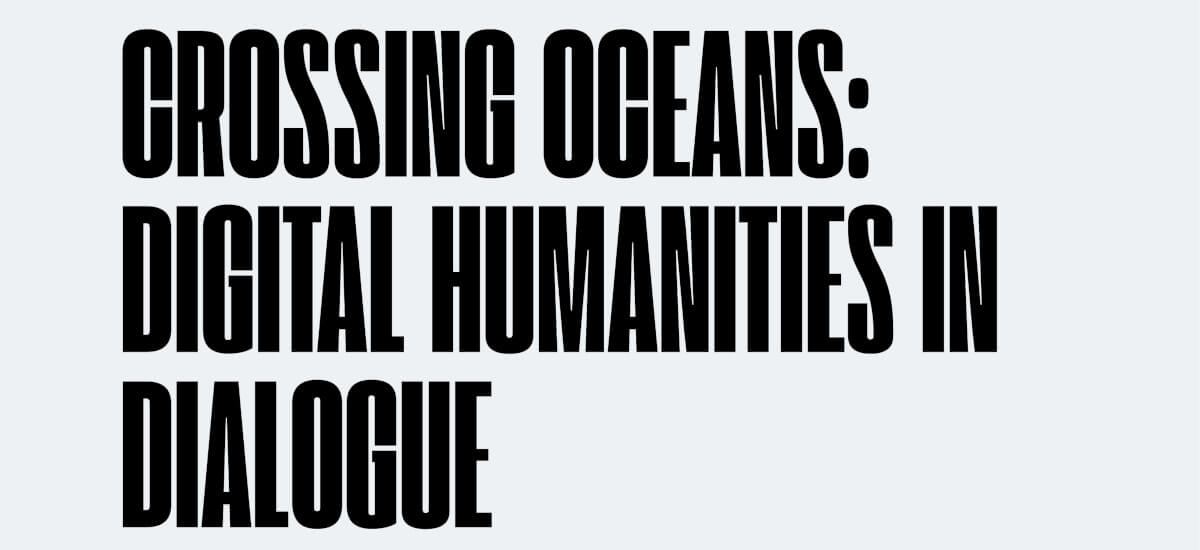
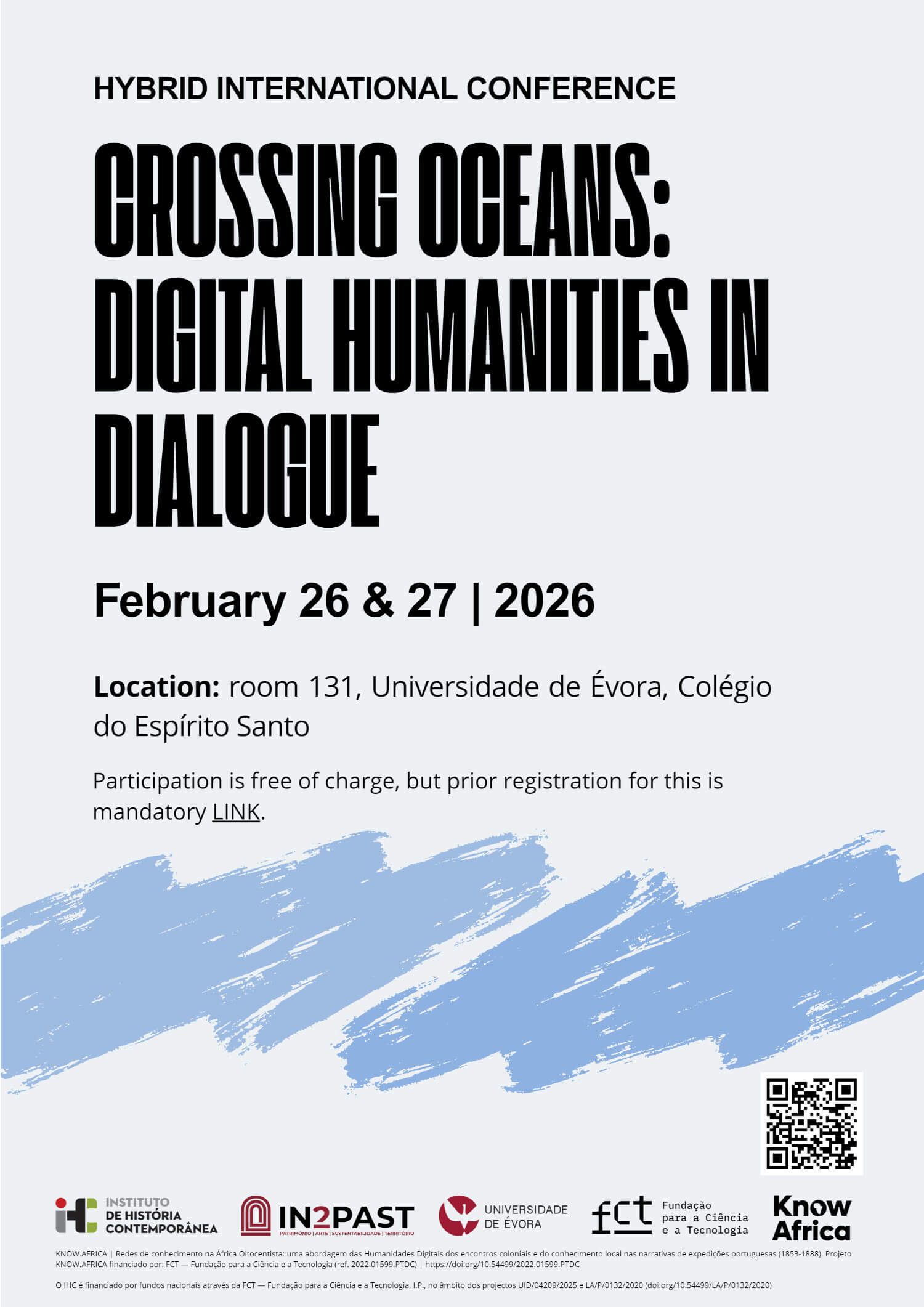
This conference aims to open the space for dialogue on how Digital Humanities can boost plural approaches to history, memory, heritage, and creativity. Crossing Oceans: Digital Humanities in
Ver mais
Detalhes do Evento
This conference aims to open the space for dialogue on how Digital Humanities can boost plural approaches to history, memory, heritage, and creativity.
Crossing Oceans: Digital Humanities in Dialogue
We are pleased to announce the international conference Crossing Oceans: Digital Humanities in Dialogue, bringing together researchers, practitioners, and digital humanists from all around the globe. This event seeks to create a space of truly transoceanic dialogue to discuss the present and future of Digital Humanities.
The conference invites participants to rethink methodologies for work in the Humanities at a time when digital transformations are reshaping how we investigate, interpret, and share knowledge. The digitization of archival materials, alongside the proliferation of born-digital records, has multiplied the sources available for historical, literary, and cultural analysis. Today, researchers have at their disposal a wide range of digital tools and software that allow them to organise, interpret, manipulate, share, and store data in increasingly diverse ways, opening new pathways for both collaborative and innovative research. At the same time, the emergence of artificial intelligence challenges us to critically assess both the possibilities and the risks of automated tools in the construction of knowledge.
Programme highlights
26 February
08:30 GMT – Registration and welcome coffee
08:45 GMT – Opening
09:00–10:30 GMT – Digital archives and collections
10:30–12:00 GMT – Digital heritage
13:00–15:00 GMT – Round-table
15:00–15:30 GMT – Coffee break
15:30–17:00 GMT – Digital approaches to colonialism
17:00–18:30 GMT – Databases and archives
27 February
08:30 GMT – Welcome coffee
09:00–10:30 GMT – Artificial Intelligence
10:30–12:00 GMT – Databases
113:00–15:00 GMT – Round-table
15:00–15:30 – Coffee break
15:30–17:00 GMT – Infrastructures and methods
17:00–18:30 GMT – Artificial Intelligence
Call for papers
By crossing oceans and perspectives, this conference aims to open the space for dialogue on how Digital Humanities can boost plural approaches to history, memory, heritage, and creativity, while also confronting questions of accessibility, ethics, and epistemic justice, as when we use these tools to give voice to new agents previously made invisible by traditional historiography, for instance.
On this conference, we welcome contributions on topics including but not limited to:
- Methodological innovations in Digital Humanities research.
- The impact of AI on the Humanities and critical approaches to its use.
- Digitization projects and the challenges of working with born-digital materials.
- Digital strategies for reaching non-academic audiences.
- Tools and projects that facilitate collaborative and transnational projects.
Submission period: 20 October – 5 December 2025 26 January 2026 [new deadline]
Participation: Free of charge, registration required
Language: English (presentations in other languages may be considered)
🔗 Registration and proposal submission
Organisation
Organising Committee
Anderson Antunes (University of Évora / IHC / IN2PAST)
Sara Albuquerque (University of Évora / IHC / IN2PAST)
Scientific Committee
Ana Margarida Dias da Silva (University of Coimbra / CHSC / DCV-UC)
Anderson Antunes (University of Évora / IHC / IN2PAST)
Daniel Alves (IHC — NOVA FCSH / IN2PAST)
Santiago Perez (CEComp — FLUL)
Sara Albuquerque (University of Évora / IHC / IN2PAST)
Silvia Valencich Frota (CEComp — FLUL)
Executive Committee
Anderson Antunes (University of Évora / IHC / IN2PAST)
Diana Barbosa (IHC — NOVA FCSH / IN2PAST)
Sara Albuquerque (University of Évora / IHC / IN2PAST)
Paula Gentil Santos (University of Évora)
This conference is inspired by the KNOW.AFRICA project (https://doi.org/10.54499/2022.01599.PTDC), which investigates nineteenth-century Portuguese scientific expeditions in Angola by highlighting the invisible contributions of local agents who made travelling and collecting possible. In this project, we analyse how cooks, guides, interpreters, porters, local rulers, and others, collaborated with the construction of knowledge and the formation of scientific collections. Through the use of Digital Humanities methods and tools – such as GIS mapping, network analysis and visualisation, databases, and interactive digital timelines – KNOW.AFRICA aims to explore how digital tools can assist in the construction and dissemination of historical knowledge. By combining archival research with digital tools, the project not only advances academic debates on colonial science but also develops outputs aimed at wider publics, including digital exhibitions, podcasts, and interactive maps and timelines. In this way, KNOW.AFRICA aims to use the Digital Humanities as a way to bridge research and dissemination, turning historical inquiry into a shared, multidisciplinary and collaborative process.
Tempo
26 (Quinta-feira) 8:30 am - 27 (Sexta-feira) 6:30 pm
Organizador
Institute of Contemporary History - University of Évoracehfc@uevora.pt Largo dos Colegiais, 2 — 7000-812 Évora
News
VINCULUM — An end and a new beginning
Feb 24, 2026
FCSH hosted the closing session of the VINCULUM project
In March, Lisbon becomes the Capital of International Intrigue
Feb 21, 2026
Between 2 and 31 March, at the Portuguese Cinematheque
Anita Buhin is on a research mission in Italy
Feb 20, 2026
She is now a Visiting Researcher at CAST, University of Bologna