
Daniel Alves
Biography
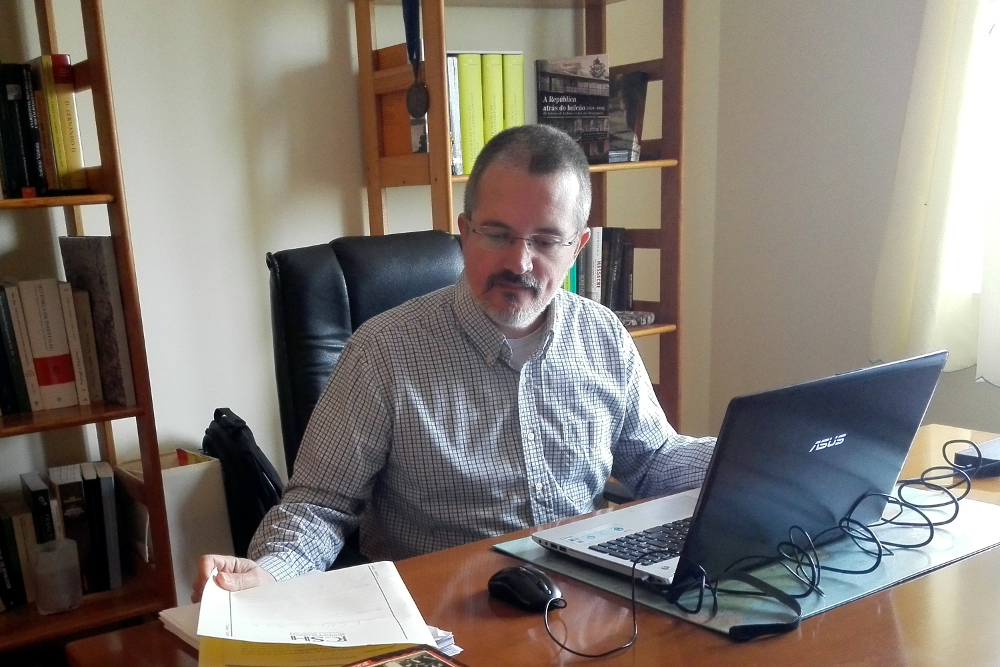
Daniel Alves is an Assistant Professor at the History Department in the NOVA School of Social Sciences and Humanities (FCSH), Universidade NOVA de Lisboa, and a researcher in the Institute of Contemporary History (IHC).
He has an MA in 19th Century History (2001) and a PhD in Economic and Social Contemporary History (2010). He has collaborated in several projects funded by the Portuguese Science and Technology Foundation, and the European Science Foundation. He has a special interest in the study of the lower middle-classes between 1870 and 1914, in the History of Revolutions, Urban History, and Historical GIS. He published several books and papers in Portuguese and international peer review journals, mainly about economic and social history, and Historical GIS.
He is the coordinator of IHC’s Digital Humanities Lab.
Research fields
- Social and economic history
- History of the revolutions
- Urban history
- Digital humanities
Selected publications
- Alves, Daniel, Ana Paula Barreira, Maria Helena Guimarães & Thomas Panagopoulos. “Historical Trajectories of Currently Shrinking Portuguese Cities: A Typology of Urban Shrinkage,” Cities 52 (2016): 20–29. [link]
- Alves, Daniel. “Introduction: Digital Methods and Tools for Historical Research,” International Journal of Humanities and Arts Computing 8 (2014): 1-12. [link]
- Alves, Daniel, & Ana Isabel Queiroz. “Studying Urban Space and Literary Representations Using GIS: Lisbon, Portugal, 1852-2009,” Social Science History 37 (2013): 457–81. [link]
- Alves, Daniel. A República atrás do balcão: os Lojistas de Lisboa e o fim da Monarquia (1870-1910). Chamusca: Edições Cosmos, 2012. [link]
Main projects
- Coordinator of the project “Arquivo digital do comércio de Lisboa (1870-1974): organização e disponibilização online do arquivo histórico da UACS” — Hosted by the UACS and the IHC – NOVA FCSH, and funded by the Calouste Gulbenkian Foundation. 2016-2017
- Coordinator of the project “Património e História da Indústria dos Mármores” — Hosted by the IHC – NOVA FCSH, and funded by INALENTEJO – QREN 2007-2013.
- Team member of the project “The Development of European Waterways, Road and Rail Infrastructures: A Geographical Information System for the History of European Integration (1825-2005)” — Coordinated by Jordi Marti-Henneberg (Departament de Geografia i Sociologia – Universitat de Lleida) and funded by the European Science Foundation and the Fundação para a Ciência e Tecnologia. 2008-2011 [link]
- Team member of the project “DICTIONARIUM – Cartografar as Memórias Paroquiais de 1758” — Coordinated by Luís Espinha da Silveira (IHC – NOVA FCSH), and funded by the POS_Conhecimento POS_C644/4.2/C/REG programme. 2006-2008.
Search
Events
outubro, 2026
seg
ter
qua
qui
sex
sab
dom
-
-
-
1
2
3
4
5
6
7
8
9
10
11
12
13
14
15
16
17
18
19
20
21
22
23
24
25
26
27
28
29
30
31


News
History is at School! — IHC’s school programme for 2026/2027
The History in the Public Sphere Programme is relaunching the project this academic year
IHC to host 13 new CEEC contracts from the FCT
Six Junior Researchers and seven Assistant Researchers
IHC supports exhibition on the Spanish Civil War
The exhibition will open on 29 September at FCSH