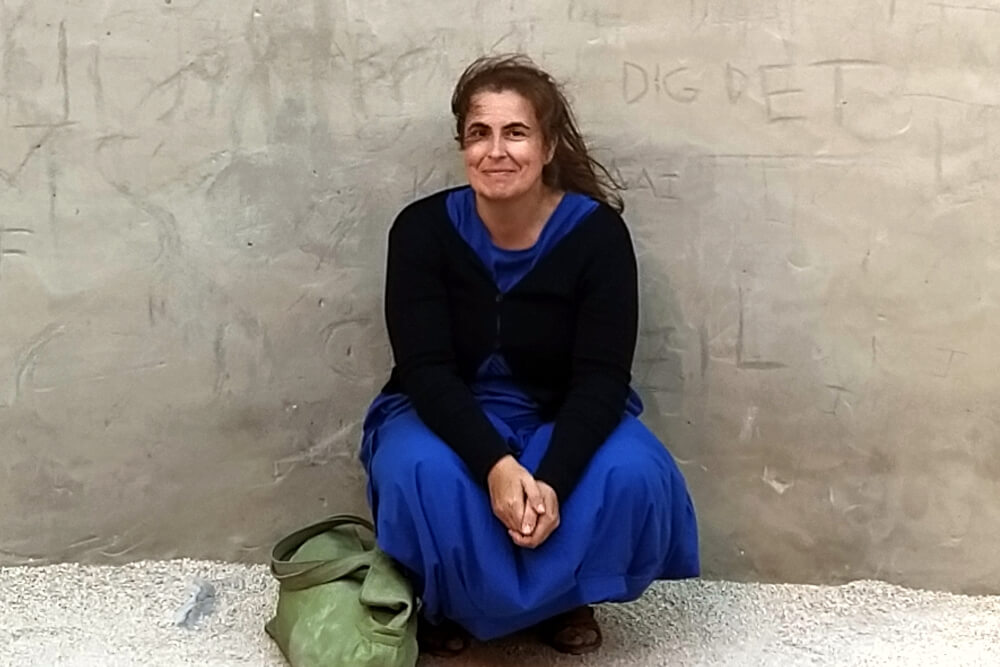
Elisa Lopes da Silva
Economy and Society
Contact:
elisals@fcsh.unl.pt
Biography
Elisa Lopes da Silva is a historian at the IHC. She has a Master’s degree in Contemporary History (NOVA FCSH, 2011) and a PhD in History: change and continuity in a global world (PIUDHist) (Institute of Social Sciences of the University of Lisbon, 2020). She researches and publishes in the fields of social history, state history and historiography. Her doctoral thesis focused on the history of internal colonisation during the Estado Novo, in particular the relations between state powers, agriculture and developmentalism.
She participated in collaborative research in urban studies as a postdoctoral fellow at CRIA (Centre for Research in Anthropology) under the H2020 project COESO — Collaborative Engagement on Societal Issues. She has also worked in academic publishing as a member of the Editorial Board of Imprensa de História Contemporânea [IHC Press] and the journal Práticas da História. Journal on Theory, Historiography and Uses of the Past.
Her current research project — “Out of Work: a critical history of unemployment in Portugal, 1890s-1970s” — looks at the relationship between state categories and policies, cultural representations and the everyday experiences of (not) working.
Research fields
- Cultural history of labour
- State history
- Internal colonisation
- Historiography
- Uses of the past
Selected publications
- Silva, Elisa Lopes da, “Precarizar o desemprego: a longa história de uma categoria,” in Pobreza e fome, uma história contemporânea. Temas, metodologias e estudos de caso, coordinated by Ana Isabel Queiroz, Bárbara Direito, Helena da Silva, and Lígia Costa Pinto, 109-117. Lisbon: Imprensa de História Contemporânea, 2022. [link]🔓
- Silva, Elisa Lopes da. “The Polemics of History: Historiographical Debates and Public Life,” Práticas da História 13 (2021): 7-28. [link]🔓
- Silva, Elisa Lopes da. “Estado, território, população: As ideias, as políticas e as técnicas de colonização interna no Estado Novo”. PhD Thesis in History, University of Lisbon, Institute for Social Sciences, 2020. [link]🔓
- Silva, Elisa Lopes da, “Recampesinar no Estado Novo: Propriedade, Estado e os seus Sujeitos,” in O espectro da pobreza. História, cultura e política em Portugal no século XX, organised by Frederico Ágoas and José Neves, 105-124. Lisbon: Mundos Sociais, 2016. [link]
Main projects
- Individual project “Out of Work: a critical history of unemployment in Portugal, 1890s-1970s” — Hosted by the IHC and funded by the Foundation for Science and Technology (2022.00905.CEECIND). 2023-2029
- Postoctoral fellow at the project “COESO — Collaborative Engagement on Societal Issues” — Coordinated in Portugal by Frédéric Vidal (CRIA ISCTE) and funded by the European Commission [Grant Agreement No.101006325]. 2021-2023 [link]
- Researcher in the project “The Making of State Power in Portugal: Institutionalization Processes from 1890 to 1986” — Coordenado por José Neves (IHC — NOVA FCSH) e financiado pela Fundação para a Ciência e Tecnologia (PTDC/HIS-HIS/104166/2008). 2010-2013 [link]