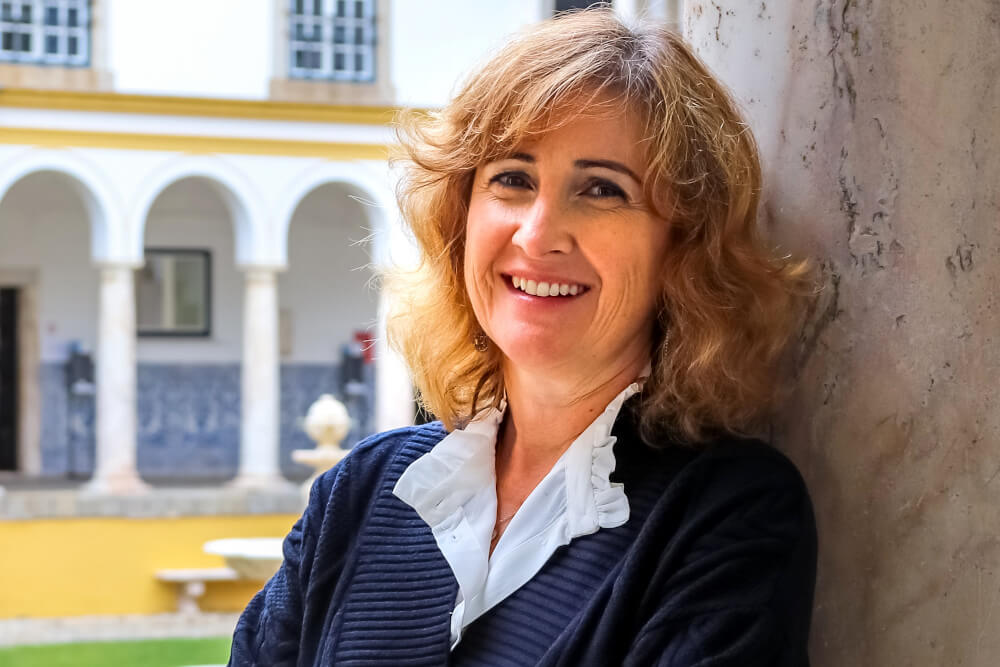
Elisabete Pereira

História da Ciência, da Tecnologia e do Ambiente
Contacto:
ejsp@uevora.pt
Biografia
Elisabete J. Santos Pereira é doutorada em História e Filosofia da Ciência com especialização em Museologia (2017).
Autora do livro “Colecionismo Arqueológico e Redes de Conhecimento” (DGPC, Colecção Estudos de Museus, 2018), foi distinguida, em 2023, pelo German Federal Foreign Office para participar no programa internacional TheMuseumsLab 2023, desenvolvido em Berlim e Nairobi (Quénia). A EuroClio — European Association of History Educators e a Evens Foundation premiaram a sua estratégia pedagógica inclusiva para alunos do ensino secundário: “Usando biografias de objetos para revelar como nossos passados estão interligados” (2019, ‘Sharing European Histories‘, disponível em sete línguas). Publicou artigos e capítulos em revistas e editoras nacionais e internacionais (Taylor & Francis/Routledge, Reino Unido; Hermann editions, França; Service des Musées de France, The Royal Society, Reino Unido; Techniche Universität Dresden Press, Alemanha; Fundação Oswaldo Cruz, Brasil).
Foi co-cordenadora do Dicionário Quem é Quem na Museologia Portuguesa (edição revista e aumentada) e é investigadora principal do projeto “TRANSMAT — Materialidades transnacionais (1850-1930): reconstituindo colecções e ligando histórias” (PTDC / FER-HFC / 2793/2020). Integrou os projectos internacionais “Museum Networks: People, Itineraries And Collections” (Alexander von Humboldt-Stiftung, Alemanha), “Desafíos educativos y científicos de la Segunda República española” (Ministerio de Ciencia, Innovación y Universidades de Espanha) e European Researcher’s Night 2023 (Marie Sklodowska-Curie Actions).
Áreas de Investigação
- História da ciência
- História das colecções e do coleccionismo científico
- Colecções etnográficas coloniais
- Biografias de objectos
- Museologia
Publicações destacadas
- Pereira, Elisabete J. Santos, “The antique collection of Teixeira de Aragão (1823-1903): Lisbon and Paris,” in La Belle Époque des collectionneurs d’antiques en Europe (1850-1914), dirigido por Dietrich Boschung, Cécile Colonna, Néguine Mathieux e François Queyrel, 135-143. Paris: Hermann / Louvre Editions, 2022. [link]
- Pereira, Elisabete, “Using object biographies to reveal how our pasts are interconnected,” in Sharing European Histories, editado por Katria Tomko, Steven Stegers, Marjolein Delvou e Hanna Zielinska, 14-29. Haia: Euroclio / Evens Foundation, 2021. [link]🔓
- Pereira, Elisabete J. Santos, Maria Margaret Lopes & Maria de Fátima Nunes. “‘Collective wisdom’ at the National Archaeological Museum in Portugal,” Museum History Journal 12 (2019): 171-191. [link]
- Pereira, Elisabete J. Santos. Colecionismo Arqueológico e Redes de Conhecimento: Atores, Coleções e Objetos (1850-1930). Casal de Cambra: Caleidoscópio, 2018. [link]
Projectos principais
- Coordenadora do projecto “TRANSMAT — Materialidades transnacionais (1850-1930): reconstituir coleções e conectar histórias” — Acolhido pelo IHC — Universidade de Évora e financiado pela Fundação para a Ciência e Tecnologia (PTDC /FER-HFC /2793/2020). [link]
- Investigadora seleccionada para o projecto TheMuseumsLab 2023 — Financiado pelo Deutscher Akademischer Austauschdienst (German Academic Exchange Service); desenvolvido em Berlim (Alemanha) e Nairobi (Quénia); incluiu igualmente o financiamento de uma residência no Rautenstrauch-Joest-Museum, em Colónia (Alemanha).
- Investigadora colaboradora no projecto “Desafíos educativos y científicos de la Segunda República Española: internacionalización, popularización, innovación en universidades e institutos” — Coordenado por Leoncio López-Ocón (Instituto de Historia — CSIC) e Álvaro Ribagorda (Universidad Carlos III de Madrid) e financiado pela Agencia Estatal de Investigación, Espanha (PGC2018-097391-B-I00). [link]
- Investigadora no projecto “Sharing European Histories” — Acolhido pela EuroClio — European Association of History Educators e financiado pela Evens Foundation. [link]
- Membro do “Museums Networks: People, Itineraries and Collections (1770-1920)” — Coordenado por Irina Podgorny (CONICET – Museo de La Plata, Universidad Nacional de La Plata) e financiado pela Fundação Humboldt (Alemanha). 2016- [link]
Pesquisa
Agenda
maio, 2026
Tipologia do Evento:
Todos
Todos
Apresentação
Ciclo
Colóquio
Conferência
Congresso
Curso
Debate
Encontro
Exposição
Inauguração
Jornadas
Lançamento
Mesa-redonda
Mostra
Open calls
Outros
Palestra
Roteiro
Seminário
Sessão de cinema
Simpósio
Workshop
- Event Name
seg
ter
qua
qui
sex
sab
dom
-
-
-
-
1
2
3
4
5
6
7
8
9
10
11
12
13
14
15
16
17
18
19
20
21
22
23
24
25
26
27
28
29
30
31

Detalhes do Evento
Seminário de investigação que procura alargar o campo dos estudos sobre o petróleo para além das narrativas, geografias e fronteiras disciplinares estabelecidas, dando maior destaque às perspetivas do Sul Global e
Ver mais
Detalhes do Evento
Seminário de investigação que procura alargar o campo dos estudos sobre o petróleo para além das narrativas, geografias e fronteiras disciplinares estabelecidas, dando maior destaque às perspetivas do Sul Global e de outros locais de extracção e resistência.
Mind the Gap III:
Unearthing Petromodernity: Oil Studies in the Anthropocene
Online Research Seminar
The rise of fossil fuels has been central to the political, economic, cultural, and material transformations of the past two centuries, yet the forms of power, knowledge, and life enabled by carbon energy often remain analytically invisible. As we confront the converging crises of the Anthropocene, the need to rethink the centrality of fossil fuels to modern life has never been more urgent.
At a moment when toxic landscapes, resource frontiers, and environmental inequality reveal the uneven geographies of fossil modernity, the humanities and social sciences are reorienting analytical attention toward the energetic foundations of modern life. From pipelines and refineries to plastics and everyday petrochemical products, the material properties of oil have fundamentally shaped modern infrastructures and forms of life. What forms of political and social power are created through fossil fuel industries? How have fossil fuels shaped modern societies, their economic models, governmental regimes, everyday lives? How have they contributed to uneven global geographies rooted in colonialism and capitalism? What kinds of transitions to post-carbon futures are possible?
Bringing together approaches from history, anthropology, political ecology, and geography, we seek to expand the field of oil studies beyond established narratives, geographies, and disciplinary boundaries, amplifying perspectives from the Global South and other sites of extraction and resistance.
📎 Download full programme (PDF)
Programme:
Every fortnight we will meet online to discuss an article or book chapter circulated in advance. The sessions will start with a 20–30 minute presentation, followed by discussion. The sessions will take place on Mondays at 2PM.
We will explore key concepts such as petro-culture, carbon democracy, extractivism, fossil capital, energy regimes, and transition imaginaries, examining how energy dependence shapes modern subjectivities, infrastructures, economies, and ecological futures. The texts will be shared with participants in advance.
Everyone is welcome.
To register, please fill out the online form. After registering you will receive the readings and access information ahead of each session.
For more information, please write to unearthingpetromodernity@proton.me.
30 March | Timothy Mitchell, Carbon Democracy: Political Power in the Age of Oil. Selected chapter TBA (Verso, 2011)
Davide Scarso (CIUHCT — FCT NOVA)
Focus: How fossil fuels structured democratic politics, labour power and modern governance
13 April | Adam Hanieh, “Petrochemical Empire: The Geo-Politics of Fossil-Fuelled Production“ New Left Review (139)
Ricardo Noronha (IHC — NOVA FCSH / IN2PAST)
Focus: Global production networks, the Gulf region and the restructuring of capitalism through petrochemicals
27 April | Carola Hein (ed.), Oil Spaces: Exploring the Global Petroleumscape. Chapter 8: Peyerl, D. “Building Brazil’s Petroleumscape on Land and Sea: Infrastructure, Expertise, and Technology” (Routledge, 2022)
Henrique Oliveira (IHC — NOVA FCSH / IN2PAST)
Focus: Infrastructure, territorial development and the spatial materiality of oil
11 May | Stephanie LeMenager, Living Oil: Petroleum Culture in the American Century. Selected chapter TBA (Oxford University Pres, 2014)
Raquel Ribeiro (CHAM — NOVA FCSH)
Focus: Oil, media, culture, and everyday life in twentieth-century society
25 May | Appel, Mason & Watts (Eds.), Subterranean Estates: Life Worlds of Oil and Gas. Introduction: “Oil Talk” (Cornell University Press, 2015)
Amedeo Policante (IHC — NOVA FCSH / IN2PAST)
Focus: Anthropological and political-economic perspectives on oil extraction and everyday life
8 June | Alice Mah, Petrochemical Planet: Multiscalar Battles of Industrial Transformation. Chapter 2: “Enduring Toxic Injustice and Fenceline Mobilizations” (Duke University Press, 2023)
João Pedro Santos (IHC — NOVA FCSH / IN2PAST)
Focus: Environmental justice, pollution, and grassroots activism around petrochemical industries
22 June | Chelsea Schields, Offshore Attachments: Oil and Intimacy in the Caribbean. Introduction and Chapter 1. “Crude Bargains” (University of California Press, 2023)
Anita Buhin (IHC — NOVA FCSH / IN2PAST)
Focus: Oil economies, intimacy, and social relations in offshore extraction zones
6 July | Tim Di Muzio & Matt Dow, “Global capitalism and oil“ in Handbook on Oil and International Relations (Edward Elgar Publishing , 2022)
Davide Scarso (CIUHCT — FCT NOVA), Amedeo Policante & Ricardo Noronha (IHC — NOVA FCSH / IN2PAST)
Focus: Oil in international relations, financialization and the structure of global capitalism
Organisation:
Davide Scarso (CIUHCT — FCT NOVA)
Amedeo Policante (IHC — NOVA FCSH / IN2PAST)
Ricardo Noronha (IHC — NOVA FCSH / IN2PAST)
Tempo
(Segunda-feira) 2:00 pm - 4:00 pm
Localização
Link a divulgar a quem se inscrever
Plataforma Zoom
Organizador
Instituto de História Contemporânea — Faculdade de Ciências Sociais e Humanas da Universidade NOVA de Lisboa e Centro Interuniversitário de História das Ciências e da Tecnologia
Notícias
Nuno Silas expõe no MUHNAC
Abr 29, 2026
É um dos curadores da exposição “Olhares Críticos no Arquivo Colonial – Sombras e Memórias”
Pedro Cerdeira, Prémio Amílcar Cabral, em Lisboa
Abr 28, 2026
Participará no encontro “Desconstruir o Colonialismo: Entre Tradição e Revolução”
Fernando Rosas: o actor da história que estudou
Abr 23, 2026
“É muito importante tornar a história da democracia em Portugal muito presente”