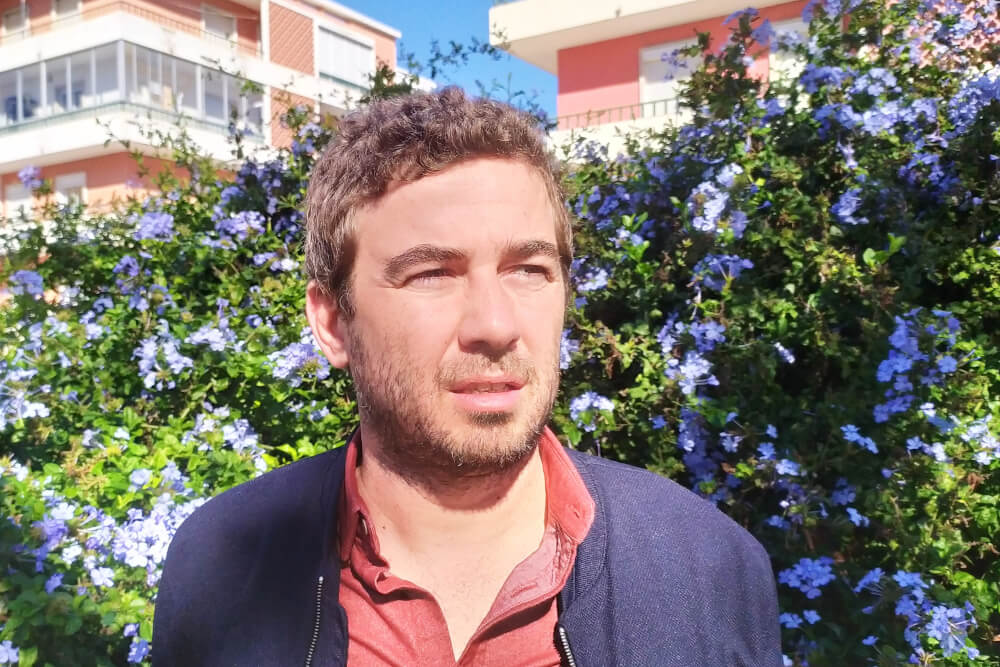
Miguel Carmo

History of Science, Technology, and the Environment
Contact:
miguelcarmo@fcsh.unl.pt
Biography
Miguel Carmo has been an Integrated Researcher at the Institute of Contemporary History since 2021, where he works on the history of fire, rice, and soil between the modern period and the 20th century, seeking to connect environmental, political, social, and techno-scientific dynamics. He graduated in environmental engineering (IST, 2005) and completed a master’s degree in Land Management (NOVA FCSH, 2009), where he studied the ‘preferences’ of rural fire propagation in northern Portugal, based on the mosaic of land use and terrain characteristics.
After a period of academic leave (2009-2012), during which he worked in Mozambique and Guinea-Bissau, he completed his PhD in agricultural engineering (ISA, 2018). In his thesis, he presented an environmental history of Portuguese agriculture between the late 19th century and 1960, focusing on the expansion of cereal cultivation, the transition from organic fertilisation systems to chemical fertilisation, and the deterioration of agricultural soil fertility during the Wheat Campaign.
He was a member of the team working on the project ‘Amílcar Cabral, from Political History to Politics of Memory‘ (PTDC/EPH-HIS/6964/2014) between 2016 and 2019, and a research fellow on the project ‘FIRESTORM – Weather and Behaviour of Fire Storms‘ (PCIF/GFC/0109/2017) project between 2019 and 2021. He is Principal Investigator on the project ‘FIREUESES — Burning landscapes: A political and environmental history of the large wildfires in Portugal (1950-2020)‘ (PTDC/HAR-HIS/4425/2021) since 2022, and a Junior Researcher (CEECIND/07362/2023) since 2024.
Research fields
- Environmental history
- Rural history
- History of agriculture
- Environmental sciences
Selected publications
- Sousa, Joana, Can Çinar, Miguel Carmo & Marco A. S. Malagoli. “Social and historical dimensions of wildfire research and the consideration given to practical knowledge: a systematic review,” Natural Hazards 114 (2022). [link]
- Carmo, Miguel, João Ferreira, Manuel Mendes, Álvaro Silva, Pedro Silva, Daniela Alves, Luís Reis, Ilda Novo & Domingos Xavier Viegas. “The climatology of extreme wildfires in Portugal, 1980–2018: Contributions to forecasting and preparedness,” International Journal of Climatology 42 (2022). [link] 🔓
- Carmo, Miguel & Tiago Domingos. “Agricultural expansion, soil degradation, and fertilization in Portugal, 1873-1960: From history to soil and back again,” Social Science History 45 (2021). [link]
- Carmo, Miguel, Joana Sousa, Pedro Varela, Ricardo Ventura & Manuel Bivar. “African knowledge transfer in Early Modern Portugal: Enslaved people and rice cultivation in Tagus and Sado rivers,” Diacronie 44 (2020): 45-66. [link] 🔓
Main projects
- Co-coordinator, with Ana Isabel Queiroz, of the project ‘FIREUSES — Burning landscapes: A political and environmental history of the large wildfires in Portugal (1950-2020)‘ — Hosted by the IHC and funded by the Foundation for Science and Technology (PTDC/HAR-HIS/4425/2021; https://doi.org/10.54499/PTDC/HAR-HIS/4425/2021). 2022-2025 [link]
- Postdoctoral project “Planting fire, banning fire: The disputed historical grounds of large wildfires in Portugal, 1950-2020” — Hosted and funded by the IHC, with funds from the Foundation for Science and Technology (UIDB/04209/2020). 2021-2024
- Fellow of the project “FIRESTORM — Weather and Behaviour of Fire Storms ” — Coordinated by Domingos Xavier Viegas (ADAI) and funded by the Foundation for Science and Technology (PCIF/GFC/0109/2017).
Search
Events
fevereiro, 2026
Tipologia do Evento:
Todos
Todos
Colloquium
Conference
Conference
Congress
Course
Cycle
Debate
Exhibition
Launch
Lecture
Meeting
Movie session
Open calls
Opening
Other
Presentation
Round table
Seminar
Showcase
Symposium
Tour
Workshop
- Event Name
seg
ter
qua
qui
sex
sab
dom
-
-
-
-
-
-
1
2
3
4
5
6
7
8
9
10
11
12
13
14
15
16
17
18
19
20
21
22
23
24
25
26
27
28

Detalhes do Evento
Closing session of the VINCULUM project, which includes the premiere of a documentary and the presentation of a new science communication programme. Sessão de encerramento do VINCULUM O projecto VINCULUM
Ver mais
Detalhes do Evento
Closing session of the VINCULUM project, which includes the premiere of a documentary and the presentation of a new science communication programme.
Sessão de encerramento do VINCULUM
O projecto VINCULUM vai terminar com uma sessão de encerramento que terá lugar na NOVA FCSH no dia 23 de Fevereiro de 2026, pelas 15h.
Nesta sessão, serão oradores Vítor Cardoso (Instituto Superior Técnico) e Henrique Leitão (Faculdade de Ciências da Universidade de Lisboa).
Além destas intervenções, terá lugar a estreia do documentário VINCULUM: um caminho de investigação científica / a journey of scientific research, e será apresentado o programa de comunicação de ciência Manter Vínculos com a História: Passados Longos para um Presente Consciente, a desenvolver a partir de 2026, no IHC.
Estarão presentes o Reitor da Universidade NOVA de Lisboa, Paulo Pereira, Directora da Faculdade de Ciências Sociais e Humanas, Alexandra Curvelo.
Solicita-se confirmação de presença, até dia 19 de Fevereiro, para o mail vinculum@fcsh.unl.pt
🔗 Quem não puder estar presente, poderá acompanhar a sessão via Zoom, neste link.
Tempo
(Segunda-feira) 3:00 pm - 6:00 pm
Organizador
Institute of Contemporary History — NOVA School of Social Sciences and Humanitiescomunicacao.ihc@fcsh.unl.pt Avenida de Berna, 26C - 1069-061 Lisbon

Detalhes do Evento
Session of the seminar ‘Revisiting the 19th Century,’ which seeks to restore the centrality of studies on the so-called ‘Long 19th Century.’ Alturas e desigualdade: desigualdade social e económica
Ver mais
Detalhes do Evento
Session of the seminar ‘Revisiting the 19th Century,’ which seeks to restore the centrality of studies on the so-called ‘Long 19th Century.’
Alturas e desigualdade: desigualdade social e económica em Portugal antes da industrialização
Carlos Manuel Faísca (Universidade de Coimbra, CEIS20)
Esta comunicação analisa os níveis de vida biológicos no sul de Portugal no final do Antigo Regime, com base no estudo de mais de 1500 soldados do Regimento de Infantaria de Tavira, nascidos entre 1730 e 1786. Através da comparação das estaturas segundo a origem geográfica e o enquadramento social, identificam-se diferenças relevantes, nomeadamente um “prémio urbano”, com indivíduos criados em meios urbanos a apresentarem maior estatura do que os provenientes de áreas rurais, não se observando, contudo, diferenças significativas entre populações do litoral e do interior. Os resultados evidenciam igualmente fortes desigualdades sociais, com oficiais e filhos de famílias de estatuto mais elevado a revelarem maior estatura média, enquanto os filhos de pai desconhecido apresentam valores mais baixos. Observa-se ainda uma tendência de decréscimo da estatura média ao longo das coortes, reflectindo o contexto de estagnação económica que marcou Portugal a partir do final do século XVIII. No seu conjunto, a análise sugere que o acesso a bens e serviços característicos dos centros urbanos, mesmo de pequena dimensão, constituiu um factor central para o bem-estar na sociedade portuguesa pré-industrial.
Revisitar o Século XIX — Seminário Permanente
Ao fim de uma década de ausência, o Iscte e o IHC reeditam o seminário Revisitar o Século XIX, que Luís Espinha da Silveira e Paulo Jorge Fernandes mantiveram sem interrupção entre 2009 e 2015 na NOVA FCSH. Originalmente, o propósito da iniciativa era o de (re)animar, sempre que possível numa perspectiva comparada e actualizada, os estudos sobre este período da História nacional e internacional, por vezes menos valorizado pela historiografia, sempre mais sensível a novas modas e tendências. Para além de dar continuidade a este mesmo propósito sempre fundamental, o objectivo agora, pela mão de Gonçalo Gonçalves (Iscte) e Paulo Jorge Fernandes (IHC — NOVA FCSH), procura recuperar a centralidade dos estudos sobre o chamado “Longo Século XIX” e evocar a figura de Luís Espinha da Silveira, precocemente desaparecido, destacando o seu importante legado enquanto interessado pelo desenvolvimento do conhecimento sobre esta época. Até ao final do presente ano lectivo propomos a apresentação e discussão de autores e tópicos tão inovadores quanto relevantes para este período histórico em sessões que terão lugar alternadamente na NOVA FCSH e no Iscte.
Tempo
(Segunda-feira) 6:00 pm - 8:00 pm
Organizador
Institute of Contemporary History — NOVA School of Social Sciences and Humanities and Centre for Research and Studies in Sociology — Iscte
News
In March, Lisbon becomes the Capital of International Intrigue
Feb 21, 2026
Between 2 and 31 March, at the Portuguese Cinematheque
Anita Buhin is on a research mission in Italy
Feb 20, 2026
She is now a Visiting Researcher at CAST, University of Bologna
IN2PAST has new governing bodies
Feb 13, 2026
Following elections held on 15 December 2025, the new governing bodies took office for the 2026-2028 term
CONTACTS
WORKING HOURS