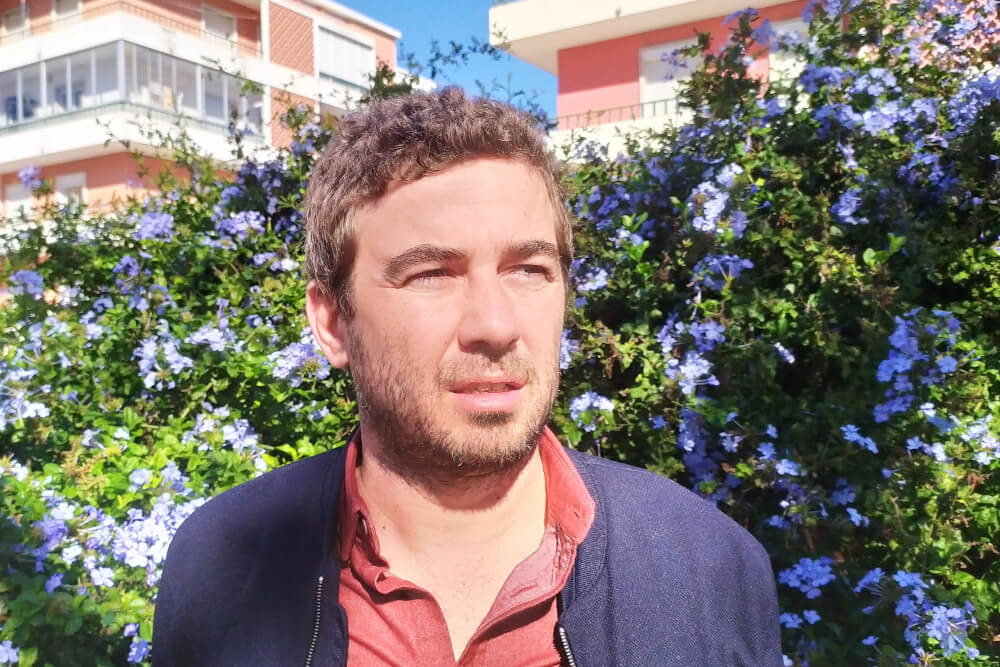
Miguel Carmo
History of Science, Technology, and the Environment
Contact:
miguelcarmo@fcsh.unl.pt
Biography
Miguel Carmo has been an Integrated Researcher at the Institute of Contemporary History since 2021, where he works on the history of fire, rice, and soil between the modern period and the 20th century, seeking to connect environmental, political, social, and techno-scientific dynamics. He graduated in environmental engineering (IST, 2005) and completed a master’s degree in Land Management (NOVA FCSH, 2009), where he studied the ‘preferences’ of rural fire propagation in northern Portugal, based on the mosaic of land use and terrain characteristics.
After a period of academic leave (2009-2012), during which he worked in Mozambique and Guinea-Bissau, he completed his PhD in agricultural engineering (ISA, 2018). In his thesis, he presented an environmental history of Portuguese agriculture between the late 19th century and 1960, focusing on the expansion of cereal cultivation, the transition from organic fertilisation systems to chemical fertilisation, and the deterioration of agricultural soil fertility during the Wheat Campaign.
He was a member of the team working on the project ‘Amílcar Cabral, from Political History to Politics of Memory‘ (PTDC/EPH-HIS/6964/2014) between 2016 and 2019, and a research fellow on the project ‘FIRESTORM – Weather and Behaviour of Fire Storms‘ (PCIF/GFC/0109/2017) project between 2019 and 2021. He is Principal Investigator on the project ‘FIREUESES — Burning landscapes: A political and environmental history of the large wildfires in Portugal (1950-2020)‘ (PTDC/HAR-HIS/4425/2021) since 2022, and a Junior Researcher (CEECIND/07362/2023) since 2024.
Research fields
- Environmental history
- Rural history
- History of agriculture
- Environmental sciences
Selected publications
- Sousa, Joana, Can Çinar, Miguel Carmo & Marco A. S. Malagoli. “Social and historical dimensions of wildfire research and the consideration given to practical knowledge: a systematic review,” Natural Hazards 114 (2022). [link]
- Carmo, Miguel, João Ferreira, Manuel Mendes, Álvaro Silva, Pedro Silva, Daniela Alves, Luís Reis, Ilda Novo & Domingos Xavier Viegas. “The climatology of extreme wildfires in Portugal, 1980–2018: Contributions to forecasting and preparedness,” International Journal of Climatology 42 (2022). [link] 🔓
- Carmo, Miguel & Tiago Domingos. “Agricultural expansion, soil degradation, and fertilization in Portugal, 1873-1960: From history to soil and back again,” Social Science History 45 (2021). [link]
- Carmo, Miguel, Joana Sousa, Pedro Varela, Ricardo Ventura & Manuel Bivar. “African knowledge transfer in Early Modern Portugal: Enslaved people and rice cultivation in Tagus and Sado rivers,” Diacronie 44 (2020): 45-66. [link] 🔓
Main projects
- Co-coordinator, with Ana Isabel Queiroz, of the project ‘FIREUSES — Burning landscapes: A political and environmental history of the large wildfires in Portugal (1950-2020)‘ — Hosted by the IHC and funded by the Foundation for Science and Technology (PTDC/HAR-HIS/4425/2021; https://doi.org/10.54499/PTDC/HAR-HIS/4425/2021). 2022-2025 [link]
- Postdoctoral project “Planting fire, banning fire: The disputed historical grounds of large wildfires in Portugal, 1950-2020” — Hosted and funded by the IHC, with funds from the Foundation for Science and Technology (UIDB/04209/2020). 2021-2024
- Fellow of the project “FIRESTORM — Weather and Behaviour of Fire Storms ” — Coordinated by Domingos Xavier Viegas (ADAI) and funded by the Foundation for Science and Technology (PCIF/GFC/0109/2017).
Search
Events
novembro , 2026
seg
ter
qua
qui
sex
sab
dom
-
-
-
-
-
-
1
2
3
4
5
6
7
8
9
10
11
12
13
14
15
16
17
18
19
20
21
22
23
24
25
26
27
28
29
30


News
IHC welcomes five new PhD students on FCT fellowships
Following the announcement of the final results of the FCT’s 2026 PhD Research Fellowship Competition
Elisabete Pereira is part of the project that has created a ‘twin’ for the Escoural Cave
Digital TwinsFor Smart, Sustainable Tourism and Cultural Heritage Preservation
History is at School! — IHC’s school programme for 2026/2027
The History in the Public Sphere Programme is relaunching the project this academic year