

New Challenges of Interactivity in Narrative Creation
Deadline: 15 February 2026
Narrative as a form of communication is one of the most important modes of human cognitive perception and understanding. In recent years, emerging media have significantly shaped that process, leading to new developments, opportunities, and challenges for the narrative form and its creation.
In history, with each new media technology innovation—from the invention of writing to the printing press, and from the mass distribution of video to digital games—the relationship between narrative form and its audiences has changed. This process has intensified. The proliferation of screens and the widespread use of the internet and smartphones enable individuals to access written, audio, audiovisual, and multimedia narratives on a personalized, permanent, and persistent basis. This fuels the expansion of media convergence and the emergence of transmedia narratives, fictional worlds shared across platforms and devices that can impact social, cultural, and political realities. Narrative has shifted from the domain of the storyteller into a process marked by reciprocity, negotiated between the author and the recipient.
In this space, users’ agency and interactivity have introduced new opportunities and challenges to traditional understandings of narratology, prompting a redefinition of the discipline. The rise of multilinear narratives has called for a more comprehensive, interdisciplinary approach. For example, interactivity in cinema and television promotes the creation of hybrid artifacts, which require multidisciplinary tools and methods tailored to their unique modes of expression and narrative processes. Likewise, narratives created for digital media platforms forge connections with cinematic storytelling and literature through intertextuality, aesthetics, and narrative structure. Similar origins can be traced to theater, board games, and many other forms, leading to new processes of interactive narrative creation and audience meaning-making.
Added to these challenges is the ease and diffusion of narrative production. Everyday devices, free applications, and artificial intelligence are sufficient to generate sophisticated narratives that can reach millions of people. Yet, they can also be ignored or quickly forgotten. Subsequently, the value of narrative has been reduced even as it is used for education, entertainment, influence campaigns, propaganda, and social engineering.
This special issue seeks to reflect on how social, technological, and cultural elements have transformed the very process of narrative creation. It hopes to explore the relationships between media platforms, technologies, and how they establish audience agency, interactions, and attention. The issue is interested in these topics across media types and domains from online forums, fandom, social movements, mobile devices, immersive media, games, and more.
Articles may focus, although not exclusively, on the following lines of research:
— The process of creating interactive narratives from films, digital games; microdramas, web series, intermedia, and other digital platforms;
— Next-generation AI tools in narrative production;
— The impact of media globalization on narrative construction;
— Development of new narrative formats;
— Modes of interaction in narrative;
— Narratology in the face of new challenges in digital culture;
— The impact of social media on narrative construction;
— Narrative content as an increasingly central component of social media;
— Modalities of representation and identity in interactive narratives;
— Evaluation and usability of interactive narratives;
— Interactive narrative as a tool of marketing and propaganda;
— Uses of interactive narrative in the global North and global South and by indigenous peoples or fringe groups;
This thematic dossier is coordinated by Francisco Merino (University of Beira Interior), Jorge Palinhos (Porto School of Arts) and Joshua A. Fisher (Ball State University).
Francisco Merino, originally from Viseu, holds a bachelor’s and doctoral degree in Communication Sciences from the University of Beira Interior. He has been a lecturer in the Film Studies program at the University of Beira Interior since 2006 and directed the Film Studies degree program between 2016 and 2020. His research focuses on topics related to Television and New Media, Expanded Cinema, New Cinemas, and Digital Storytelling.
Jorge Palinhos is an author, researcher, and professor. He has collaborated with various entities in the development of theatrical, radio, site-specific, intermediate, immersive, and virtual reality pieces, and written or collaborated on screenplays for several live-action and animated works. He is a lecturer at the Porto Higher School of Arts and the Polytechnic Institute of Cávado and Ave, and a researcher at the Arnaldo Araújo Center for Studies.
Joshua A. Fisher is an associate professor at Ball State University in the Center for Emerging Media Design and Development. His research focuses on community and interactive storytelling using AI and immersive media. He is the editor of two collections, Augmented and Mixed Reality for Communities and An Educator’s Guide to Interactive Digital Narrative. Fisher’s research has appeared in Frontiers in Virtual Reality, the Journal of Interactive Narrative, and Journalism Practice, as well as in the proceedings of the International Conference on Interactive Digital Storytelling (Springer), ACM Foundations of Digital Games, IEEE Conference on Games, and the International Conference of the Learning Sciences.
The deadline for full and original papers is 15 February 2026.
The submitted papers will be evaluated by the editors and by blind review of external reviewers. The text should have less then 8000 words and include, in Portuguese and English (and Spanish, if that is the paper language): title, abstract with less then 300 words and a maximum of 6 keywords.
Before submitting your paper, please check the journal’s norms.
If you have any questions, please contact the journal at aniki@aim.org.pt.
A few suggested references:
- Aarseth, Espen. 1997. Cybertext: Perspectives on Ergodic Literature. Baltimore and London: John Hopkins University Press.
- Aston, Judith & Gaudenzi, Sandra. 2012. Interactive Documentary: setting the field. Studies in Documentary Film 6. 10.1386/sdf.6.2.125_1.
- Bellini, Mattia.2022. “Interactive digital narratives as complex expressive means.” In Frontiers in Virtual Reality 3. 854960. https://www.frontiersin.org/journals/virtual-reality/articles/10.3389/frvir.2022.854960/full
- Bode, Christopher & Dietrich, Rainer. 2013. Future Narratives. Theory, Poetics and Media-Historical Moment. Berlin: De Gruyter.
- Chinita, Fátima & Palinhos, Jorge. (ed.) 2024. Ekphrasis, vol.31/1. Reconfigurations: New Narrative Challenges in Moving Images. Cluj-Napoca: Babeș-Bolyai University. https://www.ekphrasisjournal.ro/docs/R1/31e0.pdf
- Domsch, Sebastian. 2013. Storyplaying- Agency and Narrative in Video Games. Berlin: De Gruyter.
- Fisher, J. A. 2023. “Centering the human: Digital humanism and the practice of using generative AI in the authoring of interactive digital narratives.” In International Conference on Interactive Digital Storytelling (pp. 73-88). Cham: Springer Nature Switzerland. https://link.springer.com/chapter/10.1007/978-3-031-47655-6_5
- Mendes da Silva, B., Carrega, J. (eds).2021. The Forking Paths: Interactive Film and Media. Faro: CIAC. ISBN:9789899023536. https://ciac.pt/publicacoes/The-Forking-Paths-versao-eletronica.pdf
- Murray, Janet. 2017. Hamlet on the Holodeck. Updated edition. Boston: MIT.
- Koenitz, H., Eladhari, M. P., & Barbara, J. 2024. “Can AI Create an Interactive Digital Narrative? A Benchmarking Framework to Evaluate Generative AI Tools for the Design of IDNs.” In International Conference on Interactive Digital Storytelling (pp. 160-180). Cham: Springer Nature Switzerland. https://link.springer.com/chapter/10.1007/978-3-031-78453-8_11
- Koenitz, H., Barbara, J., & Bakk, A. K. 2023. “An ethics framework for interactive digital narrative authoring.” In The authoring problem: Challenges in supporting authoring for interactive digital narratives (pp. 335-351). Cham: Springer International Publishing. https://link.springer.com/chapter/10.1007/978-3-031-05214-9_21
- Mateas, Michael, and Andrew Stern.2003. “Façade: An experiment in building a fully-realized interactive drama.” Game developers conference. Vol. 2. https://users.soe.ucsc.edu/~michaelm/publications/mateas-gdc2003.pdf
- Ryan, Marie-Laure. 2022. A New Anatomy Of Storyworlds: What Is, What If, As If. Columbus: Ohio State University Press.
- Serbanescu, Anca, and Frank Nack. 2024. “Towards an analytical framework for AI-powered creative support systems in interactive digital narratives.” In Journal of Entrepreneurial Researchers 2.1. pp. 097-115.
- Silva, Cláudia. 2023. “Fighting against hate speech: a case for harnessing interactive digital counter-narratives.” In International Conference on Interactive Digital Storytelling. Cham: Springer Nature Switzerland, 2023. https://link.springer.com/chapter/10.1007/978-3-031-47655-6_10
News
-
 Applications are open until 16 February
 -
 Will take office as a Full Member
 -
 The city took up the challenge launched by the IHC last year
 -
 Distinguished social and cultural historian from the University of Oxford
 -
 Film cycle focusing on the relationship between his work and this art form
 -
 Special supplement to the journal História, Ciências, Saúde — Manguinhos
 -
 Awarded jointly by the IHC and the Monument to the Discoveries / Lisboa Cultura
 -
 The IHC is one of the participating institutions of the Transatlantic Crossroads Lab
 -
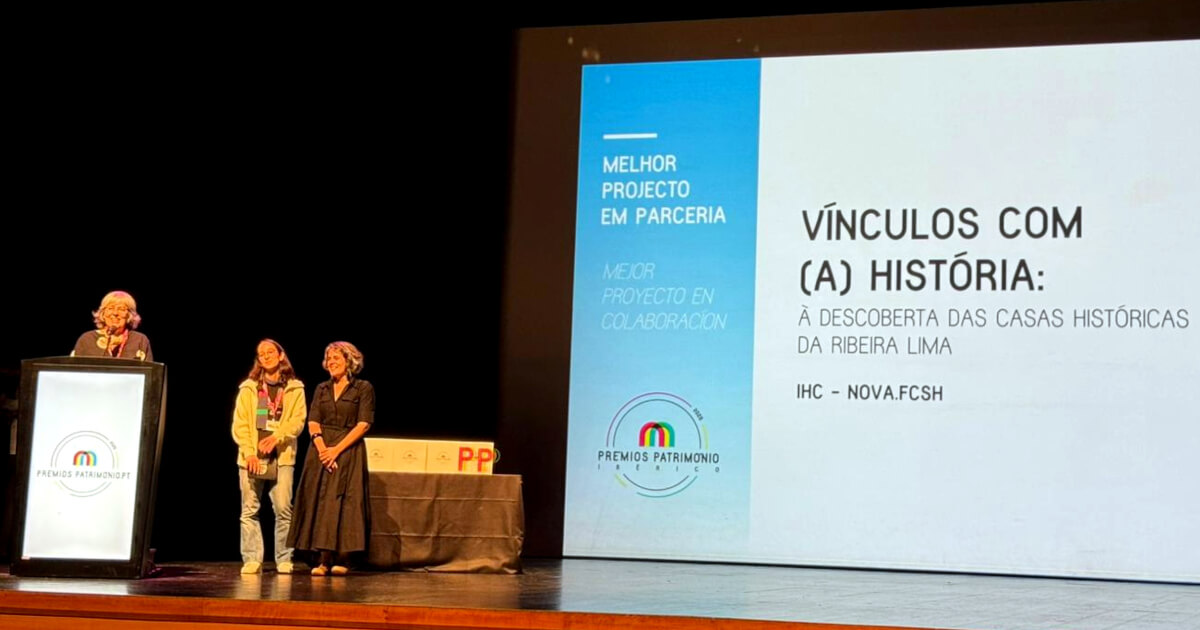 It was the winner of the Best Partnership Project
 -
 The commemorative session marked his retirement
 -
 Programme aims to familiarise students with historical research and its tools
 -
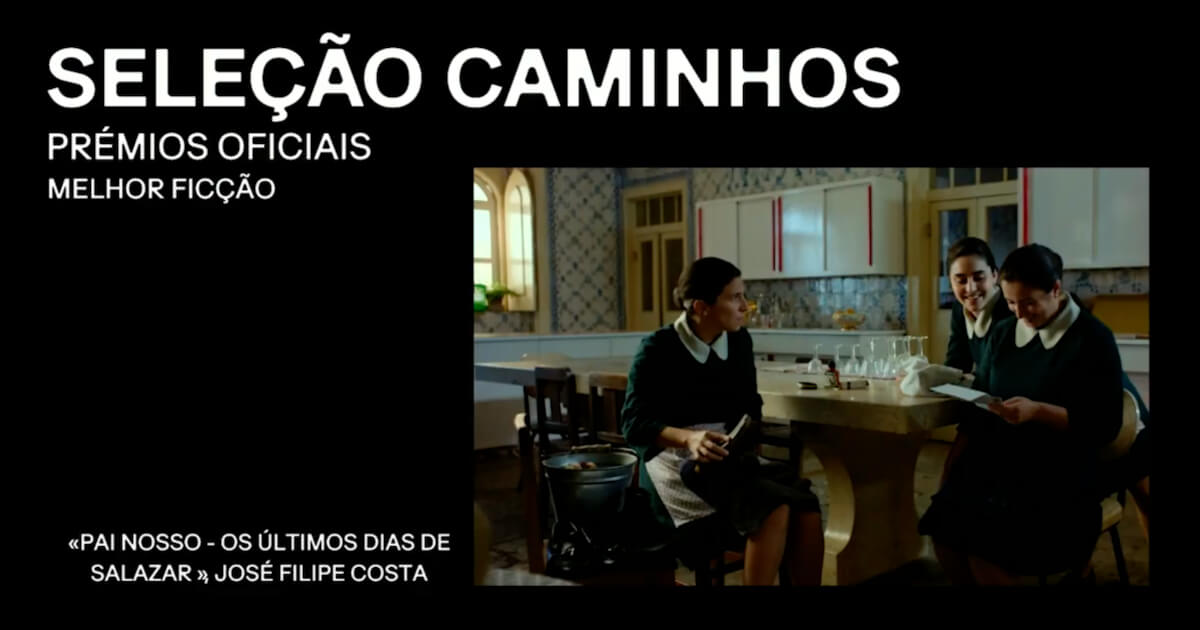 received three awards at the Caminhos do Cinema Português festival
 -
 The two activities hosted by the IHC will take place on 25 November
 -
 The IHC supported applications for four different PhD Research Scholarships calls
 -
 Isabel Baltazar was honoured at the International Educational Awards
 -
 The Government of Us All. 50 Years of Democratic Local Government (1976–2026)
 -
 ‘Links with History: discovering the historic houses of Ribeira Lima’ was the nominated initiative
 -
 FCSH will celebrate its Research and Innovation Day with the theme ‘Research on Track’
 -
 Mélanie Toulhoat was invited to join the DEGESUD team — Decentering the “sciences of childhood”