Samira Miranda

Culture — Power, Mediations, and the Arts
Contact:
a2023104545@campus.fcsh.unl.pt
Biography
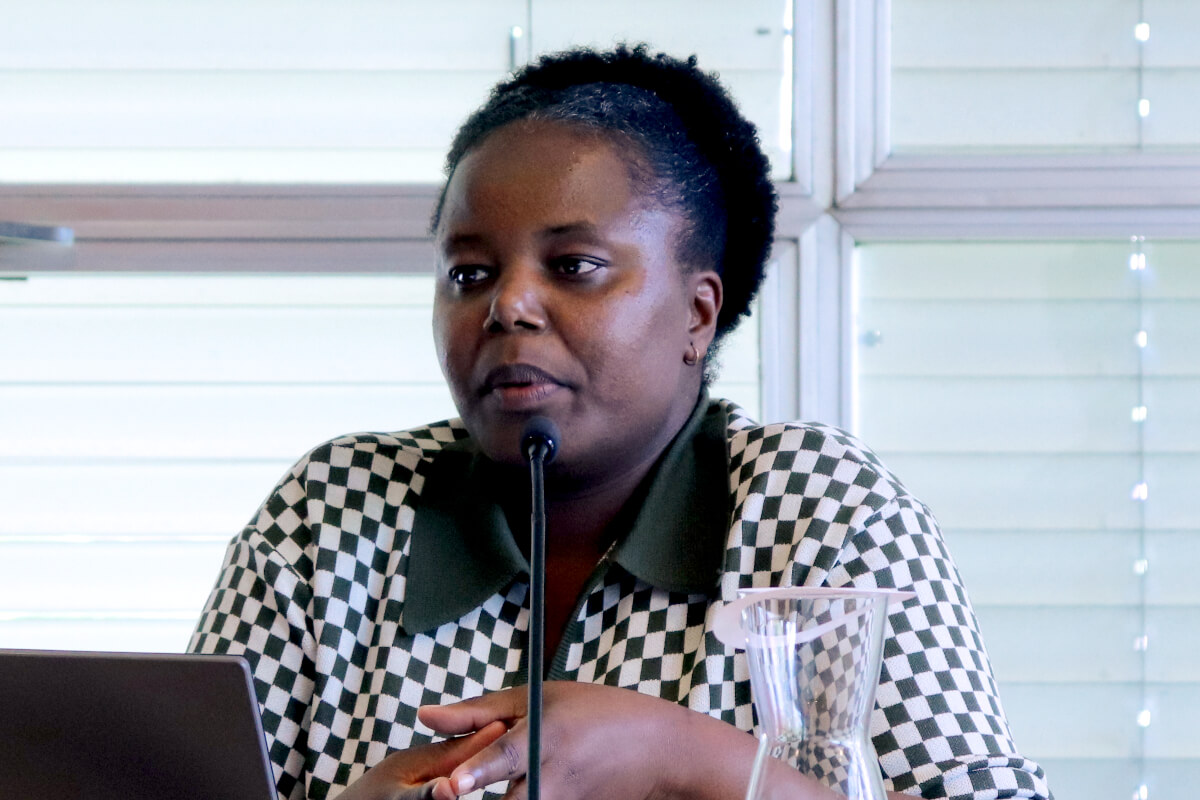
Master’s degree in Anthropology, specialising in Archaeology, from the Federal University of Pelotas, and a degree in History from the University of Cape Verde. Between 2018 and 2023, she taught Cape Verdean History and Culture at secondary schools in Cape Verde. In the 2021/2022 academic year, she was a lecturer in the Department of History and Geography at the University of Cape Verde, teaching the courses Prehistory and Introduction to the History of Black Africa. She is a PhD student in History – specialising in Contemporary History – at NOVA University Lisbon.
She has organised and participated in events, namely conferences, research projects and academic meetings. Examples include the organisation of and participation in the International Colloquium ‘Lugares e Práticas Historiográficas, Educação, Património e Cultura Impressa‘ [Historiographical Places and Practices, Education, Heritage and Printed Culture]; the oral presentation of work at the 1st International Conference on Textbooks: National and Global Historical Perspectives; and the organisation of the workshop: ‘O livro didático de História: Brasil, Cabo Verde e Portugal‘ [The History Textbook: Brazil, Cape Verde and Portugal], organised by the University of Coimbra, Centre for Interdisciplinary Studies of the 20th Century. She was a member of the Scientific Committee of the International Network for the History of Pedagogies, Cultural Heritage and Teaching Materials in the Portuguese Language, where she participated in the Colloquium organised by the Network in February 2023 in Portugal. She also participated in archaeological excavation projects in Brazil, Portugal and Cape Verde.
Research fields
- Colonial legacies
- Memories of slavery
- Materialities
Selected publication
- Miranda, Sandra Samira Tavares. “Arqueologia da Cidade Velha, Cabo Verde : da escravidão às múltiplas vozes na contemporaneidade.” Master’s in Anthropology dissertation presented to the Federal University of Pelotas, 2016. [link] 🔓
Main projects
- ‘História, Narrativas Contemporâneas e Construção da Memória Pública da Escravatura em Cabo Verde’ [History, Contemporary Narratives, and the Construction of Public Memory of Slavery in Cape Verde] — PhD thesis to be presented to the NOVA School of Social Sciences and Humanities, supervised by Victor Barros (IHC — NOVA FCSH). Individual PhD project funded by the Foundation for Science and Technology (2024.12897.PALOP). 2024-
- Researcher in the project ‘A Conservação In Situ de Materiais Arqueológicos‘ [In Situ Conservation of Archaeological Materials] — Coordinated by Jaime Mujica Sallés (LÂMINA — Federal University of Pelotas).
- Researcher in the project ‘Fórum da cidade romana Pax Julia e a sua dinâmica na longa duração‘ [The forum of the Roman city of Pax Julia and its dynamics over the long term] — Coordinated by Maria da Conceição Lopes (CEAACP — University of Coimbra).
- Researcher in the project ‘National Plan for the Rehabilitation of Historic and Religious Buildings’ — Coordinated by the Instituto do Património Cultural and funded by the Government of Cabo Verde.

Search
Events
junho, 2026
Tipologia do Evento:
Todos
Todos
Colloquium
Conference
Conference
Congress
Course
Cycle
Debate
Exhibition
Launch
Lecture
Meeting
Movie session
Open calls
Opening
Other
Presentation
Round table
Seminar
Showcase
Symposium
Tour
Workshop
- Event Name
seg
ter
qua
qui
sex
sab
dom
1
2
3
4
5
6
7
8
9
10
11
12
13
14
15
16
17
18
19
20
21
22
23
24
25
26
27
28
29
30

Detalhes do Evento
Three-day conference on the alter-lives of independence movements that explores the evolution and transformation of anti-colonial and anti-imperial struggles. The Alter-lives of Independence Movements: Frustrated Hopes, Renewed Utopias Decades
Ver mais
Detalhes do Evento
Three-day conference on the alter-lives of independence movements that explores the evolution and transformation of anti-colonial and anti-imperial struggles.
The Alter-lives of Independence Movements:
Frustrated Hopes, Renewed Utopias
Decades after formal decolonisation, anti-colonialism and anti-imperialism have remained a wellspring of inspiration and contestation. Studies about anticolonial thought, the 1955 Bandung Conference, and transcontinental solidarity movements have proliferated in academia and activist networks, providing the basis of theories and practices of resistance in contemporary times. Nevertheless, the ideas and the movements they inspired did not perish with the epoch that produced them. They evolved and acquired alternative lives in the period of nation-building and world-making, whether in extended or distorted forms. On the one hand, there were local and transnational efforts to sustain and enrich the revolutionary impulse through embracing the anticolonial spirit in various areas such as development, education, and diplomacy. As international institutions such as the UN welcome additional member states, Europeans and non-Europeans travelled to decolonised states like Algeria and Angola to learn
and further cultivate ideas in building new societies. On the other hand, some dominant groups that took over the independent states capitalised on the anti-colonial pride to justify authoritarian and anti-democratic rule. Their utopian visions led to the systematic oppression of opposing forces and to the reproduction of the hierarchical international state model. The fear of neocolonialism and disillusionment propelled both the former coloniser and colonised to reorganise their strategies and desires in the face of an emerging world order.
This conference on the alter-lives of independence movements explores the evolution and transformation of anti-colonial and anti-imperial struggles. It focuses on events and reflections on the early years of independence, a period of turbulent transition from colonial domination to
self-governing nation-states and the tumultuous beginnings of a new international order. We introduce the concept “alter-lives” to denote the process of altering imaginaries and practices that emerged during the colonial period in responding to uncertain futures, including the
political uses of anticolonial memories and/or histories. It also refers to alternative relations forged between former colonisers and colonised after independence. Thus, using “alter-lives” as a conceptual ground, this conference engages in the following questions: first, how have
anticolonial thinking and practices evolved domestically and transnationally? Second, what were the structural and agential forces behind these evolutions? Third, how were anticolonial memories and histories politicised to achieve certain ends? Fourth, what difficulties did these
agents face in realising their envisioned future? Lastly, how have alterations and alternatives affirmed and/or challenged the revolutionary ideas of the independence struggles?
>> Download the full programme (PDF) <<
Contact:
If you need more information on the conference, please send an email to jiw.hopesandfears@gmail.com.
This event is organised as part of the Joint International Workshop “Hopes and Fears. Anti-colonial and Postcolonial Imaginaries in the Lusotopy and Beyond”, that gathers the Institute of Contemporary History — NOVA University Lisbon / University of Évora, the University of São Paulo, and the Pontifical Catholic University of Rio Grande do Sul.

Tempo
junho 25 (Quinta-feira) - 27 (Sábado)
Localização
Lisbon, Portugal
Organizador
Institute of Contemporary History — NOVA FCSH, University of São Paulo, and Pontifical Catholic University of Rio Grande do Sul
News
Marta Pinto Machado in a double bill in Lisbon: MNAC and CCCV
May 14, 2026
“Ceci n’est Pas Francisco” is at MNAC and will extend to CCCV
VINCULUM is still going in Madeira
May 12, 2026
The Inscription I of the Church of Machico will serve as the theme for a series of cultural events
Nuno Silas is exhibiting at MUHNAC
Apr 29, 2026
He is one of the curators of the exhibition “Olhares Críticos no Arquivo Colonial – Sombras e Memórias”