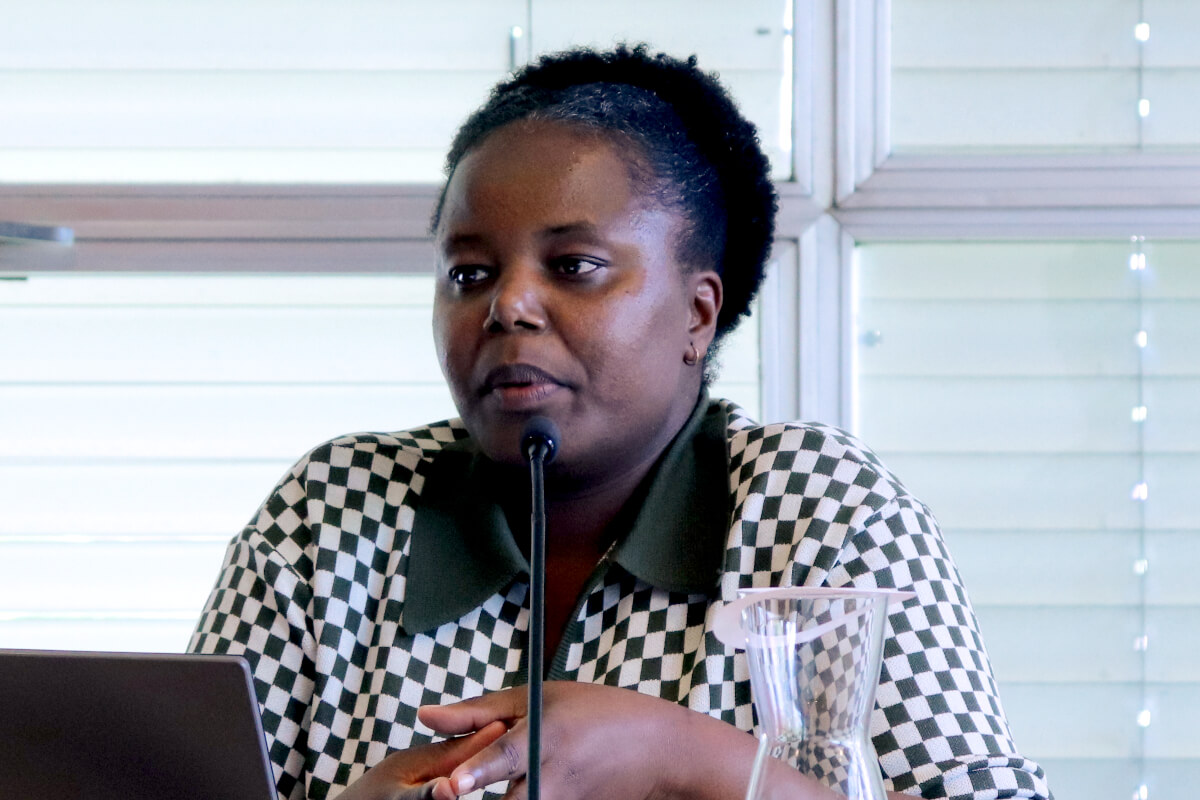
Samira Miranda

Culture — Power, Mediations, and the Arts
Contact:
a2023104545@campus.fcsh.unl.pt
Biography
Master’s degree in Anthropology, specialising in Archaeology, from the Federal University of Pelotas, and a degree in History from the University of Cape Verde. Between 2018 and 2023, she taught Cape Verdean History and Culture at secondary schools in Cape Verde. In the 2021/2022 academic year, she was a lecturer in the Department of History and Geography at the University of Cape Verde, teaching the courses Prehistory and Introduction to the History of Black Africa. She is a PhD student in History – specialising in Contemporary History – at NOVA University Lisbon.
She has organised and participated in events, namely conferences, research projects and academic meetings. Examples include the organisation of and participation in the International Colloquium ‘Lugares e Práticas Historiográficas, Educação, Património e Cultura Impressa‘ [Historiographical Places and Practices, Education, Heritage and Printed Culture]; the oral presentation of work at the 1st International Conference on Textbooks: National and Global Historical Perspectives; and the organisation of the workshop: ‘O livro didático de História: Brasil, Cabo Verde e Portugal‘ [The History Textbook: Brazil, Cape Verde and Portugal], organised by the University of Coimbra, Centre for Interdisciplinary Studies of the 20th Century. She was a member of the Scientific Committee of the International Network for the History of Pedagogies, Cultural Heritage and Teaching Materials in the Portuguese Language, where she participated in the Colloquium organised by the Network in February 2023 in Portugal. She also participated in archaeological excavation projects in Brazil, Portugal and Cape Verde.
Research fields
- Colonial legacies
- Memories of slavery
- Materialities
Selected publication
- Miranda, Sandra Samira Tavares. “Arqueologia da Cidade Velha, Cabo Verde : da escravidão às múltiplas vozes na contemporaneidade.” Master’s in Anthropology dissertation presented to the Federal University of Pelotas, 2016. [link] 🔓
Main projects
- ‘História, Narrativas Contemporâneas e Construção da Memória Pública da Escravatura em Cabo Verde’ [History, Contemporary Narratives, and the Construction of Public Memory of Slavery in Cape Verde] — PhD thesis to be presented to the NOVA School of Social Sciences and Humanities, supervised by Victor Barros (IHC — NOVA FCSH). Individual PhD project funded by the Foundation for Science and Technology (2024.12897.PALOP). 2024-
- Researcher in the project ‘A Conservação In Situ de Materiais Arqueológicos‘ [In Situ Conservation of Archaeological Materials] — Coordinated by Jaime Mujica Sallés (LÂMINA — Federal University of Pelotas).
- Researcher in the project ‘Fórum da cidade romana Pax Julia e a sua dinâmica na longa duração‘ [The forum of the Roman city of Pax Julia and its dynamics over the long term] — Coordinated by Maria da Conceição Lopes (CEAACP — University of Coimbra).
- Researcher in the project ‘National Plan for the Rehabilitation of Historic and Religious Buildings’ — Coordinated by the Instituto do Património Cultural and funded by the Government of Cabo Verde.
Search
Events
fevereiro, 2026
Tipologia do Evento:
Todos
Todos
Colloquium
Conference
Conference
Congress
Course
Cycle
Debate
Exhibition
Launch
Lecture
Meeting
Movie session
Open calls
Opening
Other
Presentation
Round table
Seminar
Showcase
Symposium
Tour
Workshop
- Event Name
seg
ter
qua
qui
sex
sab
dom
-
-
-
-
-
-
1
2
3
4
5
6
7
8
9
10
11
12
13
14
15
16
17
18
19
20
21
22
23
24
25
26
27
28

Detalhes do Evento
This meeting seeks to encourage the participation and sharing of ideas calling on the voice of workers and the power of archives as a living tool for knowledge. We
Ver mais
Detalhes do Evento
This meeting seeks to encourage the participation and sharing of ideas calling on the voice of workers and the power of archives as a living tool for knowledge.
We are with you at home
Domestic work and collective action — Archives, memories, testimonies
In recent decades, the formation of a global economy of care and domestic services has become one of the central elements in understanding the transformations of work in capitalist societies (Ehrenreich and Hochschild, 2002; Lutz, 2011). This process of “international division of reproductive labour” (Parreñas, 2001; Anderson, 2007) is an example of how historical inequalities have been reconfigured and deepened in the transition from colonial to postcolonial contexts (Cox, 2006; Sartri, 2008). The absence of public care policies, combined with labour market deregulation and labour shortages in the sector, has produced a scenario of labour and social precariousness in which gender, ethnicity and class intersect. Employers’ preference for migrant workers—often without residence permits—has allowed the formation of a new servile class, characterised by fragile ties, an almost complete absence of rights and low wages (Giordano, 2022).
This context of structural vulnerability fuels the idea that domestic and care work is marked by social invisibility and a supposed inability to mobilise collectively. However, this interpretation tends to obscure the long history of resistance and organisational experiences led by these workers. Since the 19th century, multiple examples of labour demands and struggles against oppressive practices demonstrate that the sector, far from being disorganised, has been the scene of various forms of mobilisation for better working conditions (Anderson, 2001; Boris and Nadassen, 2008; Gutiérrez-Rodríguez, 2010). To recover and reflect on this historical trajectory is not only an exercise of remembrance, but a necessary step to reinscribe domestic and care work in the global history of labour struggles, challenging narratives that seek to naturalise its subalternity.
>> Registration (free but mandatory)
DOMESTIC AND ARCHIVAL WORK
The title of this meeting is taken from a letter sent by a domestic worker to her union, kept in an archive, with no date, no sender or recipient, only a handwritten note: archive. It reads: ‘And never think you are alone, we are with you in the house where we work.’
We took inspiration for this meeting from this short excerpt, part of a text that describes, in the first person, the early migration to the city of Lisbon to work in someone else’s home at the age of seven.
Work on the archives of women workers’ organisations and the increased focus on trade unionism in the domestic service sector has received growing attention in recent years, throughout the world, partly driven by a renewed interest in the intersection of gender, class and migration inequalities in the sphere of paid domestic work. At this meeting, which will take place on 6 and 7 February 2026 in Lisbon, we are opening a space for, based on the project A Voz das Trabalhadoras (The Voice of Women Workers: The Archives of the Domestic Service Union [1974-1992]), to gather contributions from different geographical areas and fields of practice that intersect around domestic work, care and cleaning — and their articulation with forms of collective action, cooperativism, trade unionism, and memory construction.
Thus, with immersion in trade union archives and experiences of self-management and cooperativism in domestic service as our main starting point, we invite submissions of proposals that focus on the various repertoires of organisation and struggle adopted by workers in this sector/activity, focusing on oral history or archival research, the narration of experiences and self-representations of working conditions and contexts.
A TRANSNATIONAL AND INTERDISCIPLINARY DIALOGUE
Seeking to establish a transnational and interdisciplinary dialogue on these experiences, contributions are welcome in the following areas:
- Archival practices of/on domestic work;
- Migratory flows, citizenship, gender, and racialisation in domestic, cleaning, and care work;
- Collective action, cooperativism, and trade unionism in domestic work.
This meeting seeks to encourage the participation and sharing of ideas among activists, artists, researchers, workers and trade unions — calling on the voice of workers and the power of archives as a living tool for knowledge, learning and transformation.
Call for papers
We therefore invite proposals from different disciplinary fields and with different methodological approaches, welcoming the intersection of perspectives. The Meeting welcomes proposals from:
a) artists (performance, theatre, audiovisual);
b) researchers, archivists, activists and students;
c) domestic and care workers (collectives, cooperatives, trade unions)
Who, where, how?
Send short abstracts (max. 500 words) with a brief biography by 10 November 2025. Submissions to: encontro.trabalhodomestico2026@gmail.com.
Accepted languages: Portuguese, Spanish, English.
Venues: NOVA FCSH, Cape Verde Cultural Centre (Lisbon)
Organisation: CICS.NOVA and IHC
>> Download the call for papers (PDF) <<
Organising Committee
Ackssana Silva
Elsa Nogueira
Inês Brasão
José Soeiro
Mafalda Araújo
Nuno Ferreira Dias
Tempo
6 (Sexta-feira) 9:00 am - 7 (Sábado) 7:00 pm
Localização
NOVA School of Social Sciences and Humanities and Cabo Verde Cultural Centre
Organizador
Institute of Contemporary History and CICS.NOVA — NOVA School of Social Sciences and Humanities

Detalhes do Evento
Ricardo Noronha's book about the events of 25 November 1975 will be presented in Faro, at the Portuguese Institute of Sport and Youth. A Ordem
Ver mais
Detalhes do Evento
Ricardo Noronha‘s book about the events of 25 November 1975 will be presented in Faro, at the Portuguese Institute of Sport and Youth.
A Ordem Reina Sobre Lisboa. Uma história do 25 de Novembro
A CÍVIS, Associação para o o Aprofundamento da Cidadania, dia 6 de fevereiro, em Faro, a apresentação do livro “A Ordem reina sobre Lisboa. Uma história do 25 de Novembro”, da autoria de Ricardo Noronha.
A sessão terá lugar no auditório do IPDJ, a partir das 18h30, com entrada livre, e assinala a apresentação pública da obra editada pela Tigre de Papel, em Novembro de 2025.
A CÍVIS convida todas e todos os cidadãos a participarem nesta apresentação, de entrada livre, sublinhando a importância do debate para uma melhor compreensão do significado histórico e político do 25 de Novembro.
Sobre o livro:
Este livro aproveita a efeméride cinquentenária para explorar algumas hipóteses e interrogações relativas ao 25 de Novembro, procurando identificar tanto aquilo que se apresenta como indisputável quanto as inúmeras questões que permanecem em aberto. É também uma tentativa de abrir a interpretação do processo revolucionário a formas de imaginação histórica distintas das que têm caraterizado boa parte da paisagem editorial. Ao privilegiar os acontecimentos ocorridos nas ruas, ou dentro dos quartéis, em relação aos que tiveram lugar nos gabinetes ministeriais, ou dentro dos estados-maiores, a reconstrução dos acontecimentos que aqui se apresenta procura compreender o 25 de Novembro enquanto um episódio de insubordinação militar plenamente alinhado com os repertórios de conflituosidade social e de radicalização política que caraterizaram a Revolução Portuguesa de 1974-75.
Mais informações sobre o livro
Tempo
(Sexta-feira) 6:30 pm - 7:30 pm
Localização
Portuguese Institute of Sport and Youth — Faro
Rua da Policia da Seguranca Publica, 1 — 8000-151 Faro
Organizador
CÍVIS and Portuguese Institute of Sport and Youth
News
Ana Cristina Martins at the International Academy of Portuguese Culture
Jan 26, 2026
Will take office as a Full Member
Proença-a-Nova is the first partner in the ‘The Government of Us All’ programme
Jan 23, 2026
The city took up the challenge launched by the IHC last year
IHC hosts eleven new permanent contracts
Jan 21, 2026
IHC’s efforts to consolidate scientific careers